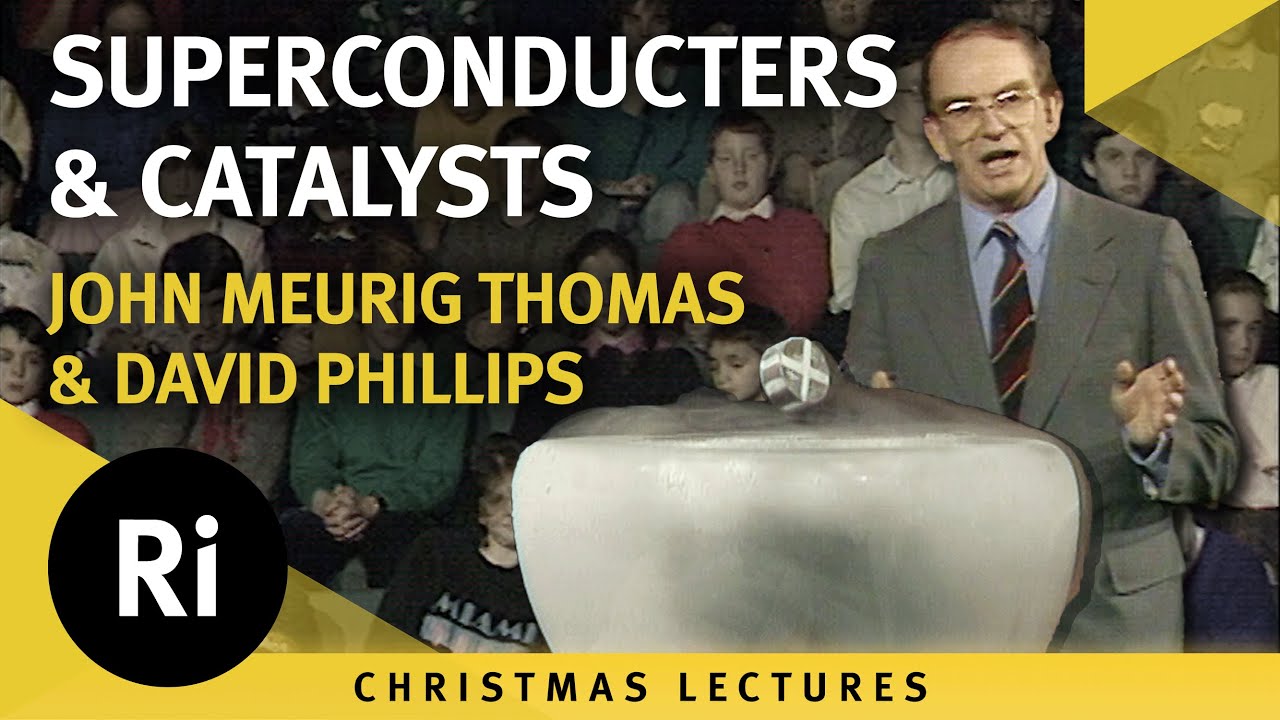
Catalysts, Semi & Superconductors - John M. Thomas & David Phillips's 1987 Christmas Lectures 3/6
Keywords
Summary
124 words
Critical Evaluation
The lecture is a masterful demonstration of scientific principles, combining historical context with live experiments. The presenters, both distinguished scientists, provide clear explanations of the underlying physics and chemistry. The demonstrations are visually striking and effectively illustrate the concepts of resistance, superconductivity, and magnetic levitation. The historical narrative, from Davy’s early experiments to the recent discovery of high-temperature superconductors, adds depth and context. The discussion of potential applications, such as magnetic levitation trains and medical diagnostics, highlights the practical significance of these materials. The lecture is well-structured, progressing logically from conductors to semiconductors to superconductors, and then to catalysts. The use of audience participation and visual aids enhances engagement. However, some information is dated, particularly regarding the maximum superconducting temperatures and the development of practical applications. The lecture also assumes a basic understanding of chemistry and physics, which may be challenging for some viewers. Overall, this is an excellent educational resource that effectively communicates complex scientific concepts to a broad audience.
161 words
Title / Content Match
The title accurately reflects the content, covering catalysts, semiconductors, and superconductors.
Quality & Reliability
8/10
Lecture by renowned scientists at the Royal Institution, demonstrating fundamental concepts with live experiments. The content is accurate and well-presented, though some information is dated (e.g., high-temperature superconductors).
Key Moments
Markers derived by PSI from the transcript: the creator did not define chapters.
- Demonstration of Davy's experiment showing resistance decreases with temperature.
- Comparison of electrical conductivity of various materials.
- Explanation of superconductivity and its discovery by Kamerlingh Onnes.
- Demonstration of zero resistance in a high-temperature superconductor.
- Magnetic levitation demonstration with a superconductor.
- Discussion of potential applications of superconductors, including trains and medical imaging.
- Introduction to semiconductors and their use in electronics.
- Discussion of catalysts, including platinum and zeolites, and their industrial applications.
Cited Sources
- RI Science Podcast — Podcast from the Royal Institution, possibly related to the lecture series.
- Editing Ri Talks and Moderating Comments — Information about the Royal Institution's editing and moderation policies.
- Donate to the Ri — Donation page for the Royal Institution.
- Christmas Lectures Playlist — Playlist containing all lectures in this series.
- Newest Christmas Lectures Playlist — Playlist of more recent Christmas Lectures.
Concurring Sources
- Superconductivity — General reference on superconductivity, consistent with the lecture's content.
- High-temperature superconductivity — Reference on high-temperature superconductors, which the lecture discusses.
Contribution & Novelties
This lecture provides a historical perspective on the discovery and understanding of superconductivity, semiconductors, and catalysts, with live demonstrations that make the concepts tangible. It highlights the rapid progress in high-temperature superconductors in the late 1980s and discusses potential applications.
Pour aller plus loin :
- Superconductivity — Overview of the phenomenon and its history.
- High-temperature superconductivity — Details on the materials and mechanisms.
- Semiconductor — Fundamental concepts and applications.
- Zeolite — Microporous minerals used as catalysts.
76 words
Radar Profile
The radar profile shows high scores in information quality and reliability, with moderate scores in technical depth and quantity. This indicates a well-presented, scientifically accurate lecture that is accessible to a general audience.