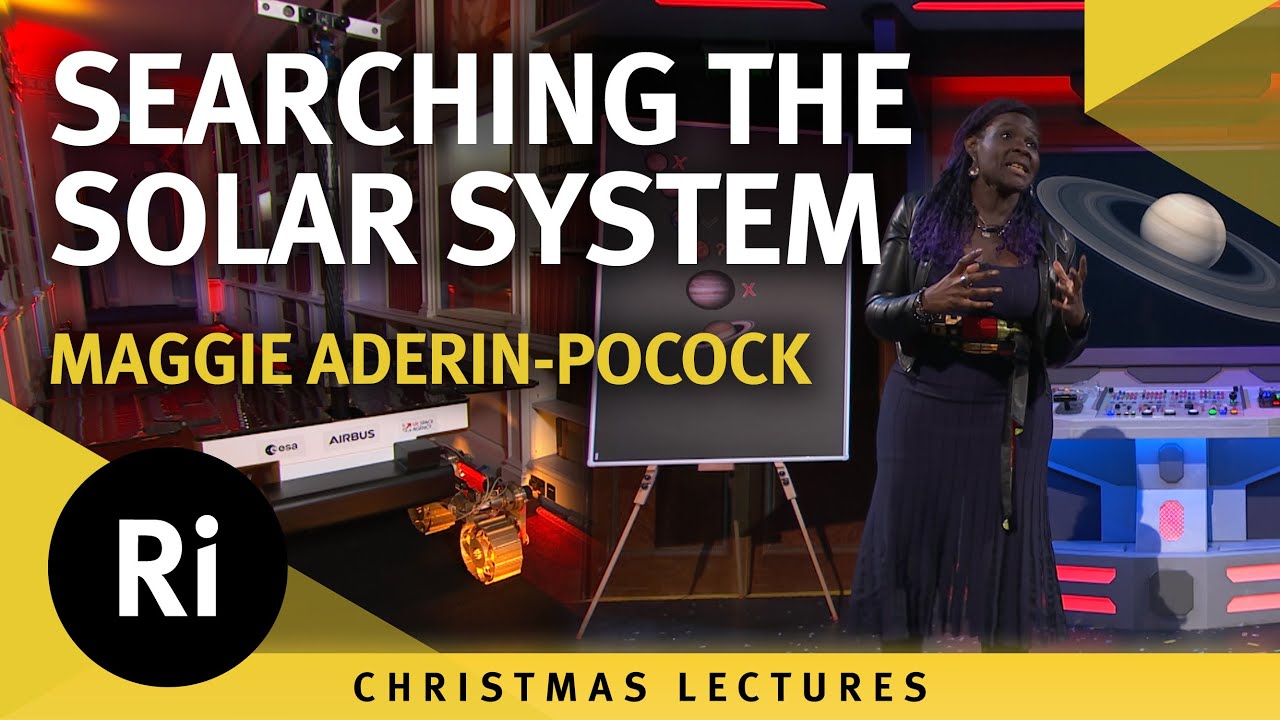
Searching the Solar System - Christmas Lectures 2025 with Maggie Aderin-Pocock 2/3
Keywords
Summary
157 words
Critical Evaluation
The lecture is a well-structured and engaging presentation that effectively communicates complex scientific concepts to a general audience. The inclusion of Dr. Nicky Fox, head of science at NASA, adds authority and firsthand insight into the Parker Solar Probe mission. The demonstration of stellar evolution using volunteers and confetti is a creative and memorable way to explain nucleosynthesis and the origin of elements. The content is scientifically accurate, with clear explanations of fusion, the solar wind, and the greenhouse effect on Venus. The discussion of Mars is current, referencing recent data from the Perseverance rover, and the explanation of how Mars lost its atmosphere is well-founded. However, the lecture is a popular science presentation, so it simplifies some topics and does not provide formal citations. The interactive voting on habitability is a nice pedagogical tool but does not delve deeply into the scientific criteria. Overall, the lecture is informative, inspiring, and scientifically sound, making it a valuable resource for public science education.
162 words
Title / Content Match
The title accurately reflects the content: a tour of the solar system focusing on the search for life.
Quality & Reliability
8/10
The lecture features expert testimony from NASA's head of science, Dr. Nicky Fox, and includes demonstrations and explanations grounded in established physics. The content is accurate and up-to-date, with references to recent missions like Parker Solar Probe and Perseverance. However, it is a public lecture aimed at general audiences, so some simplifications are made, and no formal citations are provided.
Key Moments
Markers derived by PSI from the transcript: the creator did not define chapters.
- Introduction to the lecture and the search for life in the solar system.
- Interview with Dr. Nicky Fox about the Parker Solar Probe.
- Demonstration of stellar evolution and nucleosynthesis.
- Discussion of the Sun's role in providing energy for life.
- Tour of Mercury and Venus, including the runaway greenhouse effect.
- Exploration of Mars, including recent findings from Perseverance rover.
- Explanation of how Mars lost its atmosphere and water.
- Discussion of the possibility of life on other moons like Europa and Enceladus.
- Summary of the most promising places for life in the solar system.
Cited Sources
- Ri Science Podcast — Mentioned as a resource for further exploration.
- Christmas Lectures — Official page for the Christmas Lectures series.
- Editing RI Talks and Moderating Comments — Information about the Royal Institution's content policies.
- Donate to the Royal Institution — Support the Royal Institution.
- Christmas Lectures 2025 Playlist — All three lectures in the series.
- Christmas Lectures Archive — Full archive of past Christmas Lectures.
Concurring Sources
- NASA Parker Solar Probe — Confirms the mission details and findings mentioned in the lecture.
- NASA Mars 2020 Perseverance Rover — Supports the discussion of recent Mars findings.
Contribution & Novelties
The lecture provides an engaging overview of the search for life in our solar system, highlighting recent missions like Parker Solar Probe and Perseverance. It uniquely combines expert interviews, live demonstrations, and audience interaction to convey the scientific process. The emphasis on stellar evolution and the origin of elements connects the search for life to cosmic processes.
Pour aller plus loin :
- Parker Solar Probe — Official NASA mission page with detailed information.
- Perseverance Rover — NASA’s Mars 2020 mission page.
- Stellar nucleosynthesis — Overview of element formation in stars.
- Runaway greenhouse effect — Explanation of the phenomenon on Venus.
- Europa Clipper — NASA’s mission to study Jupiter’s moon Europa.
110 words
Radar Profile
The radar profile shows high scores in quantity and quality of information, reflecting the lecture's rich content and expert input. The technical level is moderate, suitable for a general audience, while reliability is high due to the involvement of NASA scientists and accurate scientific explanations.
💬 Sur les 0 commentaires analysés, aucune tendance n'est disponible.