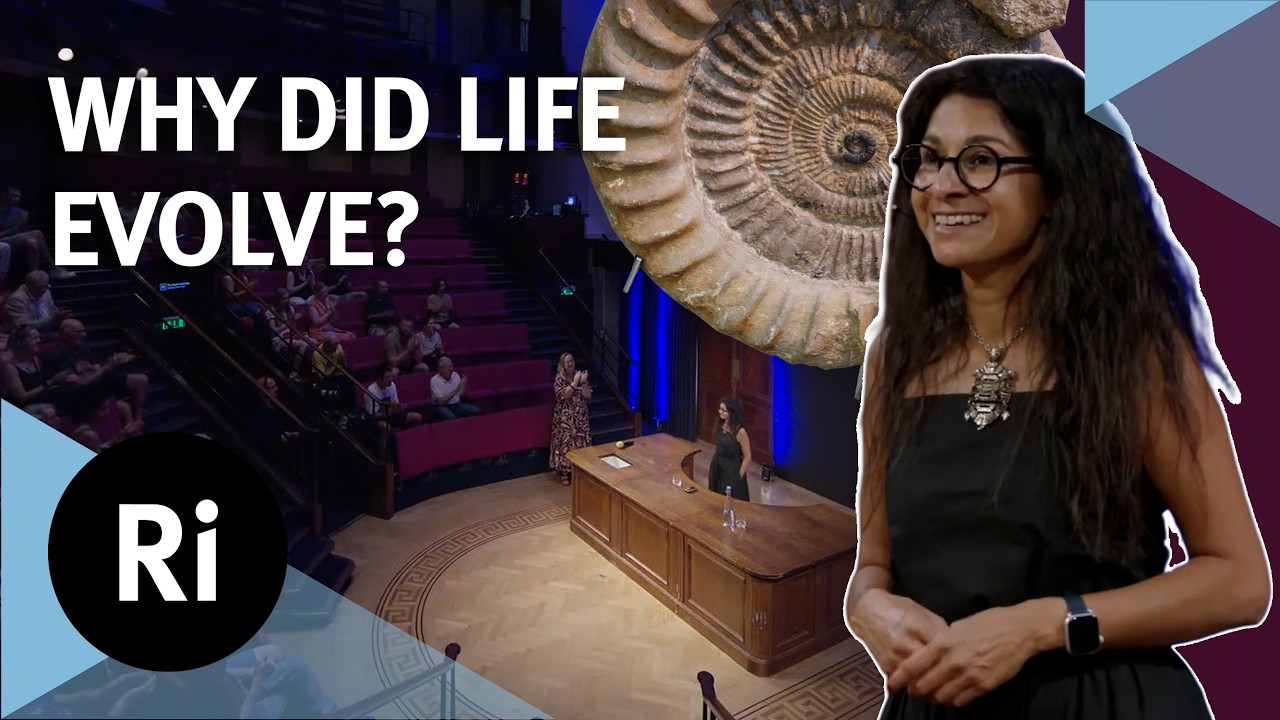
The hidden rule behind all evolution | with biologist Anjali Goswami
Keywords
Summary
155 words
Critical Evaluation
The lecture provides a compelling and well-articulated overview of evolutionary phenomics, a cutting-edge approach to understanding morphological evolution. Anjali Goswami’s expertise is evident, and she effectively communicates complex ideas to a general audience without oversimplifying the science. The use of cats as a recurring example is pedagogically effective, illustrating how developmental constraints (isometry vs. allometry) and ecological specialization (loss of grinding teeth) can limit evolutionary potential. The comparison with dogs, which have undergone dramatic diversification due to allometric growth, is particularly illuminating. The talk also touches on convergent evolution, using the Tasmanian tiger and wolf as examples, and discusses the role of AI in accelerating phenomic analyses. The scientific content is grounded in published research, though specific citations are not always provided during the talk. The argumentation is logical and builds a coherent narrative from fundamental questions to specific case studies and broader implications. However, the lecture could be criticized for potentially overstating the role of constraints in evolution, as it does not extensively discuss counterexamples or the interplay with other factors like genetic drift or environmental change. Additionally, the claim that cats are ’evolutionarily perfect’ is presented somewhat tongue-in-cheek, but it might be misinterpreted by some viewers. The talk’s relevance to current biodiversity crises is well-argued, linking evolutionary rates to extinction vulnerability. Overall, the lecture is scientifically rigorous, engaging, and thought-provoking, making it a valuable resource for anyone interested in evolutionary biology. The title accurately reflects the content, and the presentation is well-structured. The only minor weakness is the lack of explicit citations during the talk, but the speaker’s authority and the overall coherence mitigate this.
267 words
Title / Content Match
The title accurately reflects the core theme of the talk: uncovering hidden constraints that shape evolution, as presented by biologist Anjali Goswami.
Quality & Reliability
8/10
The talk is delivered by a leading evolutionary biologist, Anjali Goswami, who presents her own research and that of colleagues, with references to published studies. The content is well-structured, based on empirical data and established evolutionary theory. However, as a public lecture, it simplifies complex topics and does not provide full methodological details or peer-reviewed citations for all claims.
Chapters
- Introduction
- Why species diversity isn't evenly spread across the planet
- What is "evolutionary phenomics"?
- Why cats are the weirdest mammals alive
- How diet and teeth trapped cats in one niche
- The "fly in a tube": why most life forms never evolve
- Convergent evolution: the Tasmanian tiger and the wolf
- Why the past looked nothing like the present
- Building 3D shape models — and automating it with AI
- Scanning a million insects to solve a 200-year-old mystery
- Birds, dinosaurs, and mammals: who evolves fastest?
- Climate change, mass extinction, and what comes next
Cited Sources
- Ri Science Podcast — Mentioned in the video description as a resource for further science content.
- Ri Talks Editing and Comment Moderation — Linked in the description, likely for information about how talks are edited and comments moderated.
- Donate to the Ri — Linked in the description as a call to support the Royal Institution.
Concurring Sources
- Scientific American article on cats — Mentioned in the talk as an interview about why cats might be evolutionarily perfect.
Contribution & Novelties
This talk provides an accessible introduction to evolutionary phenomics, a relatively new field that uses high-dimensional shape data to study evolution. It highlights how developmental constraints, such as isometric growth in cats, can limit evolutionary potential, and how ecological specialization can lock species into narrow niches. The lecture also showcases the application of AI and automated imaging to accelerate phenomic research, opening up new possibilities for studying diverse groups like insects. The discussion of convergent evolution and the comparison between cats and dogs offers fresh perspectives on evolutionary constraints.
Pour aller plus loin :
- Evolutionary Phenomics — Overview of phenomics, the high-dimensional study of phenotypes.
- Convergent Evolution — Explanation of convergent evolution, with examples like the Tasmanian tiger and wolf.
- Carnassial Teeth — Description of carnassial teeth, which are central to the talk’s discussion of dietary constraints in carnivorans.
139 words
Radar Profile
The radar profile shows high scores in quantity and quality of information, reflecting the lecture's rich content and scientific grounding. The technical level is moderate, suitable for a general audience, while reliability is high due to the speaker's expertise. This indicates a well-balanced and trustworthy presentation.