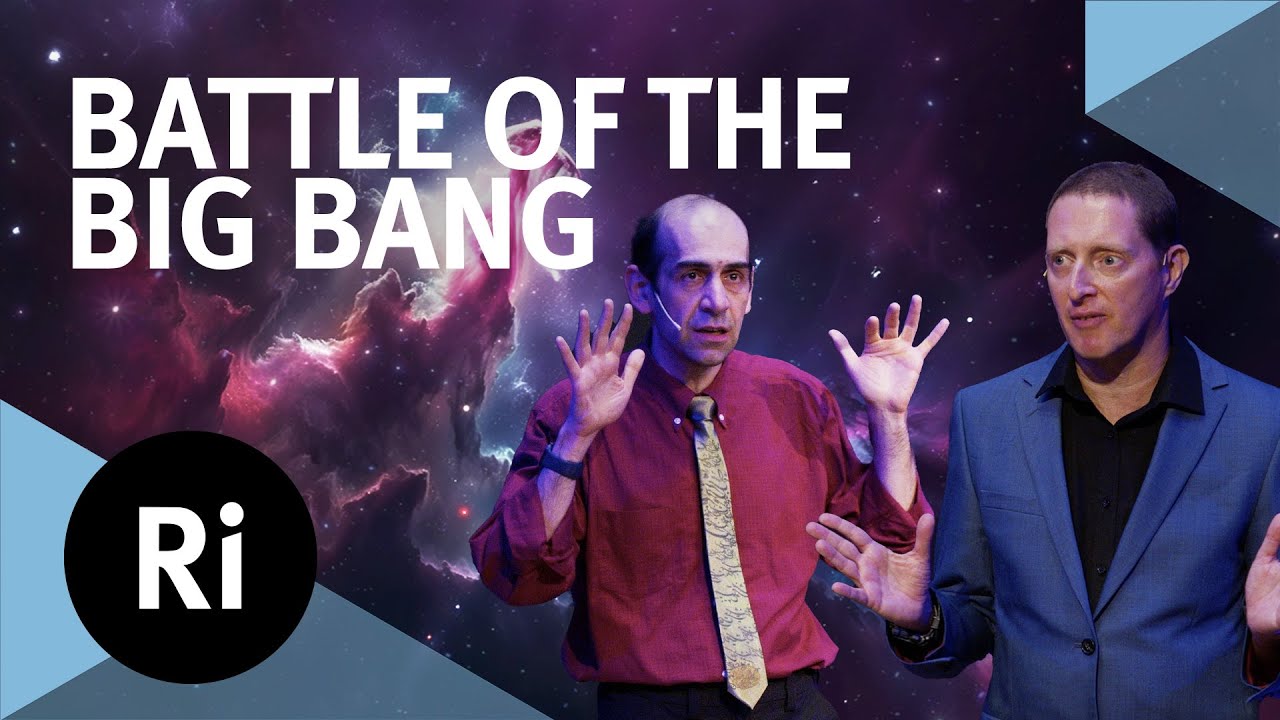
What really happened during the Big Bang? - with Niyayesh Afshordi
Keywords
Summary
210 words
Critical Evaluation
The lecture provides a compelling and accessible overview of the current state of cosmology regarding the Big Bang, blending historical context with frontier research. Afshordi’s credentials as a professor of physics and astronomy lend authority to the presentation. The historical narratives, such as the Einstein-Lemaître exchange and the Ryle-Hoyle rivalry, are well-documented and add human interest, making the science more relatable. The discussion of the cosmic microwave background is accurate, and the acknowledgment of Andrew McKellar’s earlier detection is a valuable correction to the standard narrative. The lecture excels in presenting the uncertainty and ongoing debates in cosmology, particularly the speculative ideas about the universe’s origin. However, these speculative sections, such as the black hole birth scenario and the multiverse, are presented with less critical scrutiny, and the evidence for them is not thoroughly examined. The talk is primarily a popular science lecture, so it does not delve into the mathematical details, but it does convey the key concepts effectively. The sources cited are limited to the speaker’s own book and general institutional links, which is typical for such lectures but limits the ability to verify specific claims. The title is well-matched to the content, as the lecture indeed addresses ‘what really happened’ by presenting both established knowledge and open questions. Overall, the lecture is scientifically sound, engaging, and thought-provoking, though it could benefit from a more balanced treatment of speculative theories versus established evidence.
235 words
Title / Content Match
The title accurately reflects the content: the lecture explores the latest debates on the Big Bang, including alternative scenarios and the question of what came before.
Quality & Reliability
8/10
The lecture is delivered by a leading astrophysicist (professor at University of Waterloo and Perimeter Institute) and covers established cosmology (Hubble-Lemaître law, CMB) alongside speculative frontier theories (black hole origin, multiverse). The content is scientifically grounded, but the speculative parts are clearly presented as such. The talk includes historical anecdotes and some personal interpretations, but overall maintains high scientific rigor.
Key Moments
Markers derived by PSI from the transcript: the creator did not define chapters.
- Introduction: Afshordi asks the audience about their earliest memories, setting the stage for exploring the universe's earliest moments.
- Discussion of the Einstein-Lemaître debate over the expanding universe, including Einstein's famous dismissal.
- Explanation of how Hubble's observations confirmed the expanding universe, leading to the Hubble-Lemaître law.
- Introduction to the steady-state theory and the battle with the Big Bang model, featuring key figures like Hoyle and Ryle.
- Discovery of the cosmic microwave background (CMB) as decisive evidence for the Big Bang, including the earlier detection by Andrew McKellar.
- Explanation of the CMB's temperature fluctuations as seeds of cosmic structure.
- Speculative ideas about what came before the Big Bang, including black hole origin, multiverse, and cyclic universe scenarios.
- Concluding remarks on the ongoing 'battle' and the human element in scientific discovery.
Cited Sources
- Battle of the Big Bang: The New Tales of Our Cosmic Origins (book) — Mentioned as the speaker's book co-written with Phil Halper, covering the debates on cosmic origins.
- Ri Science Podcast — Linked in the description as a resource for further science content from the Royal Institution.
- Royal Institution Support Page — Linked in the description for supporting the institution's public lectures.
- Q&A Session (exclusive for Science Supporters) — Mentioned in the description as a follow-up Q&A for supporters.
Concurring Sources
- Cosmic microwave background — Supports the discussion of the CMB as evidence for the Big Bang.
- Hubble–Lemaître law — Confirms the relationship between distance and recession velocity of galaxies.
Dissenting Sources
External References
Contribution & Novelties
The lecture offers a fresh perspective on the Big Bang by framing it as an ongoing scientific battle, blending historical anecdotes with cutting-edge speculative theories. It highlights the human element in cosmology, showing how rivalries and personalities shape scientific progress. The inclusion of the earlier CMB detection by Andrew McKellar adds a novel historical insight. The talk also presents the speaker’s own research on black hole origins and multiverse scenarios, providing a glimpse into active research frontiers.
Pour aller plus loin :
- Cosmic microwave background — Essential for understanding the evidence for the Big Bang.
- Big Bang — Overview of the standard cosmological model.
- Multiverse — Discusses the concept of multiple universes, relevant to the speculative ideas presented.
- Black hole cosmology — Explores the idea that our universe may have originated from a black hole.
- Steady-state theory — Historical alternative to the Big Bang, discussed in the lecture.
148 words
Radar Profile
The radar profile shows high scores in quantity and quality of information, reflecting the lecture's comprehensive coverage of cosmology. The technical level is moderate, suitable for a general audience, while reliability is high due to the speaker's expertise and established science. The overall balance indicates a well-rounded presentation.
💬 No comments were provided for analysis.