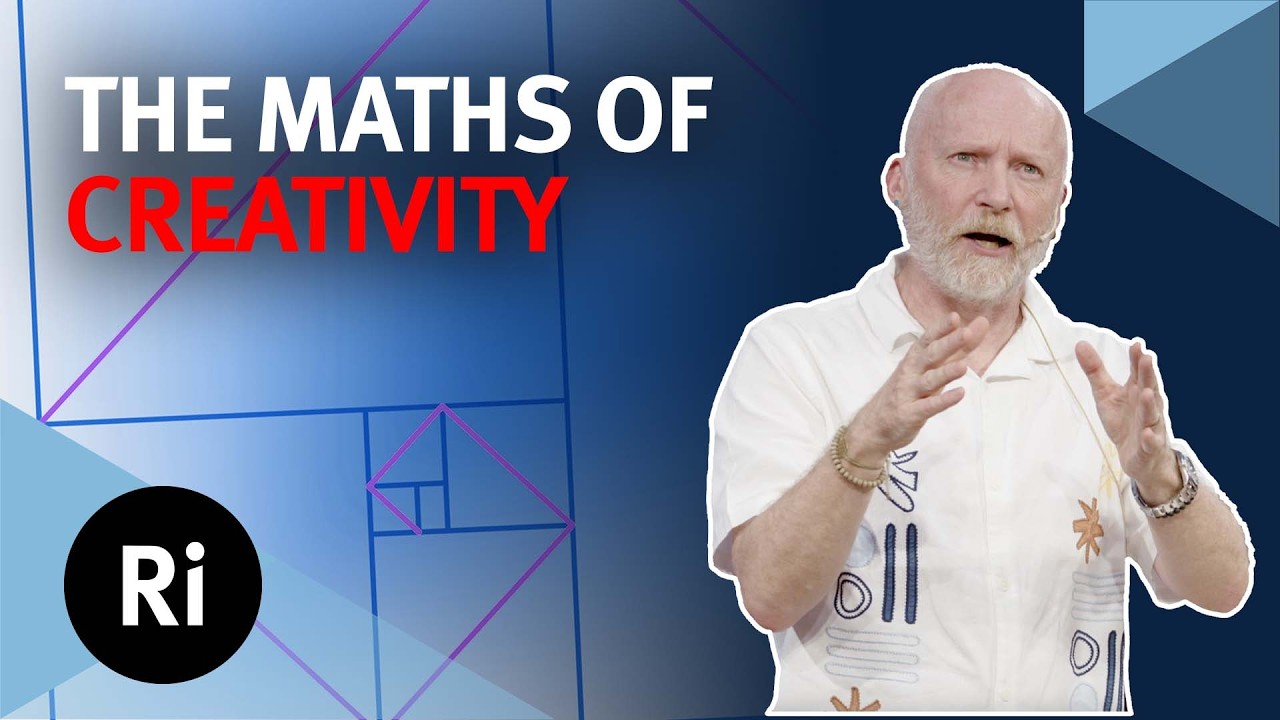
The mathematics of creativity - with Marcus du Sautoy
Keywords
Summary
184 words
Critical Evaluation
The talk is a compelling and accessible exploration of the intersection between mathematics and creativity. Marcus du Sautoy, a distinguished mathematician and science communicator, delivers a well-structured lecture that balances technical depth with engaging storytelling. The use of live music and visual examples effectively illustrates the concepts, making them tangible for the audience. The argument that mathematics is a study of structure and that artists often intuitively employ mathematical structures is convincing and supported by numerous examples from music, art, and literature. The discussion of prime numbers in Messiaen’s composition is particularly illuminating, showing how the choice of primes creates a unique aesthetic effect. The talk also touches on the golden ratio and symmetry, providing a broad overview of mathematical concepts in art. However, the lecture is primarily a popular science presentation, and some claims are presented without rigorous citations. For instance, the assertion that artists ‘discover’ mathematical structures without formal knowledge is intriguing but not deeply analyzed. The talk could benefit from more explicit references to academic sources for the historical and artistic claims. Additionally, the audio issues at the beginning may detract from the experience, though they are acknowledged and fixed early on. Overall, the talk is informative and inspiring, successfully bridging the perceived gap between the sciences and the arts. It encourages viewers to appreciate the mathematical underpinnings of creative works and to recognize the creative aspects of mathematical discovery. The content is suitable for a general audience, but it also offers insights for those with a background in mathematics or the arts. The live musical performance adds a unique and memorable element, reinforcing the central theme of the talk.
273 words
Title / Content Match
The title accurately reflects the content, which explores the connections between mathematics and creativity.
Quality & Reliability
8/10
The talk is delivered by a renowned mathematician (Marcus du Sautoy, Professor at Oxford) and recorded at the Royal Institution, a reputable scientific venue. The content is well-structured and draws on documented examples from music, art, and literature. However, it is a popular science lecture, not a peer-reviewed source, and some claims are presented without detailed citations.
Key Moments
Markers derived by PSI from the transcript: the creator did not define chapters.
- Introduction: Marcus du Sautoy shares his personal experience of being torn between science and art, and how a maths teacher inspired him to see mathematics as a creative pursuit.
- Definition of mathematics as the study of structure, and the idea that artists use mathematical structures to enhance creativity.
- Introduction of the 'blueprints' concept: nine mathematical structures that underpin creative works. First example: prime numbers in Messiaen's Quartet for the End of Time.
- Discussion of the golden ratio in architecture and art, including Le Corbusier's use of the golden ratio in his designs.
- Exploration of symmetry in music and visual arts, with examples from Bach and Escher.
- Examination of randomness and chance in art, including the Dada movement and the use of random processes in music.
- Conclusion: Marcus du Sautoy summarizes the complementary relationship between mathematics and creativity, and encourages the audience to see both as intertwined.
Cited Sources
- Blueprints: how mathematics shapes creativity — Marcus du Sautoy's book, which expands on the ideas presented in this talk.
- Q&A session for Science Supporters — Exclusive Q&A for members, likely providing further discussion.
- RI Science Podcast — Podcast from the Royal Institution, possibly featuring related content.
- Editing RI talks and moderating comments — Information about how the Royal Institution edits talks and moderates comments.
- Donate to the Royal Institution — Support page for the Royal Institution.
Concurring Sources
- The Mathematical Brain — General reference to the Royal Institution's mission to promote science, which aligns with the talk's purpose.
Dissenting Sources
- No discordant sources found — The talk does not contradict established scientific consensus; it is a popular science presentation.
Contribution & Novelties
The talk offers a fresh perspective on the relationship between mathematics and creativity, emphasizing that mathematical structures serve as ‘blueprints’ for artistic creation. It provides concrete examples from music, art, and literature, showing how artists intuitively use mathematical concepts. The live musical performance adds a unique dimension, illustrating the ideas in real-time.
Pour aller plus loin :
- Prime numbers — Essential background on prime numbers and their properties.
- Olivier Messiaen — Composer discussed in the talk, known for his use of mathematical structures.
- Golden ratio — A key mathematical concept in art and architecture, mentioned in the talk.
- Symmetry in music — Explores how symmetry is used in musical composition.
- Dada — Art movement that embraced randomness, as discussed in the talk.
122 words
Radar Profile
The radar profile shows high scores in quantity and quality of information, with a moderate technical level. This indicates a well-balanced talk that is both informative and accessible, with a strong emphasis on reliable content.
💬 No comments were provided for analysis.