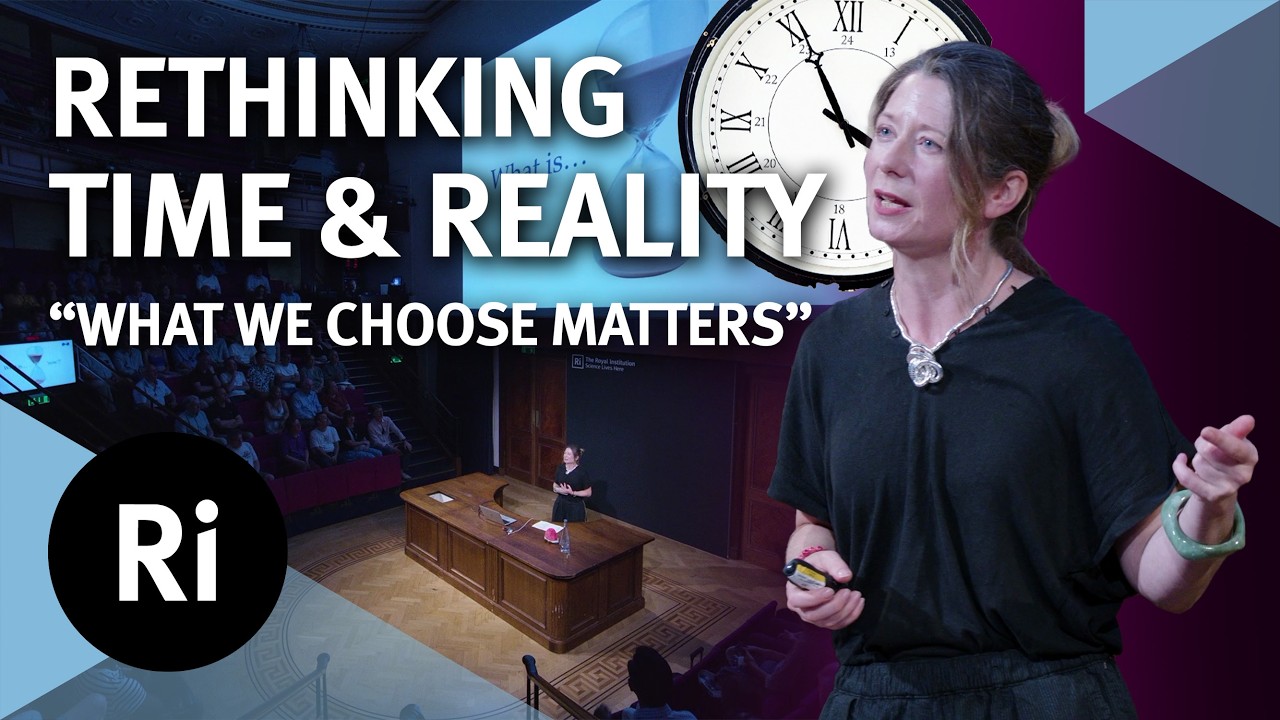
Physics says 'now' isn't real... so do your choices even matter? | Jo Marchant
Keywords
Summary
189 words
Critical Evaluation
The talk provides a comprehensive and engaging overview of the concept of ’now’, synthesizing insights from physics, neuroscience, and philosophy. Marchant’s presentation is clear and accessible, using vivid examples and live demonstrations to illustrate complex ideas. The scientific content is generally accurate, particularly in its explanation of the block universe and the relativity of simultaneity. She appropriately distinguishes between the objective description of time in physics and the subjective experience of ’now’, acknowledging that the latter is a product of brain processes. The discussion of free will is nuanced, presenting both the deterministic implications of the block universe and the potential for quantum mechanics to reintroduce uncertainty. However, the talk could be criticized for not delving deeply into the philosophical arguments against the block universe or the scientific controversies surrounding QBism. Additionally, while Marchant cites various studies and thinkers, she does not provide specific references during the talk, which limits the ability to verify claims. The title’s question about choices is addressed but not definitively answered, which is appropriate given the complexity. Overall, the talk is a valuable contribution to public understanding of time and consciousness, though it may oversimplify some debates.
192 words
Title / Content Match
The title accurately reflects the content, which explores the nature of 'now' and its implications for free will, drawing on physics and neuroscience.
Quality & Reliability
8/10
The talk is delivered by an award-winning science writer with a background as senior editor at New Scientist and Nature. It covers established physics (relativity, block universe) and neuroscience, and includes references to current research and philosophical perspectives. The presentation is clear, well-structured, and avoids overstatement, though it does not provide detailed citations for all claims.
Chapters
- What Is "Now"? Introducing the Mystery
- The Outer World vs Your Inner Experience
- A Live Experiment: Notice Your Own "Now"
- Philosophers on Time: Heraclitus to William James
- How Different Cultures Picture Time
- Physics and the Block Universe: Does "Now" Exist?
- Why Your Brain Predicts "Now" Instead of Sensing It
- The Federer Illusion: Seeing the Future Before It Happens
- How Long Does a Moment Actually Last?
- Free Will, Quantum Physics, and the Illusion of Choice
- QBism: A Universe With No Pre-Written Script
- How to Live Better in the Present Moment
Cited Sources
- In Search of Now: The Science and Mystery of the Present Moment — Jo Marchant's latest book, which expands on the themes of the talk.
- Ri Science Podcast — The Royal Institution's podcast, where related discussions may be found.
- Editing Ri Talks and Moderating Comments — Ri's policy on editing talks and moderating comments, relevant to the talk's context.
- Support the Ri — Donation page for the Royal Institution, mentioned in the description.
- Jo Marchant's Q&A — Exclusive Q&A session for channel members following the talk.
Concurring Sources
- The Block Universe Theory — Supports the description of the block universe model as a static four-dimensional spacetime.
- Relativity of Simultaneity — Confirms that simultaneity is relative, undermining a universal 'now'.
- Predictive Processing — Aligns with the talk's explanation that the brain predicts rather than directly perceives the present.
Dissenting Sources
Contribution & Novelties
The talk offers a unique interdisciplinary synthesis of the concept of ’now’, bridging physics, neuroscience, and philosophy in an accessible manner. It highlights the tension between the objective block universe and our subjective experience of a flowing present, and explores the potential role of quantum mechanics in preserving free will. The inclusion of cultural variations in time perception adds a valuable perspective often missing from scientific discussions.
Pour aller plus loin :
- Block universe — Overview of the block universe model in physics.
- Relativity of simultaneity — Key concept from Einstein’s theory relevant to the relativity of ’now'.
- Predictive processing — Theory in neuroscience explaining how the brain constructs perception, including the present moment.
- QBism — Interpretation of quantum mechanics that treats probabilities as subjective, potentially allowing for genuine choice.
130 words
Radar Profile
The radar profile shows high scores in information quantity, quality, and reliability, with a slightly lower technical level, reflecting the talk's broad accessibility while maintaining scientific rigor.
💬 Positive and engaged: viewers appreciate the thought-provoking content and the interdisciplinary approach, with many sharing personal reflections on time and free will. Sur les 30 commentaires analysés, la majorité exprime un intérêt marqué et une gratitude pour la clarté de l'exposé.