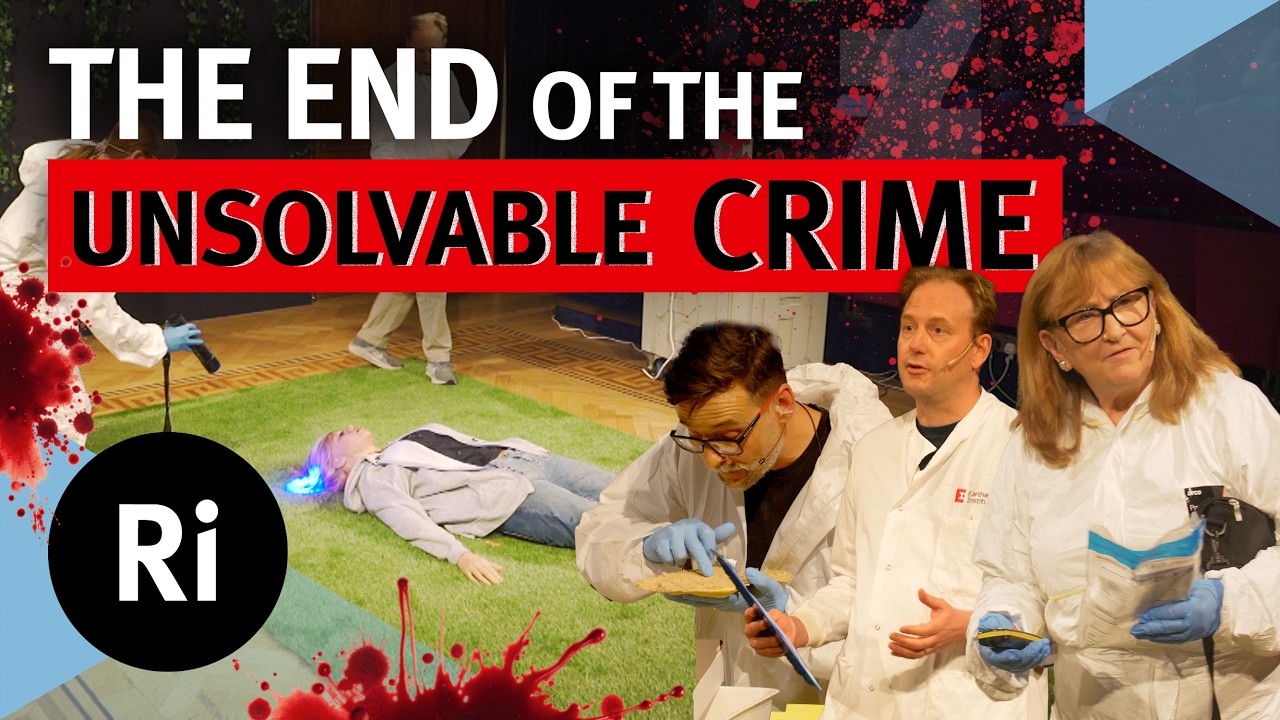
Five forensic scientists walk through a crime scene
Keywords
Summary
152 words
Critical Evaluation
The talk provides an excellent, accessible overview of forensic science, demonstrating the practical application of entomology, soil science, and DNA analysis. The experts are credible, hailing from established institutions, and they explain complex concepts clearly without oversimplifying. The live demonstrations, such as the blood test and maggot collection, add authenticity and engagement. The argumentation is solid, with each expert explaining the scientific basis of their methods and the limitations. For instance, Katherine Brown emphasizes that insect-based time of death estimates require environmental data and are not precise. The discussion of DNA evidence is particularly valuable, as it corrects common misconceptions from crime dramas, highlighting that most DNA profiles are mixed and difficult to interpret. The introduction of the SCAnDi project offers a forward-looking perspective on solving this problem. The talk is well-structured, with each segment building on the previous one. The only minor weakness is that some topics, such as the soil analysis, are covered relatively briefly, but this is understandable given the time constraints. The title accurately reflects the content, and the talk is suitable for a general audience interested in forensic science. Overall, it is a high-quality, informative presentation that balances scientific rigor with public engagement.
198 words
Title / Content Match
The title accurately reflects the content: five forensic scientists walk through a simulated crime scene, each demonstrating their specialty.
Quality & Reliability
8/10
High-quality presentation by five experts from reputable institutions (University of Portsmouth, James Hutton Institute, Earlham Institute). Techniques are demonstrated live and explained with scientific rigor. Some simplification inherent to a public talk, but no major inaccuracies detected.
Chapters
- Introduction
- Forensic entomology: using insects to estimate time of death
- Identifying maggot species and calculating age
- What else the crime scene reveals
- Forensic soil science: tracking the victim's movements
- Plant material and pinpointing a location
- DNA at the crime scene: footprints, blood and biological evidence
- The touch DNA problem
- Testing for blood: a live demonstration
- Mixed DNA profiles and the limits of current forensic science
- The SCANDI project: single cell DNA analysis and the future of forensic evidence
Cited Sources
- RI Science Podcast — Mentioned as a resource for further exploration of science topics.
- Royal Institution Editing and Moderation Policy — Referenced for information on how talks are edited and comments moderated.
- Royal Institution Donation Page — Mentioned as a way to support the Royal Institution.
Concurring Sources
- Forensic entomology: a comprehensive review — Supports the use of insect development to estimate time of death.
- Soil forensics: a review — Confirms the use of soil physical, chemical, and biological properties in forensic investigations.
Dissenting Sources
- Potential limitations of single-cell DNA analysis in forensic casework — While SCAnDi is promising, some studies highlight challenges in contamination and validation that may affect its reliability.
Contribution & Novelties
The talk provides a unique, real-time walkthrough of a crime scene by multiple forensic experts, offering an integrated view of how different disciplines contribute to an investigation. It demystifies forensic science and highlights the importance of combining evidence types. The introduction of the SCAnDi project is particularly novel, presenting a cutting-edge approach to solving the mixed DNA profile problem.
Pour aller plus loin :
- Forensic entomology — Overview of the field and its applications.
- Soil forensics — Explanation of how soil analysis is used in criminal investigations.
- DNA profiling — Background on DNA analysis techniques and their limitations.
- Single-cell DNA analysis — Overview of single-cell sequencing technologies relevant to SCAnDi.
110 words
Radar Profile
The radar profile shows high scores in quality of information and reliability, reflecting the expert panel and rigorous content. The quantity of information is also strong, though the technical level is moderate, making it accessible to a general audience. Overall, the talk is well-balanced and informative.
💬 Sur les 0 commentaires analysés, aucune tendance n'est disponible.