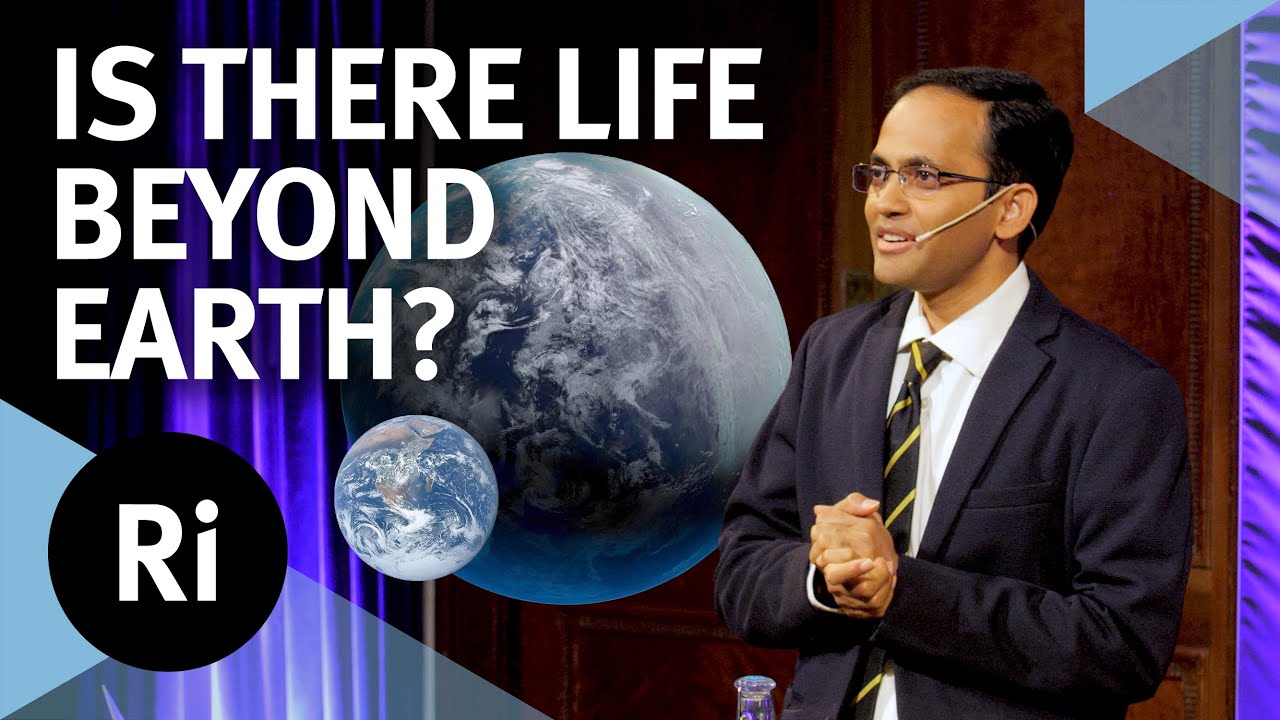
Does alien life exist? - with Nikku Madhusudhan
Keywords
Summary
187 words
Critical Evaluation
The lecture by Nikku Madhusudhan is a masterclass in scientific communication, blending rigorous technical detail with accessible explanations. The speaker’s expertise is evident throughout, as he systematically builds the case for studying Hycean worlds as promising targets in the search for life. The content is well-structured, starting with a historical perspective that underscores the rapid progress in exoplanetary science, then moving through the necessary techniques (transit spectroscopy, atmospheric retrieval) before presenting the groundbreaking JWST observations of K2-18b.
The scientific rigor is high: Madhusudhan clearly distinguishes between detection of molecules and the inference of biosignatures, emphasizing the need for caution. He acknowledges the limitations of current data and the ongoing debate about the nature of sub-Neptunes. The presentation of the K2-18b results is balanced, noting both the excitement and the uncertainties. The speaker also touches on the broader implications for habitability, discussing the potential for liquid water oceans on Hycean worlds despite their hydrogen-rich atmospheres.
The argumentation is solid, but the lecture is not without its weaknesses. The title, ‘Does alien life exist?’, is somewhat sensationalist and may overpromise; the content is more about the search for life and the potential of Hycean worlds than a definitive answer. Additionally, while the speaker mentions the importance of multiple lines of evidence, he could have delved deeper into the potential false positives for biosignatures. The lecture also assumes a certain level of prior knowledge, which might be challenging for a general audience, though the speaker does make an effort to explain concepts clearly.
The sources cited are primarily the speaker’s own research and JWST data, which are credible. However, the lecture would benefit from more explicit references to independent studies or contrasting viewpoints. The Q&A session, mentioned as available for supporters, likely addresses some of these gaps.
Overall, the lecture is highly informative and scientifically sound, offering a compelling overview of the current state of the search for life on exoplanets. It is a valuable resource for anyone interested in astrobiology and the capabilities of JWST.
333 words
Title / Content Match
The title is somewhat broad and clickbait-like, but the content directly addresses the question of alien life through the lens of exoplanet research, particularly Hycean worlds and K2-18b.
Quality & Reliability
9/10
Lecture by a leading expert in exoplanetary science, presenting peer-reviewed research and JWST observations. The content is rigorous, well-structured, and includes appropriate caveats. The speaker is a professor at Cambridge and a pioneer in atmospheric retrieval methods.
Key Moments
Markers derived by PSI from the transcript: the creator did not define chapters.
- Introduction and acknowledgments
- Historical context: from Copernicus to JWST
- Introduction to exoplanets and sub-Neptunes
- Techniques: transit method and transmission spectroscopy
- Atmospheric retrieval explained
- JWST capabilities and early results
- Hycean worlds concept and habitability
- K2-18b observations and results
- Implications for biosignatures and future prospects
- Conclusion and outlook
Cited Sources
- Ri Science Podcast — Mentioned as a resource for further exploration of related topics.
- Editing Ri Talks and Moderating Comments — Referenced in the description for editorial policies.
- Support the Ri — Encouraged to support the Royal Institution.
- Q&A for this lecture — Exclusive Q&A session for Science Supporters.
Concurring Sources
- NASA Exoplanet Archive — Provides data on exoplanets, including K2-18b, supporting the lecture's claims.
- JWST Early Release Science — Showcases early JWST results, including atmospheric spectra of exoplanets.
Dissenting Sources
- Alternative interpretations of sub-Neptune atmospheres — Some researchers propose that sub-Neptunes may be more like mini-Neptunes with thick hydrogen envelopes, not necessarily habitable ocean worlds. This is an ongoing debate.
Contribution & Novelties
The lecture provides an accessible yet detailed overview of the search for life on exoplanets, with a focus on the novel concept of Hycean worlds and the recent JWST observations of K2-18b. It highlights the potential of these larger, hydrogen-rich planets to be more amenable to atmospheric characterization than Earth-like planets, thus opening new avenues in the search for biosignatures. The speaker’s pioneering work in atmospheric retrieval is presented as a key methodological advancement.
Pour aller plus loin :
- Hycean worlds on Wikipedia — Provides background on the concept and its implications.
- James Webb Space Telescope — Official NASA site with details on the telescope and its discoveries.
- K2-18b on NASA Exoplanet Archive — Data and parameters for the specific exoplanet discussed.
- Atmospheric retrieval methods — A key technique explained in the lecture; further reading can be found in academic literature.
141 words
Radar Profile
The radar profile shows high scores across all dimensions, indicating a well-balanced and comprehensive lecture. The strong performance in 'quantite_information' and 'qualite_information' reflects the depth and accuracy of the content, while 'niveau_technique' is appropriately high for a scientific audience. The 'fiabilite_globale' score is also high, consistent with the speaker's expertise and the use of peer-reviewed data.
💬 The comments are predominantly positive, with viewers expressing fascination and optimism about the search for alien life. Some comments critique the title as clickbait, but overall the audience appreciates the scientific content. Sur les 30 commentaires analysés, la tendance est positive, avec un mélange d'enthousiasme et de réflexions sur les implications de la recherche.