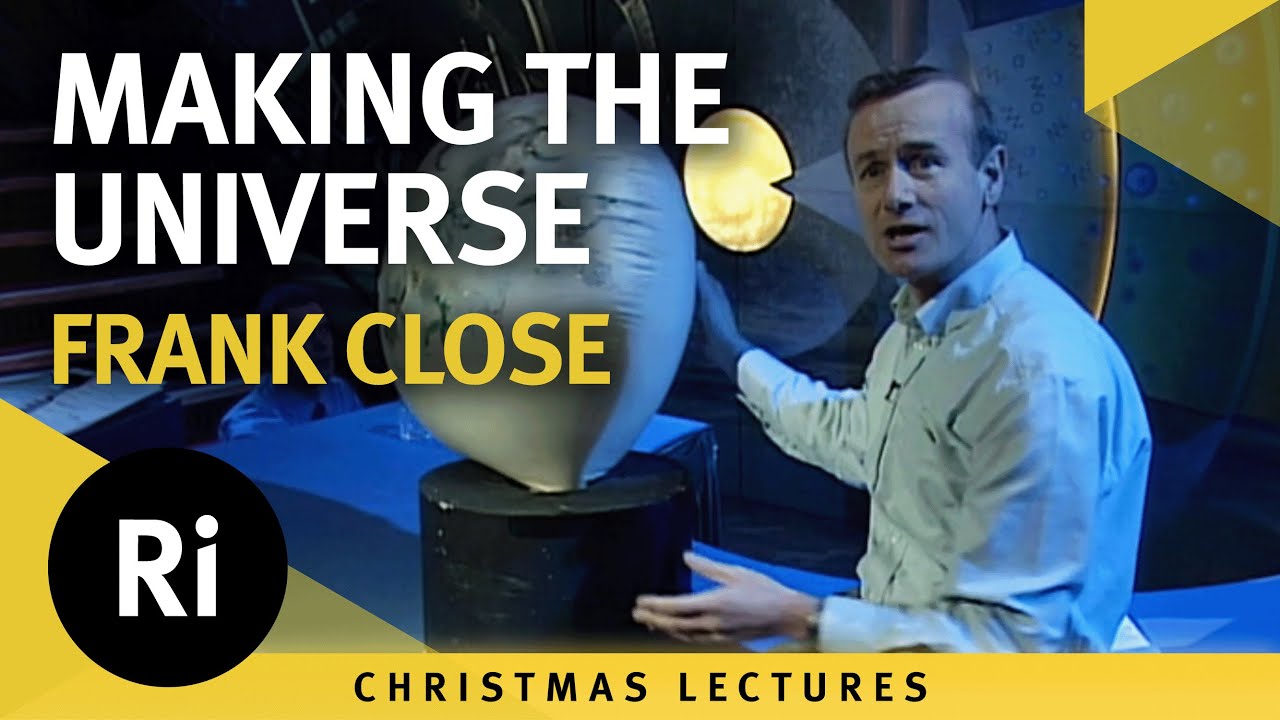
An hour to make the universe - Frank Close 1993 Christmas Lectures 5/5
Keywords
Summary
157 words
Critical Evaluation
This lecture, delivered by Frank Close, a distinguished physicist, provides a clear and engaging introduction to cosmology, specifically the expanding universe and the cosmic microwave background. The content is scientifically accurate, based on well-established discoveries such as Hubble’s law and the CMB. Close’s explanations are pedagogically effective, using analogies (e.g., Doppler effect with sound) and live demonstrations to illustrate abstract concepts. The lecture is part of the Royal Institution Christmas Lectures, a series known for its high-quality science communication, and this installment lives up to that reputation.
The argumentation is logically structured: starting with a simple observation (dark night sky), he builds up to the expanding universe, then the Big Bang, and finally the CMB as evidence. He carefully explains each step, making the science accessible without oversimplifying. The use of historical context (Hubble, Penzias and Wilson) adds credibility and shows the scientific process.
However, there are some limitations. The lecture is from 1993, so it does not include more recent cosmological discoveries, such as dark energy or precise measurements of the CMB anisotropies. Some concepts, like the matter-antimatter asymmetry, are introduced but not deeply explored, which might leave viewers wanting more detail. The demonstrations, while effective, are somewhat theatrical and may distract from the core science.
The sources cited are primarily the lecture series itself and the Royal Institution’s resources, which are reliable but not primary literature. The lecture does not reference specific papers, but it is based on established knowledge.
Overall, the lecture is a valuable educational resource, providing a solid foundation in cosmology. It is well-presented, scientifically sound, and engaging. The title accurately reflects the content, and the lecture fulfills its promise to explain the universe’s history in an hour. While it may not offer new insights to experts, it serves as an excellent introduction for a general audience.
302 words
Title / Content Match
The title accurately reflects the content: the lecture aims to explain the origin and evolution of the universe within an hour.
Quality & Reliability
8/10
Lecture by a renowned physicist, part of a prestigious series, based on established scientific knowledge (Hubble's law, cosmic microwave background). Demonstrations are illustrative but accurate. Some simplifications for a general audience, but no major errors.
Key Moments
Markers derived by PSI from the transcript: the creator did not define chapters.
- Introduction to the question 'Why is the sky dark at night?'
- Demonstration showing that if the universe were infinite and static, the night sky would be bright (Olbers' paradox).
- Explanation of the Doppler effect and redshift using sound and light.
- Introduction to Hubble's discovery of the expanding universe and the relationship between distance and recession velocity.
- Model of the expanding universe and the concept of the Big Bang.
- Discussion of the age of the universe (15 billion years) and the temperature of the Big Bang.
- Story of Penzias and Wilson and the discovery of the cosmic microwave background.
- Listening to the sound of the Big Bang and the CMB.
- Demonstration of expansion cooling and calculation of the universe's temperature history.
- Discussion of the matter-antimatter asymmetry and the need for new physics.
Cited Sources
- Royal Institution Christmas Lectures — The lecture series of which this is a part.
- RI Science Podcast — Podcast from the Royal Institution, possibly related to the lectures.
- Editing RI talks and moderating comments — Information about how the Royal Institution edits talks and moderates comments.
- Support the Royal Institution — Donation page for the Royal Institution.
- Christmas Lectures playlist — Playlist of the 1993 Christmas Lectures.
- All lectures in this series — Playlist of the entire 1993 series.
Concurring Sources
- Cosmic microwave background — Confirms the existence and properties of the CMB as described in the lecture.
- Hubble's law — Supports the expanding universe concept presented.
Contribution & Novelties
This lecture provides a clear and engaging synthesis of cosmological knowledge as of 1993, focusing on the expanding universe and the cosmic microwave background. It effectively communicates complex ideas through demonstrations and analogies, making them accessible to a general audience. The lecture’s originality lies in its pedagogical approach rather than new scientific findings.
Pour aller plus loin :
- Cosmic microwave background — For a detailed overview of the CMB and its significance.
- Hubble’s law — Explains the relationship between distance and recession velocity of galaxies.
- Big Bang nucleosynthesis — Discusses the formation of light elements in the early universe, relevant to the matter-antimatter asymmetry.
104 words
Radar Profile
The radar profile shows high scores in information quantity and quality, reflecting the lecture's comprehensive and accurate content. The technical level is moderate, suitable for a general audience, while reliability is high due to the presenter's expertise and the institutional backing.