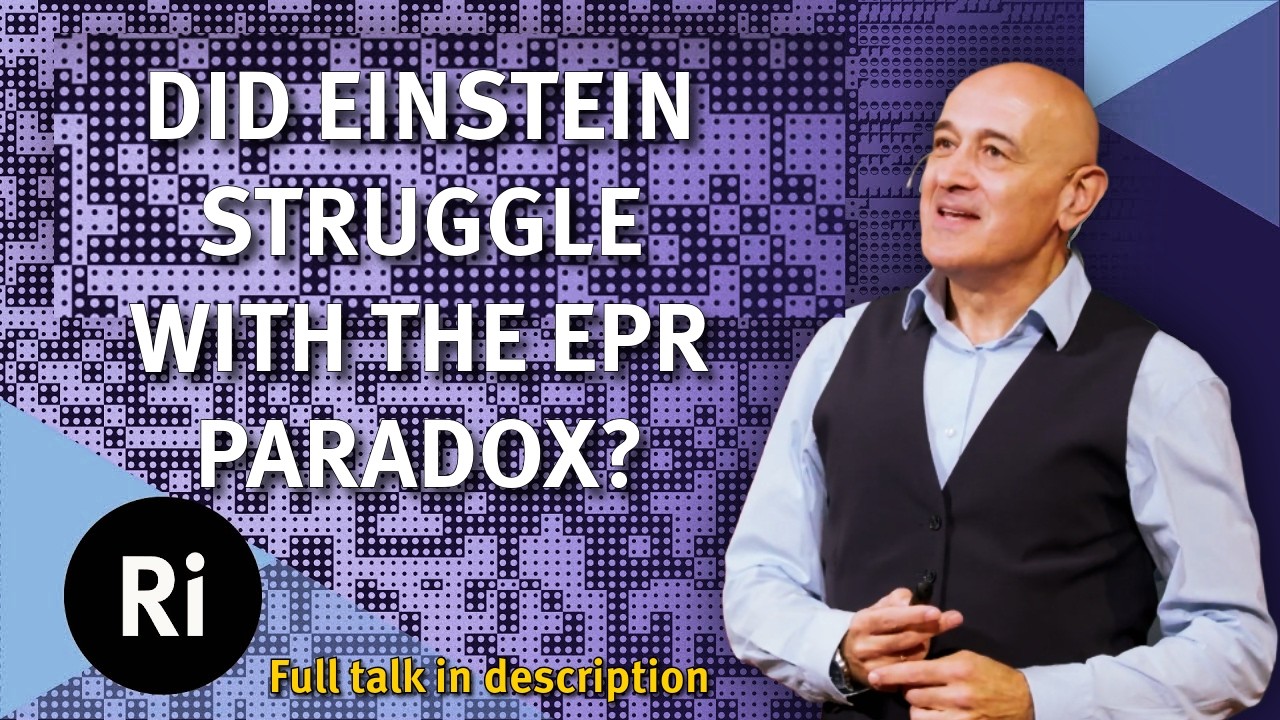
Jim Al Khalili explains Einstein's battle with quantum mechanics
Keywords
Summary
242 words
Critical Evaluation
The video provides a clear and engaging explanation of the EPR paradox, a cornerstone of quantum foundations. Jim Al-Khalili, a distinguished professor of physics, presents the material with authority and clarity. The explanation is simplified but accurate, using the analogy of gloves and the wave-particle duality to make the concepts accessible. The argumentation is solid: he correctly identifies Einstein’s concern as the completeness of quantum mechanics, not the uncertainty principle. The historical context, including the New York Times article and Einstein’s dissatisfaction with Podolsky, adds depth. The video is a clip from a longer talk, so it is concise and focused. However, it does not delve into later developments such as Bell’s theorem or experimental tests of entanglement, which would have strengthened the scientific rigor. The sources are not explicitly cited within the clip, but the presenter’s credentials and the Royal Institution’s reputation lend credibility. The title accurately reflects the content. Overall, the video is a valuable educational resource for understanding the EPR paradox, though it could have been more comprehensive.
171 words
Title / Content Match
The title accurately reflects the content, which focuses on Einstein's objections to quantum mechanics, particularly the EPR paradox.
Quality & Reliability
8/10
The content is presented by a distinguished professor of physics and is consistent with established quantum mechanics. The explanation of the EPR paradox is accurate and well-illustrated, though simplified. The video is a clip from a longer talk, and the source is a reputable institution (Royal Institution).
Key Moments
Markers derived by PSI from the transcript: the creator did not define chapters.
- Introduction: Einstein's reluctance to accept quantum mechanics.
- Explanation of the EPR paper and its authors.
- Simplified example of two photons emitted back-to-back.
- Discussion of wave-particle duality and wave packets.
- Measurement of wavelength vs. position and its implications.
- Glove analogy to illustrate Einstein's classical view.
- Quantum entanglement and the single quantum state.
- Clarification that Einstein's issue was not the uncertainty principle.
- Reading of the EPR paper's conclusion and Bohr's response.
- Historical note: New York Times coverage and Einstein's reaction.
Cited Sources
- Full talk: 100 years of quantum revolution — This video is a clip from this longer talk by Jim Al-Khalili.
- Ri podcast — The Royal Institution's podcast, mentioned in the description.
- Ri editorial policy — The Royal Institution's policy on editing talks and moderating comments.
- Donate to the Ri — Support the Royal Institution's charitable mission.
Concurring Sources
- EPR paradox - Wikipedia — Provides a detailed explanation of the EPR paradox, consistent with the video's content.
- Quantum entanglement - Wikipedia — Explains the concept of entanglement, which is central to the EPR paradox.
Contribution & Novelties
This video offers a concise and accessible explanation of the EPR paradox, a key historical debate in quantum mechanics. It clarifies common misconceptions, such as the distinction between the EPR paradox and the uncertainty principle. The use of the glove analogy is effective for conveying the classical intuition. The video also provides historical context, including the New York Times article and Einstein’s reaction.
Pour aller plus loin :
- Bell’s theorem — Bell’s theorem later showed that local hidden variable theories are incompatible with quantum mechanics, directly addressing the EPR paradox.
- Quantum entanglement — The phenomenon central to the EPR paradox, now a resource for quantum technologies.
- EPR paradox — The Wikipedia article provides a detailed overview of the paradox and its implications.
122 words
Radar Profile
The radar profile shows high scores in quality of information and reliability, reflecting the presenter's expertise and the accurate content. The quantity of information is moderate, as the video is a short clip. The technical level is moderate, suitable for a general audience but not overly simplistic.