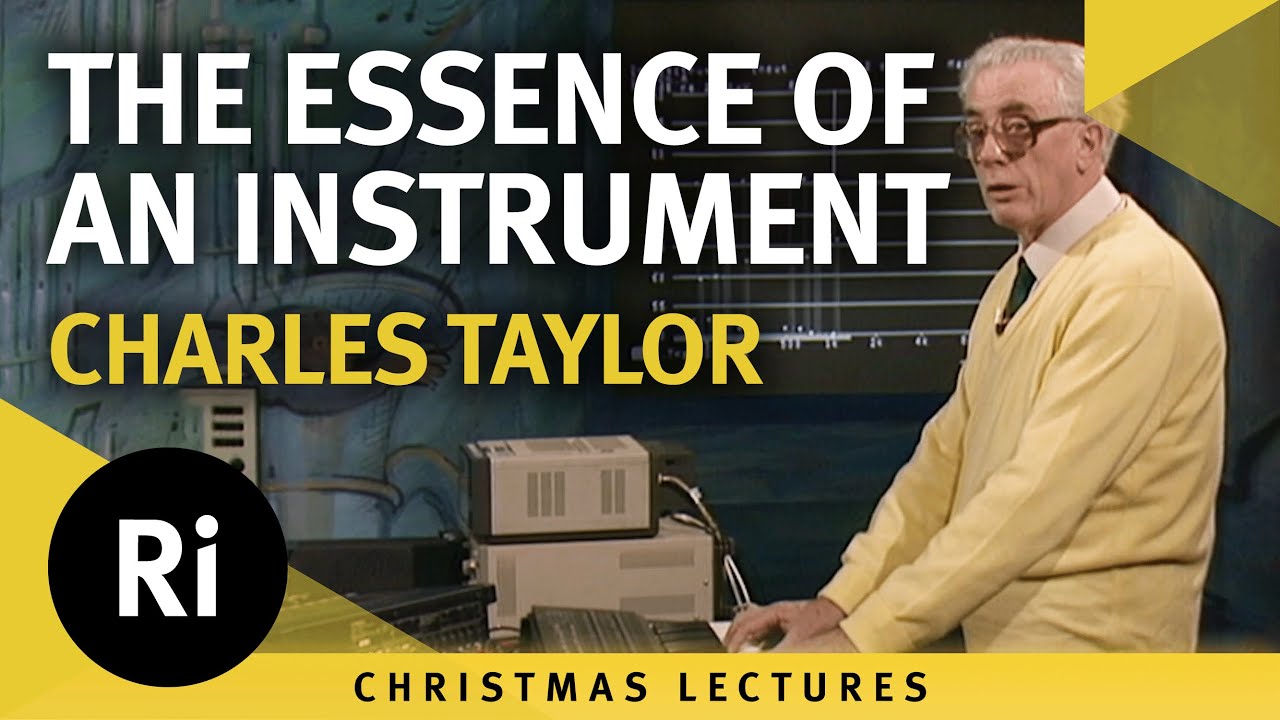
The essence of an instrument – Charles Taylor’s 1989 Christmas Lectures 2/5
Keywords
Summary
133 words
Critical Evaluation
This lecture is a masterclass in science communication, blending rigorous physics with engaging demonstrations. Charles Taylor’s explanations are clear and accessible, yet they do not sacrifice scientific accuracy. The use of historical apparatus and references to John Tyndall’s original experiments adds a valuable educational dimension, connecting current understanding to the history of science. The demonstrations are well-chosen and effectively illustrate the principles of resonance, harmonics, and vibration. The lecture’s strength lies in its hands-on approach, making abstract concepts tangible. However, some demonstrations may be less clear to a modern audience due to the age of the recording, and the pace is slower than contemporary videos. The scientific content is solid, and the sources, including Tyndall’s manuscripts, are credible. The title accurately reflects the content, and the lecture fulfills its promise to explain the essence of musical instruments. Overall, this is an excellent educational resource that remains relevant today.
148 words
Title / Content Match
The title accurately reflects the content, which focuses on the fundamental principles required for a musical instrument to produce sound.
Quality & Reliability
9/10
The lecture is delivered by a renowned physicist, Charles Taylor, and is part of the prestigious Royal Institution Christmas Lectures. The content is based on well-established physics principles, demonstrated through live experiments. The historical references to John Tyndall's work are accurate and supported by original manuscripts. The production is of high quality, with clear explanations and visual demonstrations.
Key Moments
Markers derived by PSI from the transcript: the creator did not define chapters.
- Introduction to the Shantu instrument and its sound production.
- Demonstration of longitudinal vibrations using a spring and oscilloscope.
- Explanation of natural frequency and resonance with a swing.
- Singing flame experiment demonstrating resonance in a tube.
- Xylophone resonance tubes and the effect of tube length.
- Tyndall's experiment with a large tuning fork and resonator, showing sound traveling through wood.
- Demonstration of harmonics using a synthesizer and oscilloscope.
- Large singing flame tube acting as a foghorn.
- Straw instrument demonstration and the challenge of changing pitch.
Cited Sources
- Royal Institution Christmas Lectures — Official page for the Christmas Lectures series.
- RI Science Podcast — Podcast from the Royal Institution.
- Editing RI Talks and Moderating Comments — Guidelines for editing and moderating comments on RI content.
- Donate to the Royal Institution — Support page for the Royal Institution.
- Christmas Lectures Playlist — Playlist of recent Christmas Lectures.
- 1989 Christmas Lectures Playlist — Playlist containing this lecture.
Concurring Sources
Contribution & Novelties
This lecture provides a historical and practical perspective on the physics of musical instruments, emphasizing resonance and vibration. It offers a unique blend of live demonstrations and historical context, making it a valuable educational resource.
Pour aller plus loin :
- Acoustics — Foundational concepts of sound and vibration.
- Resonance — Detailed explanation of resonance phenomena.
- Harmonic series (music) — Musical implications of harmonics.
63 words
Radar Profile
The radar profile shows high scores in quantity and quality of information, with a strong technical level and high reliability, indicating a well-rounded and authoritative educational content.