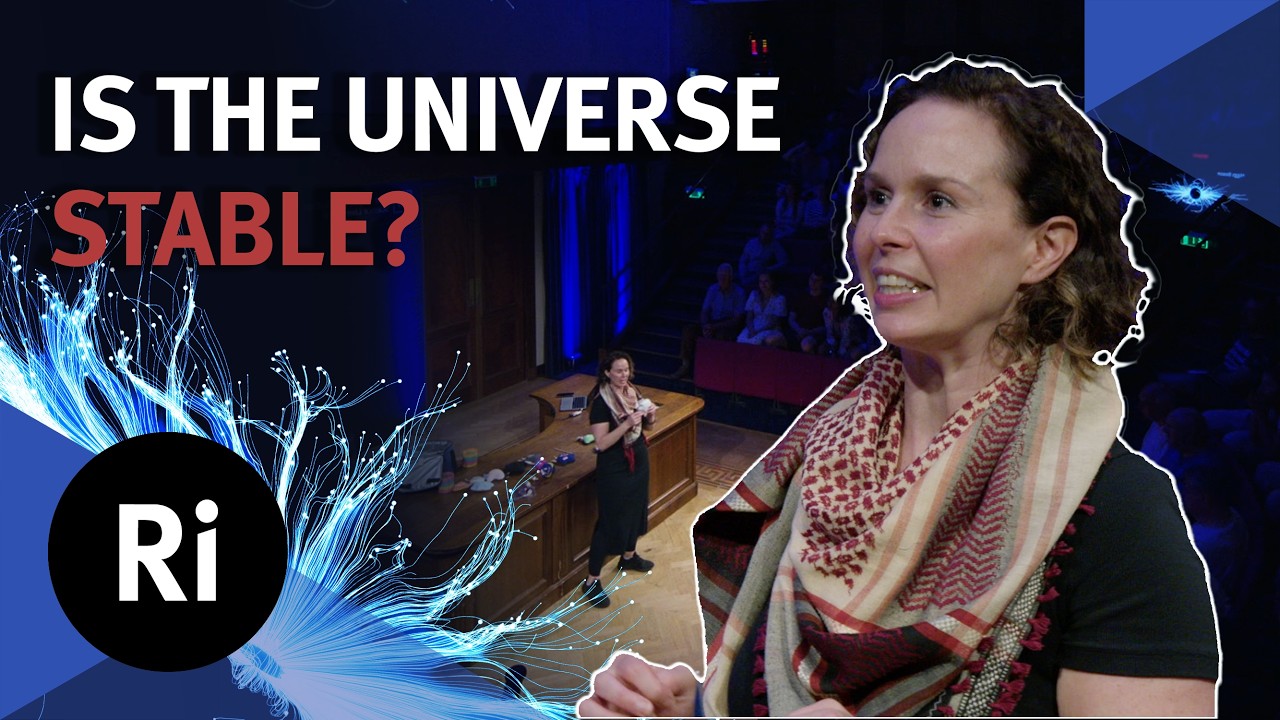
Is the top quark a threat to the universe? | with Kate Shaw
Keywords
Summary
200 words
Critical Evaluation
The lecture provides a comprehensive and engaging overview of particle physics, focusing on the top quark and its implications for vacuum stability. Kate Shaw demonstrates deep expertise and communicates complex concepts with clarity, using analogies and visual aids effectively. The historical context, from Rutherford’s gold foil experiment to the discovery of quarks, helps build a narrative that is accessible to a general audience while maintaining scientific rigor.
The scientific content is accurate and up-to-date, reflecting the current state of research on vacuum stability. Shaw correctly explains that the stability of the vacuum depends on the precise values of the top quark and Higgs boson masses, and she presents the current experimental uncertainties. She also appropriately notes that the Standard Model may not be the final theory, and that new physics could alter the predictions.
The argumentation is solid, with logical progression from the basics of particle physics to the more advanced topic of vacuum decay. Shaw is careful to distinguish between established facts and theoretical speculation, such as the possibility of a metastable vacuum. She also addresses the practical challenges of measuring the top quark mass and the need for future colliders like the FCC.
The sources cited are primarily the speaker’s own experience and the general scientific consensus, but specific references are not provided in the talk. However, the description includes links to the Royal Institution’s podcast and Q&A session, which may offer additional context. The talk is well-structured, with clear chapters, and the visual aids, including particle plushies, enhance understanding.
One minor issue is the audio quality, as some comments mention loud music and unclear speech, but this does not detract from the content. The title accurately reflects the content, and the lecture successfully addresses the question posed. Overall, this is a high-quality science communication piece that balances depth with accessibility.
303 words
Title / Content Match
The title is engaging and accurately reflects the central theme: the potential implications of the top quark mass for the stability of the universe.
Quality & Reliability
8/10
The talk is delivered by an experienced experimental particle physicist (Kate Shaw) with nearly 20 years on the ATLAS experiment. The content is based on established physics (Standard Model, Higgs mechanism, vacuum stability) and is presented with appropriate caveats. The lecture is aimed at a general audience but maintains scientific accuracy. The main limitations are the lack of detailed references and the simplified explanations, but the overall reliability is high.
Chapters
- Introduction
- Inside the ATLAS Experiment at CERN
- Why Smash Protons Together?
- From Atoms to Quarks: Building the Standard Model
- Quarks, Gluons and the Strong Force
- Colliding Protons and Hadronic Jets
- Discovering the Top Quark
- What Is the Higgs Field?
- Is the Universe Stable, Metastable, or Unstable?
- The Future Circular Collider
Cited Sources
- RI Science Podcast — Mentioned in the description as a resource for further science content.
- Q&A with Kate Shaw — Linked in the description as a follow-up Q&A session with the speaker.
Concurring Sources
- CERN's page on the Standard Model — Supports the description of the Standard Model and its particles.
- ATLAS Experiment official website — Provides information about the ATLAS experiment, which is central to the talk.
Dissenting Sources
- Some comments on the video — A few viewers noted issues with audio quality and the presentation of slides, but these are not scientific disagreements.
External References
Contribution & Novelties
The lecture provides a clear and accessible explanation of the top quark’s role in vacuum stability, a topic that is often discussed in specialized literature. It synthesizes current knowledge and highlights the importance of precise measurements. The talk also emphasizes the need for future colliders like the FCC to improve our understanding.
Pour aller plus loin :
- Vacuum instability on Wikipedia — Provides an overview of the concept and its implications.
- Top quark on Wikipedia — Detailed information about the top quark’s properties and measurement.
- Future Circular Collider study — Official CERN page on the proposed FCC project.
98 words
Radar Profile
The radar profile shows high scores in information quantity, quality, and reliability, with a slightly lower score in technical level, reflecting the talk's accessibility to a general audience. This indicates a well-balanced presentation that is both informative and scientifically sound.
💬 Positive, with a few constructive criticisms. Many viewers appreciated the lecture's clarity and depth, while some noted audio issues and the need for better slide visibility.