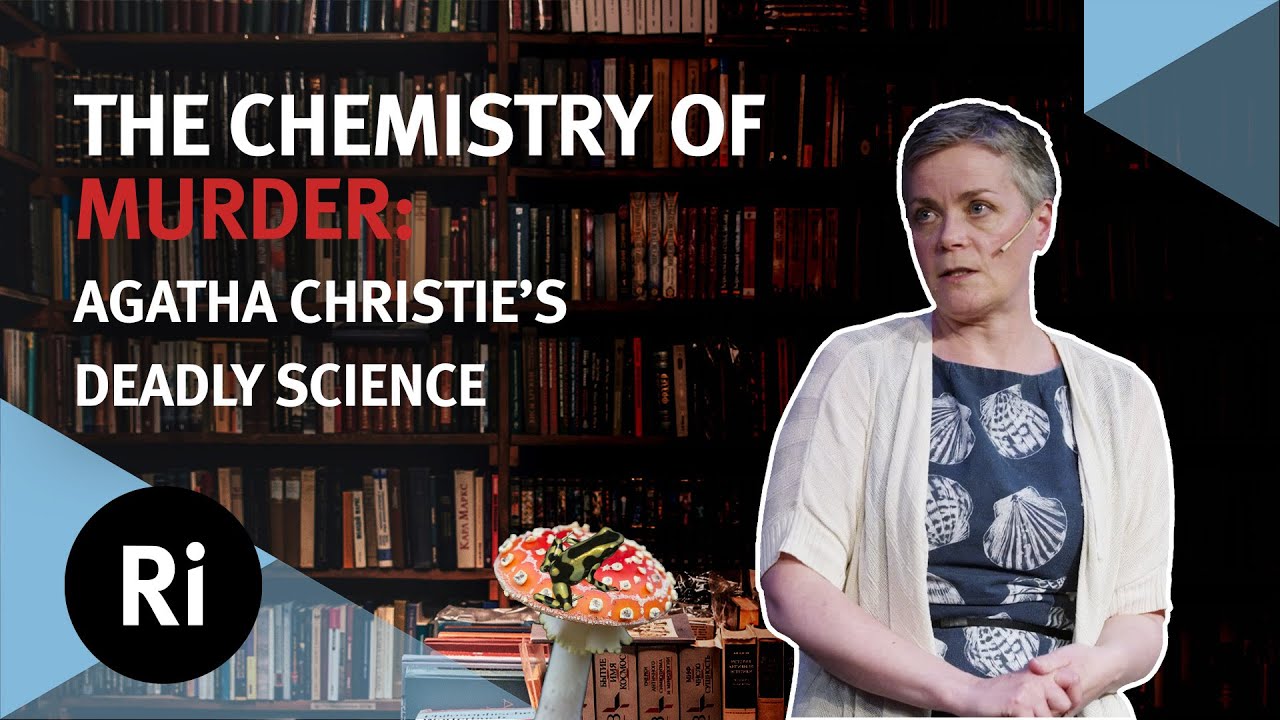
The science of murder: Agatha Christie's deadly poisons - with Kathryn Harkup
Keywords
Summary
155 words
Critical Evaluation
The lecture is an exemplary piece of science communication, blending historical narrative with chemical principles in an engaging and accessible manner. Kathryn Harkup’s expertise as a chemist and author is evident throughout, as she provides detailed explanations of the mechanisms of action for each poison, from cardiac glycosides affecting sodium-potassium pumps to the vasodilatory effects of nitroglycerine. The scientific content is accurate and well-contextualized, with references to historical figures like Dr. Livingstone and real cases that illustrate the practical applications and dangers of these substances.
The argumentation is solid, as Harkup systematically connects each poison to specific Christie stories, demonstrating how the author’s pharmaceutical training informed her writing. The lecture avoids oversimplification, offering nuanced discussions of dosage, solubility, and administration routes, which are crucial for understanding toxicity. The use of visual aids, including chemical structures and diagrams, enhances comprehension without overwhelming the audience.
The sources cited are primarily Harkup’s own books and general historical references, which are credible given her authority on the subject. However, the lecture does not provide explicit citations for all claims, which might be a minor limitation for those seeking to verify specific facts. Nevertheless, the overall reliability is high, and the content aligns with established toxicological knowledge.
The title accurately reflects the content, and the lecture delivers on its promise to explore the science behind Christie’s deadly poisons. The pacing is excellent, with clear transitions between topics, and Harkup’s engaging delivery, including subtle humor, keeps the audience attentive.
Public comments are overwhelmingly positive, with viewers praising Harkup’s communication skills and the lecture’s clarity. Many note that they were captivated despite not having a science background, indicating the talk’s broad appeal. Some comments highlight specific moments, such as the explanation of cardiac glycosides, as particularly enlightening. There is no significant criticism, and the few comments that mention technical issues (e.g., audience questions being inaudible) are not reflective of the lecture’s quality.
Overall, this lecture is a model of how to present scientific topics to a general audience, combining rigorous content with engaging storytelling. It successfully bridges the gap between literature and science, offering valuable insights into both Christie’s work and the chemistry of poisons.
358 words
Title / Content Match
The title accurately reflects the content, which explores the science behind poisons used in Agatha Christie's works.
Quality & Reliability
9/10
The lecture is delivered by a chemist and author with expertise in the subject, and it is based on documented historical and scientific facts. The content is well-researched, with references to specific cases and compounds. The Royal Institution is a reputable scientific organization, ensuring high production quality and editorial oversight.
Chapters
Cited Sources
- V is for Venom: Agatha Christie's Chemicals of Death — Book by Kathryn Harkup, mentioned as a resource for further reading.
- Q&A session (exclusive for Science Supporters) — Mentioned as a follow-up to the lecture.
- Ri Science Podcast — Mentioned in the description as related content.
- Editing Ri talks and moderating comments — Mentioned in the description as a policy page.
- Donate to the Ri — Mentioned in the description as a support link.
Concurring Sources
- Cardiac glycosides - Wikipedia — Confirms the mechanism of cardiac glycosides as described in the lecture.
- Nitroglycerin - Wikipedia — Supports the historical and chemical details about nitroglycerin.
- Chloral hydrate - Wikipedia — Confirms the sedative properties and historical use of chloral hydrate.
- Snake venom - Wikipedia — Provides background on snake venom composition and effects.
Contribution & Novelties
This lecture provides a unique interdisciplinary perspective, connecting classic literature with toxicology and chemistry. It highlights Agatha Christie’s accurate use of poisons, which is often overlooked in literary analysis. The talk offers detailed scientific explanations of each poison’s mechanism, making it accessible to a general audience. It also contextualizes the historical availability and use of these substances, adding depth to the understanding of Christie’s plots.
Pour aller plus loin :
- Cardiac glycosides - Wikipedia — Provides an overview of the class of compounds, including their mechanism and medical uses.
- Nitroglycerin - Wikipedia — Details the history, properties, and medical applications of nitroglycerin.
- Chloral hydrate - Wikipedia — Explains the sedative and hypnotic properties, as well as its historical use.
- Snake venom - Wikipedia — Discusses the composition and effects of snake venoms, including neurotoxins and hemotoxins.
- A is for Arsenic: The Poisons of Agatha Christie — Another book by Kathryn Harkup, covering more common poisons in Christie’s works.
158 words
Radar Profile
The radar profile shows high scores in quality of information and reliability, with slightly lower but still strong scores in quantity and technical level. This indicates a well-balanced lecture that is both informative and accessible, with a strong emphasis on accuracy and depth.
💬 Très positif : Les commentaires sont extrêmement élogieux, saluant la clarté, l'humour et la passion de la conférencière, ainsi que la qualité de la production. Sur les 30 commentaires analysés, la grande majorité exprime une admiration sincère et un intérêt renouvelé pour la science et la littérature.