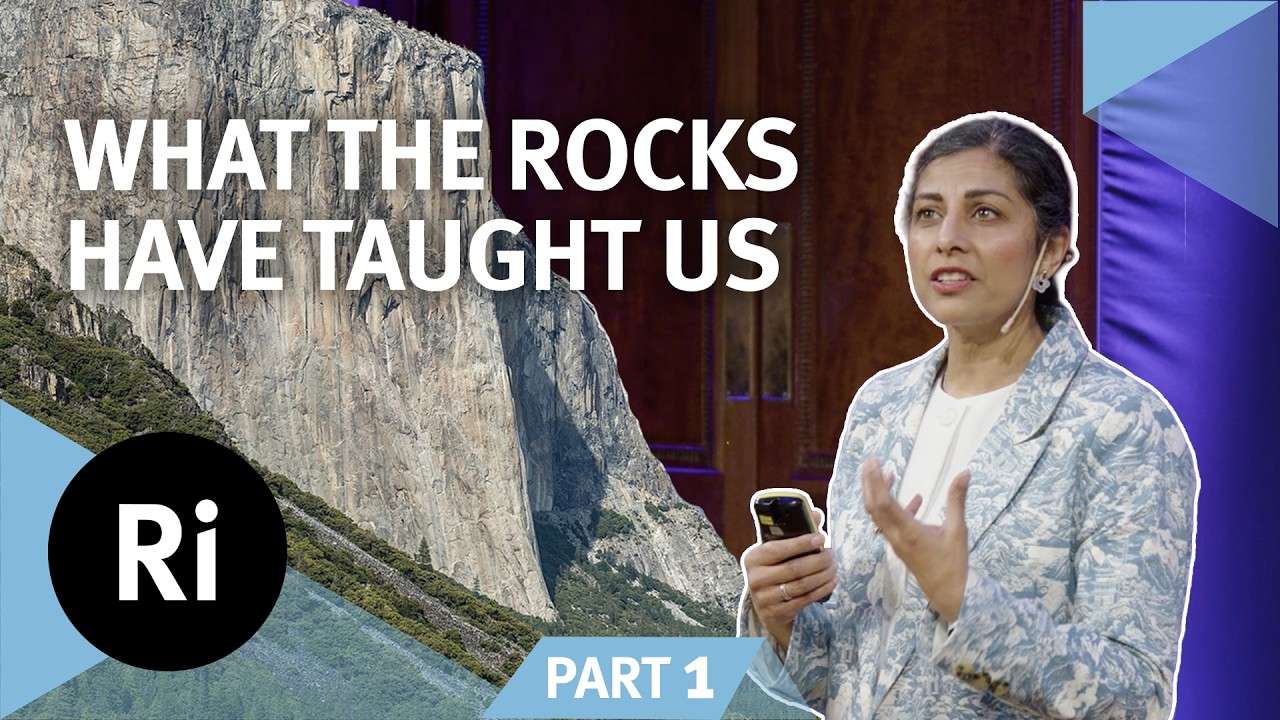
How geology built civilisation | with Anjana Khatwa | Part 1
Keywords
Summary
179 words
Critical Evaluation
The talk is a compelling blend of scientific explanation and cultural storytelling, delivered by an expert with clear passion for her subject. Khatwa’s scientific credibility is strong: she holds a PhD in earth sciences, has worked for universities and the Jurassic Coast World Heritage Site, and has received awards from the Royal Geographical Society and the Geological Society of London. The scientific content is accurate and well-presented, with clear explanations of geological processes such as the formation of sandstone and the rock cycle. The use of Petra as a case study effectively illustrates how geological history can be read in the landscape. The integration of indigenous knowledge is handled respectfully, drawing parallels between traditional practices and scientific observation without conflating them. However, the talk is more of an introduction to these themes than a deep dive, and some concepts are simplified for a general audience. The personal anecdotes, while engaging, sometimes overshadow the scientific content. The talk does not present new research but rather synthesizes existing knowledge in an accessible way. The title ‘How geology built civilisation’ is somewhat broad, and the talk focuses more on cultural connections than on the direct role of geology in building civilizations, though it touches on this through examples like the gold rush. Overall, the talk is informative and inspiring, successfully making the case for a deeper appreciation of geology.
226 words
Title / Content Match
The title accurately reflects the content, which explores how geology has shaped human civilization through cultural and scientific lenses.
Quality & Reliability
8/10
The speaker is an award-winning earth scientist with extensive professional experience. The content is well-structured, combining scientific explanations with cultural narratives. The scientific claims are accurate and presented with appropriate nuance, though some concepts are simplified for a general audience.
Chapters
- Introduction — can rocks speak?
- The Whispers of Rock: the book
- Inside the caves of Petra, Jordan
- How a 500-million-year-old sandstone forms
- Why the rock glows with colour
- What makes a geologist?
- Indigenous wisdom as science
- Delicate Arch and the vision quest
- Anjana's Hindu roots and Mataji
- Why we've lost our connection to rocks
- The rock cycle explained
- Mount Fuji and Shinto creation myths
- How Japan's people made sense of volcanoes
- The Sierra Nevada and the gold rush
- Half Dome and the Awinichie story
- The lichen that proves the legend
Cited Sources
- The Whispers of Rock: Stories from the Earth (book) — Anjana Khatwa's book, which the talk is based on, exploring the intersection of earth science and indigenous wisdom.
- Ri Science Podcast — The Royal Institution's podcast, mentioned in the video description as a related resource.
- Part 2 of this talk — The second part of the talk, continuing the exploration of geology and civilization.
Concurring Sources
- The Whispers of Rock: Stories from the Earth (book) — The book expands on the themes presented in the talk, providing more detailed stories and scientific explanations.
External References
Contribution & Novelties
The talk offers a unique perspective by blending geological science with indigenous and cultural narratives, encouraging a more holistic understanding of rocks. It emphasizes the importance of reconnecting with the geological world, which is often overlooked in discussions about the environment.
Pour aller plus loin :
- Rock cycle — Provides a comprehensive overview of the processes that form and transform rocks.
- Petra — Detailed information about the archaeological site and its geological context.
- Indigenous knowledge — Explores the concept of traditional knowledge and its value in scientific contexts.
88 words
Radar Profile
The radar profile shows high scores in quantity and quality of information, reflecting the talk's rich content and accurate science. The technical level is moderate, suitable for a general audience, while reliability is high due to the speaker's expertise. Overall, the talk is well-balanced and informative.