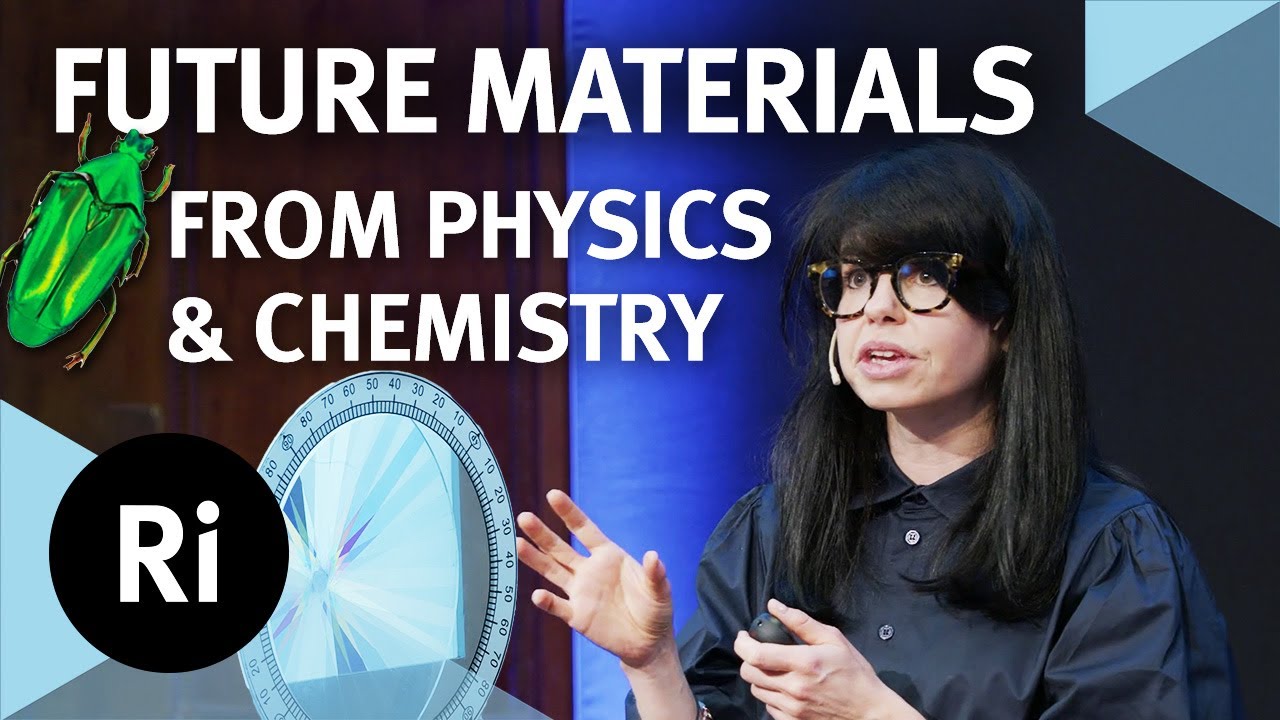
How materials science could revolutionise technology - with Jess Wade
Keywords
Summary
186 words
Critical Evaluation
The lecture is a masterclass in science communication, delivered by an expert who is clearly passionate about her field. Jess Wade’s presentation is well-structured, progressing from broad societal challenges to specific scientific concepts, and finally to potential applications. The scientific content is rigorous, with accurate explanations of chirality, spin, and materials properties, and it is supported by references to key researchers and historical developments. Wade’s ability to make complex topics accessible without oversimplifying is commendable; she uses analogies and visual aids effectively. The talk is also notable for its emphasis on the interdisciplinary nature of materials science and the importance of creativity, which is often overlooked in technical fields. The sources cited, including the Royal Institution’s own resources and the Q&A session, are credible. The only minor criticism is that some parts, such as the historical digressions, could be seen as tangential, but they enrich the narrative and humanize the science. Overall, this is an excellent lecture that informs and inspires, and it is highly recommended for anyone interested in the future of technology.
174 words
Title / Content Match
The title accurately reflects the content: the lecture focuses on how materials science, particularly chirality, can drive future technological innovations.
Quality & Reliability
9/10
Lecture by a recognized expert (Jess Wade, Royal Society University Research Fellow) at a prestigious institution (Royal Institution). Content is well-structured, technically accurate, and supported by references to historical and contemporary research. The talk is up-to-date (2025) and addresses current challenges in materials science.
Key Moments
Markers derived by PSI from the transcript: the creator did not define chapters.
- Introduction: Jess Wade outlines the talk's focus on materials science for tomorrow's technologies.
- Discussion of technology evolution and the unchanged design of solar panels since the 1950s.
- Highlighting supply chain issues and critical elements for technologies.
- Introduction of chirality as a key concept for controlling electron and photon spin.
- Examples of materials science in everyday life: carbon-plated shoes, graphene tennis rackets, induction hobs.
- Historical interlude: Brunelleschi's dome and the connection between art and science.
- Mildred Dresselhaus and her contributions to carbon allotrope research.
- Deep dive into chirality: how it works and its potential in optoelectronics and spintronics.
- Applications in quantum technologies and the challenges of cooling superconductors.
- Conclusion: call for interdisciplinary education and creativity in science.
Cited Sources
- Ri Science Podcast — Mentioned as a resource for further exploration.
- Ri Editorial Policy — Referenced in the description for transparency on talk editing.
- Donate to the Ri — Support the Royal Institution's public engagement.
- Q&A Session (exclusive for Science Supporters) — Companion video with extended discussion.
Concurring Sources
- Royal Institution — Institution hosting the lecture, known for high-quality science communication.
Contribution & Novelties
This lecture provides a comprehensive and accessible overview of how chirality can be harnessed for next-generation technologies, bridging fundamental chemistry with practical applications in optoelectronics, spintronics, and quantum computing. It uniquely combines technical depth with a humanistic perspective, highlighting the importance of creativity and interdisciplinary thinking in materials science.
Pour aller plus loin :
- Chirality (Wikipedia) — Foundational concept explained.
- Spintronics (Wikipedia) — Directly related to the talk’s focus on electron spin.
- Mildred Dresselhaus (Wikipedia) — Key figure mentioned in the lecture.
- Optoelectronics (Wikipedia) — Application area discussed.
- Quantum computing (Wikipedia) — Context for technological challenges.
96 words
Radar Profile
The radar profile shows high scores across all dimensions, with particularly strong performance in information quality and reliability, reflecting the expert presenter and rigorous content. The slightly lower score in technical level indicates that while the talk is detailed, it remains accessible to a broad audience.
💬 Très positif. Sur les 30 commentaires analysés, l'audience exprime un enthousiasme marqué pour la clarté, la passion et la richesse technique de la conférence, la qualifiant souvent de 'meilleure' ou 'fascinante'.