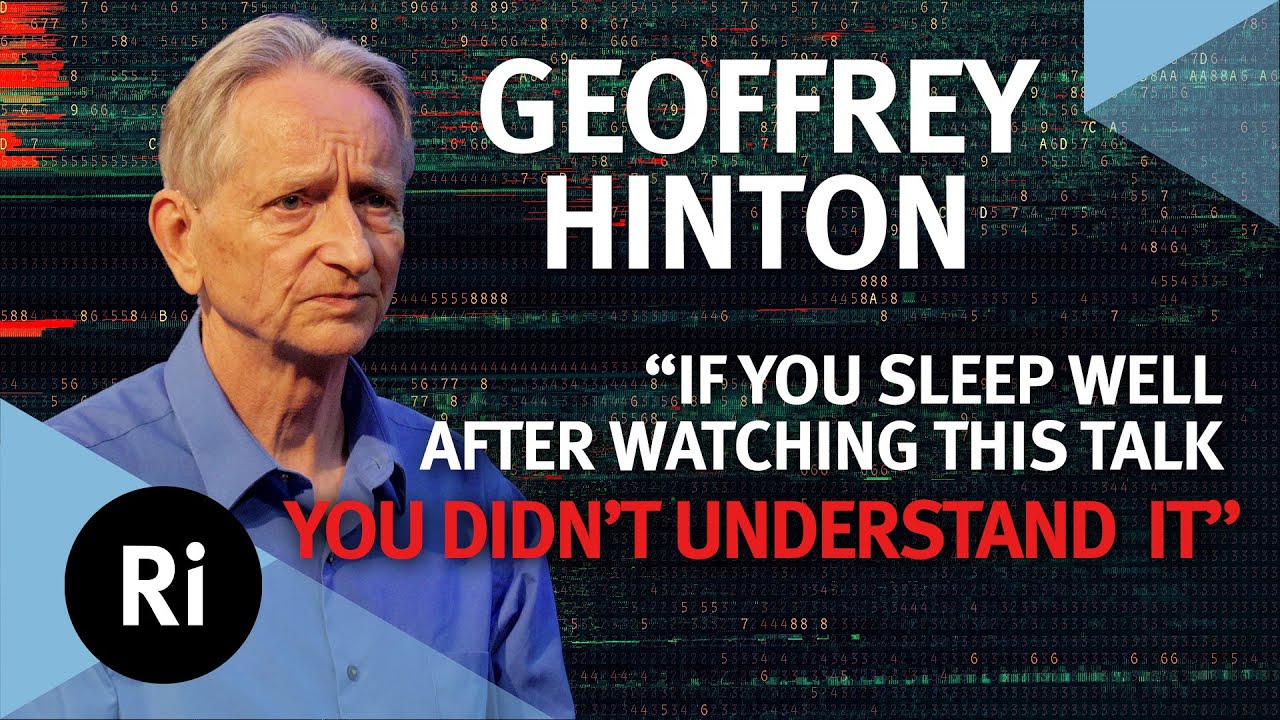
Will AI outsmart human intelligence? - with 'Godfather of AI' Geoffrey Hinton
Keywords
Summary
192 words
Critical Evaluation
Geoffrey Hinton’s lecture is a masterclass in explaining complex AI concepts to a general audience while maintaining scientific rigor. The talk is structured logically, starting with the historical dichotomy between symbolic and connectionist AI, then delving into the mechanics of neural networks, and finally addressing the broader implications. Hinton’s use of a simple model from 1985 to illustrate the principles behind modern LLMs is pedagogically effective, making abstract ideas tangible. He clearly explains backpropagation and the importance of learning features, and he convincingly argues that language is a modeling medium rather than a set of syntactic rules. His critique of Chomsky’s nativism is provocative but grounded in the success of neural networks in language tasks. The lecture’s strength lies in its clarity and the authority of the speaker; however, it is not a peer-reviewed presentation, and some claims, particularly about AI consciousness and existential risks, are speculative and based on personal opinion rather than empirical evidence. The talk is more of an expert perspective than a systematic review, but it is highly informative and thought-provoking. The title accurately reflects the content, and the lecture delivers on its promise to examine whether AI could outsmart human intelligence. The absence of formal citations is a minor weakness, but the speaker’s reputation and the institutional context lend credibility. Overall, this is an excellent talk that balances technical depth with accessibility, making it valuable for both newcomers and experts.
235 words
Title / Content Match
The title accurately reflects the content: Hinton discusses whether AI could surpass human intelligence, comparing biological and artificial systems.
Quality & Reliability
9/10
Lecture by a leading expert (Nobel laureate) with clear explanations and historical context. Some claims are speculative (e.g., AI surpassing human intelligence) but clearly presented as opinions. No formal citations during the talk, but the speaker's authority and the institutional setting (Royal Institution) support reliability.
Key Moments
Markers derived by PSI from the transcript: the creator did not define chapters.
- Introduction: Hinton contrasts logic-based AI with biologically inspired neural networks.
- Explanation of artificial neurons, weights, and the learning process.
- Discussion of backpropagation and its role in training neural networks.
- Introduction of the 1985 family tree model and its significance.
- Explanation of how the model learns semantic features and rules.
- Comparison of symbolic and connectionist approaches to meaning.
- Discussion of large language models and how they generate text.
- Critique of Chomsky's theory of innate grammar.
- Exploration of emergent abilities in AI and potential dangers.
- Discussion of subjective experience and consciousness in AI.
- Conclusion: Hinton's final thoughts on the future of AI and human intelligence.
Cited Sources
- Ri Science Podcast — Mentioned in the description as a related resource.
- Editing Ri Talks and Moderating Comments — Linked in the description, likely about the editing process.
- History of the Friday Evening Discourse — Provides background on the Discourse series where this talk was recorded.
- Donate to the Ri — Support page for the Royal Institution.
- Q&A Session for this Talk — Exclusive Q&A session for Science Supporters, mentioned in the description.
Concurring Sources
- Nobel Prize in Physics 2024 — Hinton was awarded the Nobel Prize for his work on neural networks, supporting his credibility.
Dissenting Sources
Contribution & Novelties
This lecture provides a unique perspective from a pioneer in deep learning, offering insights into the historical development and future trajectory of AI. Hinton’s ability to explain complex concepts with simple analogies makes it accessible. The talk also touches on philosophical questions about consciousness and intelligence, which are rarely addressed in technical talks.
Pour aller plus loin :
- Backpropagation — The core algorithm discussed, essential for understanding neural network training.
- Large language model — The technology behind modern chatbots, central to the talk.
- Artificial neural network — The foundational concept of the lecture.
- Geoffrey Hinton — Biographical information about the speaker.
- Royal Institution — The venue and its history.
109 words
Radar Profile
The radar profile shows high scores in quality and reliability, reflecting the speaker's expertise and clear presentation. The quantity of information is also high, though the technical level is moderate, making it accessible to a broad audience. The overall balance indicates a highly informative and credible talk.
💬 Très positif : Sur les 30 commentaires analysés, la grande majorité exprime une admiration pour la clarté et la profondeur de l'exposé de Geoffrey Hinton, avec des remarques sur ses analogies et son humour. Quelques commentaires soulèvent des inquiétudes sur les dangers de l'IA, mais dans l'ensemble, le ton est enthousiaste et respectueux.