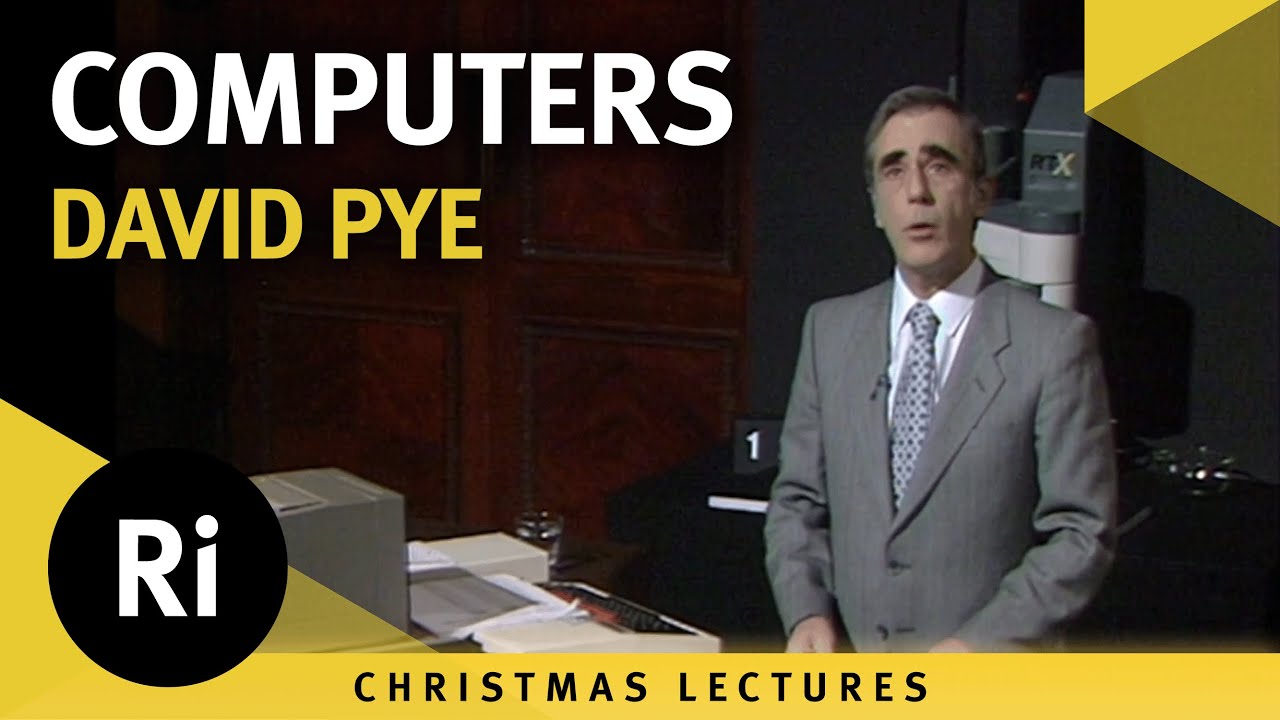
Computers – David Pye’s 1985 Christmas Lectures 6/6
Keywords
Summary
174 words
Critical Evaluation
The lecture provides a solid historical overview of computer development, accurately describing key milestones from mechanical calculators to early electronic computers. The demonstrations, such as the Pascal calculator and the EPROM model, effectively illustrate the concepts. The explanation of binary arithmetic and digital encoding is clear and accessible, making complex ideas understandable. The comparison between analog and digital transmission is particularly insightful, highlighting the advantages of digital signals in terms of noise immunity and regeneration. However, the lecture is dated, and some information, such as the expected 16-megabit chips, has been surpassed. The lack of explicit citations is a minor weakness, but the institutional context of the Royal Institution lends credibility. The argumentation is logical and well-structured, progressing from historical development to fundamental principles. The adéquation between title and content is excellent, as the lecture comprehensively covers the topic of computers. Overall, the lecture is a valuable educational resource, though its age limits its current relevance.
156 words
Title / Content Match
The title accurately reflects the content: a lecture on the development and principles of computers.
Quality & Reliability
8/10
Lecture by a professor at the Royal Institution, based on established principles of computer science and history. Demonstrations and explanations are accurate for the time, though some technical details are dated. Sources are not explicitly cited, but the institutional context and historical accuracy support reliability.
Key Moments
Markers derived by PSI from the transcript: the creator did not define chapters.
- Introduction to the lecture and the role of computers in communication.
- Demonstration of Pascal's mechanical calculator for addition and subtraction.
- Discussion of early electromechanical computers like the Harvard Mark I and code-breaking machines.
- Explanation of valve-based computers, their heat and reliability issues.
- Introduction of transistors and their advantages over valves.
- Development of integrated circuits and the first microchips.
- Demonstration of a quarter-million-transistor EPROM and future miniaturization trends.
- Comparison of computing power between a chip and an ant's brain.
- Explanation of binary arithmetic and how computers represent information.
- Demonstration of digital encoding of a wave and comparison with analog transmission.
- Advantages of digital transmission, including noise immunity and regeneration.
- Potential applications of computers, including data banks and robotics.
Cited Sources
- Christmas Lectures playlist — Link to all lectures in this series.
- Newest Christmas lectures — Link to more recent Christmas lectures.
- RI Science Podcast — Podcast from the Royal Institution.
- Royal Institution Christmas Lectures page — Official page for the Christmas Lectures.
- RI editing and moderating comments policy — Policy for comments on RI videos.
- Donate to the Royal Institution — Support page for the Royal Institution.
Concurring Sources
- History of computing hardware — Supports the historical timeline presented.
- Transistor — Confirms the role of transistors in computer development.
- Integrated circuit — Validates the progression to microchips.
Dissenting Sources
- Moore's law — The lecture's prediction of 16-megabit chips within a couple of years was optimistic; actual development took longer, but Moore's law generally supports the trend.
Contribution & Novelties
This lecture provides a historical perspective on computer development from the 1980s, offering insights into the state of technology at that time. It explains fundamental concepts such as binary representation and digital transmission in an accessible manner. The comparison between biological and silicon-based computing is thought-provoking.
Pour aller plus loin :
- History of computing hardware — Overview of the evolution of computers.
- Transistor — Key component in computer evolution.
- Integrated circuit — Foundation of modern computers.
- Binary number system — Essential concept explained in the lecture.
- Digital signal processing — Related to the digital transmission discussion.
96 words
Radar Profile
The radar profile shows high scores in information quantity, quality, and reliability, with a slightly lower technical level, indicating a well-balanced lecture that is informative and credible but not overly technical.