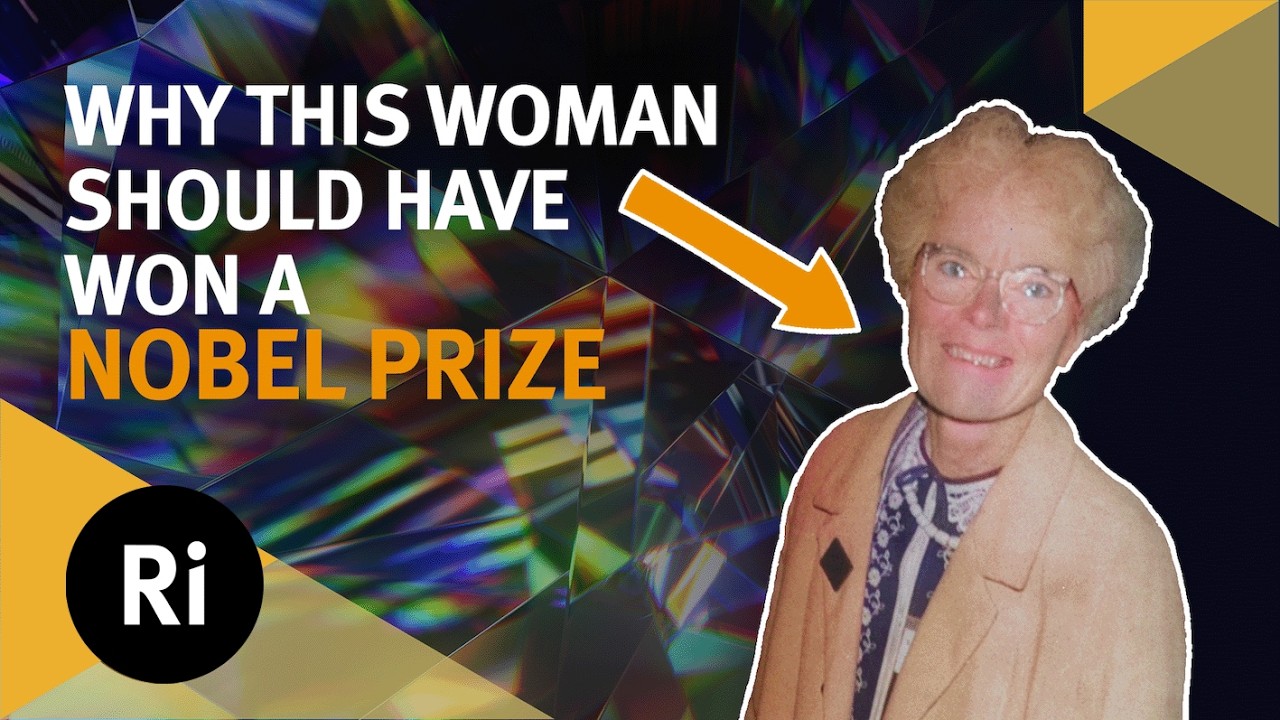
How one woman solved the 200-year old mystery of Benzene
Keywords
Summary
146 words
Critical Evaluation
The video is an excellent scientific documentary that successfully combines historical narrative with technical explanation. The choice of experts, Judith Howard and Judy Wu, adds credibility, as both are established chemists with relevant expertise in crystallography and aromaticity. The explanation of X-ray crystallography is clear and accessible, using analogies like wallpaper patterns and OS maps to convey complex concepts. The historical context is well-researched, accurately depicting the evolution of benzene structure theories from Kekulé to Lonsdale. The video’s strength lies in its ability to highlight Lonsdale’s methodological innovation—the application of Fourier analysis to X-ray diffraction data—which was crucial for solving the structure. This is presented as a major leap forward, enabling future discoveries such as DNA and penicillin structures. The production quality is high, with engaging visuals and archival footage. However, the video could have delved deeper into the technical details of Fourier synthesis and the specific challenges of the calculations, but it strikes a good balance for a general audience. The adéquation between title and content is excellent, as the video indeed focuses on Lonsdale’s role in solving the benzene mystery. The inclusion of her personal story, including her work from home and her achievements as a woman in science, adds a human dimension without detracting from the scientific content. Overall, the video is rigorous, informative, and inspiring, making it a valuable resource for anyone interested in the history of chemistry and crystallography.
234 words
Title / Content Match
The title accurately reflects the content, focusing on Kathleen Lonsdale's contribution to solving the benzene structure.
Quality & Reliability
9/10
The video features two expert chemists (Judith Howard, FRS, and Judy Wu) who provide accurate historical and scientific context, and it is produced by the Royal Institution, a reputable scientific organization. The content is well-researched and aligns with established knowledge in crystallography and chemistry.
Key Moments
Markers derived by PSI from the transcript: the creator did not define chapters.
- Introduction to crystals and the challenge of seeing inside them.
- Explanation of X-ray diffraction and its use in determining atomic structure.
- Kathleen Lonsdale's early career at the Royal Institution under William Henry Bragg.
- Historical background on benzene and its mysterious properties.
- Various proposed structures of benzene by Kekulé, Claus, Ladenburg, and others.
- The puzzle of benzene's reactivity and isomer counts.
- Lonsdale's use of Fourier analysis to solve the crystal structure of hexamethylbenzene.
- The significance of Lonsdale's work for future discoveries in chemistry and biology.
- Lonsdale's contributions to the International Tables and her legacy.
Cited Sources
- RI Science Podcast — Mentioned in the video description as a related resource.
- Editing RI Talks and Moderating Comments — Linked in the description for information about video editing and comments.
- Donate to the Royal Institution — Linked in the description for supporting the institution.
- Judy Wu's lecture on Kathleen Lonsdale — Referenced in the description as a further lecture by Judy Wu.
- Kathleen Lonsdale's 1970 lecture at the Royal Institution — Referenced in the description as an original lecture by Lonsdale.
Concurring Sources
- Kathleen Lonsdale - Wikipedia — Provides biographical details and confirms her achievements.
- X-ray crystallography - Wikipedia — Explains the technique and its development.
Contribution & Novelties
The video provides a compelling narrative of Kathleen Lonsdale’s scientific achievements, highlighting her innovative use of Fourier analysis in X-ray crystallography. It underscores the importance of her work in establishing the flat, hexagonal structure of benzene, which resolved a long-standing mystery. The documentary also brings attention to her contributions to the International Tables, which remain essential tools in crystallography. By featuring contemporary chemists, it connects historical breakthroughs to modern research, emphasizing the lasting impact of Lonsdale’s methods.
Pour aller plus loin :
- X-ray crystallography — Provides an overview of the technique and its history.
- Fourier analysis — Explains the mathematical method used by Lonsdale.
- Benzene — Details the chemical properties and historical significance of benzene.
- Kathleen Lonsdale — Biographical information about the scientist.
123 words
Radar Profile
The radar profile shows high scores in quality and reliability, with slightly lower but still strong scores in quantity and technical level. This indicates a well-balanced video that is both informative and accessible, with a strong emphasis on accurate scientific content.
💬 Sur les 0 commentaires analysés, aucune tendance n'a pu être dégagée.