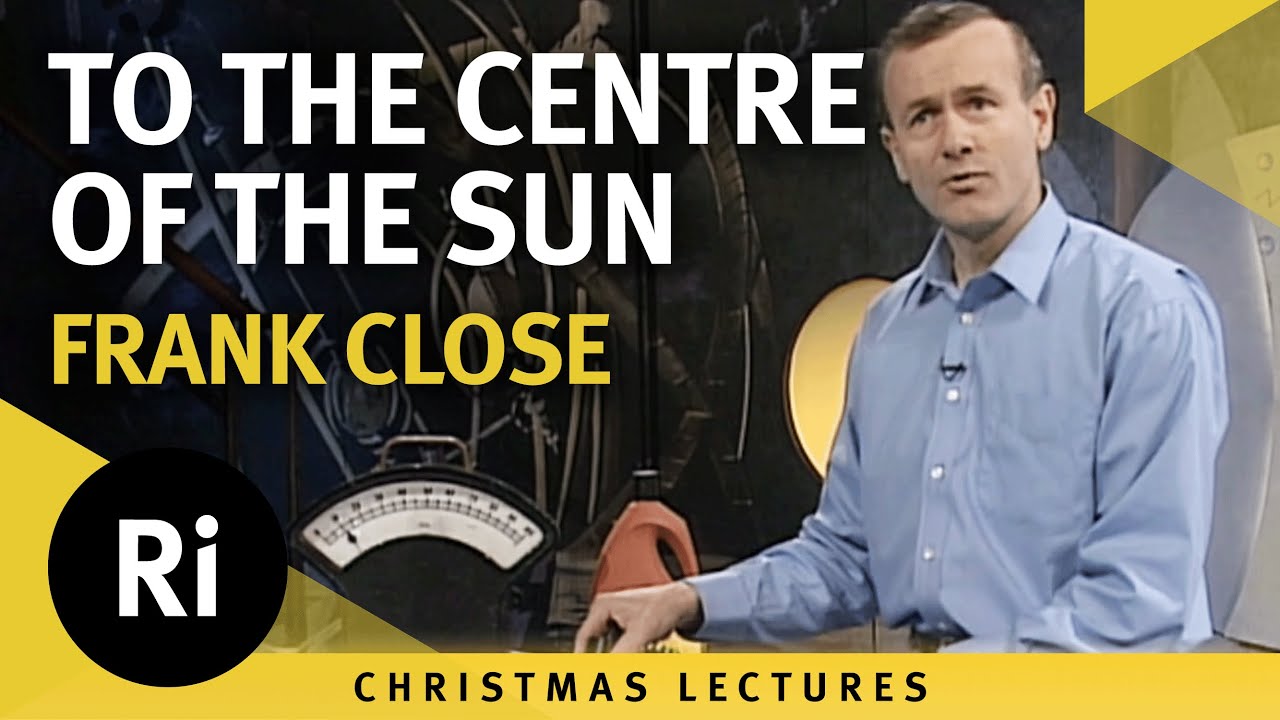
To the centre of the sun - Frank Close 1993 Christmas Lectures 2/5
Keywords
Summary
155 words
Critical Evaluation
This lecture is an exemplary piece of science communication, blending historical narrative with live demonstrations to explain complex physics. Frank Close, a distinguished physicist, delivers the content with clarity and enthusiasm, making it accessible without sacrificing scientific rigor. The demonstrations, such as the glowing cannonball and the cloud chamber, are effective in illustrating abstract concepts like temperature and radiation. The historical context, from Lord Kelvin’s calculations to the discoveries of the Curies and Rutherford, is accurately presented and helps build a coherent story. The lecture’s strength lies in its ability to convey the process of scientific discovery, showing how evidence accumulates and theories evolve. The sources cited are primarily the Royal Institution’s own resources, which are reliable. The content is well-structured, progressing logically from observation to hypothesis to the eventual solution. The only minor weakness is that the lecture stops before fully explaining the details of nuclear fusion, but this is appropriate for the series’ format. Overall, this is a high-quality educational resource that effectively communicates the fundamentals of solar physics and the history of nuclear science.
177 words
Title / Content Match
The title accurately reflects the content, which explores the journey to the center of the sun and the nuclear processes that power it.
Quality & Reliability
9/10
Lecture by a renowned physicist (Frank Close) at the Royal Institution, with historical accuracy and clear explanations. The content is based on established physics and historical discoveries, with no apparent misinformation.
Key Moments
Markers derived by PSI from the transcript: the creator did not define chapters.
- Introduction to the sun as a nuclear reactor and the two journeys: to the center of the sun and back to the early universe.
- Demonstration of how color indicates temperature using a heated cannonball.
- Explanation of spectroscopy and the discovery of helium in the sun's spectrum.
- Discussion of Lord Kelvin's calculations showing that chemical and gravitational energy sources are insufficient for the sun's age.
- Introduction to radioactivity as a new clue, with demonstrations using a Geiger counter on common objects.
- Demonstration of alpha and beta radiation using different shielding materials.
- Explanation of the cloud chamber and how it visualizes particle tracks.
Cited Sources
- Royal Institution Christmas Lectures — Official page for the Christmas Lectures series, providing context and history.
- RI Science Podcast — Podcast from the Royal Institution, offering related science content.
- Editing RI Talks and Moderating Comments — Information about how the Royal Institution moderates comments on their videos.
- Support the Royal Institution — Donation page for the Royal Institution, mentioned in the video description.
- Christmas Lectures playlist — Playlist of the 1993 Christmas Lectures series.
- Newest Christmas Lectures playlist — Playlist of the most recent Christmas Lectures.
Concurring Sources
- Royal Institution Christmas Lectures — The official page confirms the lecture series and its educational purpose.
Contribution & Novelties
This lecture provides a historical and experimental perspective on how we came to understand the sun’s energy source, bridging the gap between observation and theory. It offers a unique blend of live demonstrations and narrative that makes complex physics accessible.
Pour aller plus loin :
- Nuclear fusion — Overview of the process that powers the sun.
- Radioactive decay — Explanation of the types of radiation discussed.
- Cloud chamber — Details on the device used to visualize particle tracks.
- Spectroscopy — Technique used to analyze the sun’s composition.
87 words
Radar Profile
The radar profile shows high scores across all dimensions, indicating a well-rounded and reliable educational content. The lecture excels in information quantity and quality, with a strong technical level appropriate for a general audience.