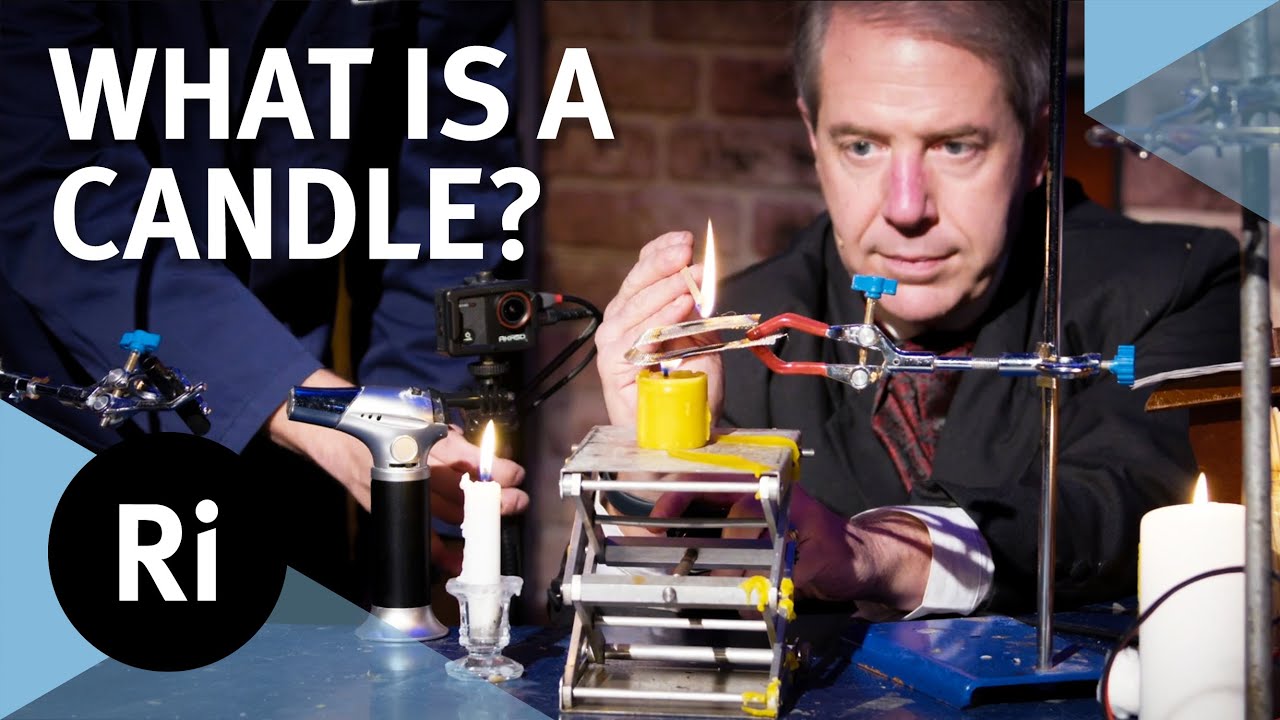
The chemical history of a candle - with David Ricketts
Keywords
Summary
171 words
Critical Evaluation
The lecture is an excellent example of science communication, blending historical context with modern demonstrations. The content is scientifically accurate, and the demonstrations are well-chosen to illustrate key concepts. The presenter, David Ricketts, is engaging and knowledgeable, and the support from the Ri demo team is professional. The lecture successfully conveys the principles of combustion, capillary action, and the role of air flow in flame shape. The use of Faraday’s original notebook adds authenticity and a sense of history. The demonstrations are visually striking and effectively illustrate the concepts. The lecture is well-structured, progressing logically from the question of what burns to the products of combustion. The only minor criticism is that some demonstrations may be difficult to see for those in the back of the auditorium, but the use of cameras helps mitigate this. Overall, this is a high-quality educational presentation that honors Faraday’s legacy while making the science accessible to a modern audience.
155 words
Title / Content Match
The title accurately reflects the content, which is a modern reenactment of Faraday's chemical history of a candle.
Quality & Reliability
8/10
The lecture is based on Michael Faraday's original Christmas lectures, with demonstrations and explanations grounded in established chemistry and physics. The presenter is an accomplished academic, and the Royal Institution is a reputable institution. The content is accurate and well-presented, with a focus on educational value.
Key Moments
Markers derived by PSI from the transcript: the creator did not define chapters.
- Introduction and tribute to Faraday
- Demonstration that solid wax does not burn
- Demonstration that vapor is what burns
- Reigniting a candle from its vapor
- Splitting a flame with a wire mesh
- Explanation of flame shape and air flow
- Capillary action demonstration with salt
- Burning wax vapor demonstration
- Products of combustion: water and carbon dioxide
- Conclusion and final remarks
Cited Sources
- Ri Science Podcast — Mentioned in the description as a resource for further science content.
- Ri Talks editing and comments policy — Linked in the description, relevant to the lecture's context.
- Support the Ri — Linked in the description, a call to support the institution.
Concurring Sources
- Michael Faraday's Chemical History of a Candle — The original lecture text, which this presentation is based on.
Contribution & Novelties
This lecture provides a modern reinterpretation of Faraday’s classic, with updated demonstrations and explanations. It makes the science accessible to a contemporary audience while preserving the historical spirit. The lecture emphasizes the importance of observation and experimentation in understanding natural phenomena.
Pour aller plus loin :
- Michael Faraday’s original lecture text — The full text of Faraday’s ‘Chemical History of a Candle’ is available on Project Gutenberg.
- Capillary action — Wikipedia article explaining the phenomenon demonstrated with the wick.
- Davy lamp — Wikipedia article on the safety lamp invented by Humphry Davy, referenced in the wire mesh demonstration.
98 words
Radar Profile
The radar profile shows high scores in information quantity and quality, indicating a content-rich and accurate presentation. The technical level is moderate, making it accessible to a general audience while still providing depth. The overall reliability is high, consistent with the reputation of the Royal Institution.
💬 Positif. Sur les 30 commentaires analysés, le public exprime une forte appréciation, avec des éloges pour la démonstration et la nostalgie des conférences de Noël.