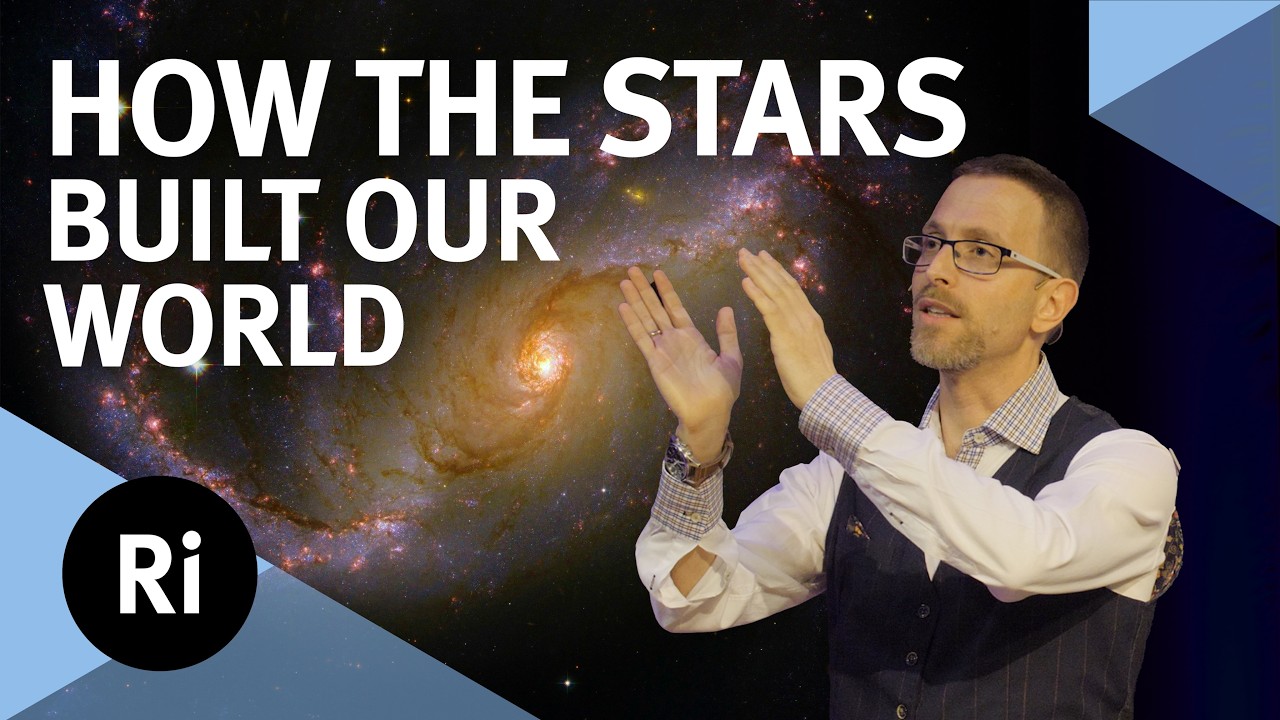
How the stars made us - with Roberto Trotta
Keywords
Summary
174 words
Critical Evaluation
The lecture is a compelling and well-argued exploration of the cultural and historical impact of astronomy. Trotta, a theoretical physicist, brings a unique perspective, blending scientific knowledge with historical and anthropological insights. The narrative is engaging and accessible, making complex ideas understandable without oversimplifying. He uses a variety of examples, from ancient megalithic structures to modern technology, to illustrate his points. The argument is well-structured, building from personal experience to broader historical analysis. However, as a popular science lecture, it does not provide in-depth citations for all claims, and some historical interpretations may be simplified. The focus is on the humanistic and cultural aspects rather than rigorous scientific detail, which is appropriate for the intended audience. The lecture is based on his book ‘Starborn’, which has been well-received, adding to its credibility. The inclusion of a hypothetical scenario (Caligo) is a creative and effective pedagogical tool, though it is speculative. Overall, the lecture is informative and thought-provoking, successfully demonstrating the profound influence of stars on human society.
167 words
Title / Content Match
The title accurately reflects the content, which explores the multifaceted influence of stars on human history and culture.
Quality & Reliability
8/10
The lecture is delivered by a professor of theoretical physics, Roberto Trotta, and is based on his book 'Starborn'. It presents a well-structured narrative supported by historical and scientific references, though it is a popular science lecture rather than a peer-reviewed source.
Key Moments
Markers derived by PSI from the transcript: the creator did not define chapters.
- Introduction: Trotta shares his personal story of a failed astronomy observation and his shift to theoretical physics.
- Visit to Callanish Stone Circle and the realization of the stars' impact on human history.
- Introduction of Caligo, a hypothetical cloud-covered planet, and its implications.
- Discussion on the cyclical nature of stars and their role in timekeeping and calendars.
- The influence of stars on religion and spirituality, with examples from various cultures.
- Historical impact of astronomical events like eclipses and comets on human psychology and history.
- The development of astronomical clocks and their contribution to the Scientific Revolution.
- The role of stars in navigation, from ancient mariners to Captain Cook's voyages.
- The star rating system and the five-pointed star symbol, tracing their ancient origins.
- Conclusion: The potential role of stars in our future survival and the search for extraterrestrial life.
Cited Sources
- Starborn: How the Stars Made Us (and Who We Would Be Without Them) — Roberto Trotta's book, which this lecture is based on.
- Q&A with Roberto Trotta — Exclusive Q&A session for Science Supporters, complementing the lecture.
- Ri Podcast — The Royal Institution's podcast, where related discussions may be found.
- Editing Ri Talks and Moderating Comments — Information about the Ri's editorial process for talks and comments.
- Donate to the Ri — Support the Royal Institution's charitable work.
Concurring Sources
- Starborn: How the Stars Made Us — The book by Roberto Trotta, which the lecture is based on, provides a more detailed exploration of the same themes.
Contribution & Novelties
This lecture offers a unique interdisciplinary perspective on the influence of astronomy on human civilization, synthesizing history, culture, and science. It introduces the thought experiment of Caligo to highlight the profound dependence of human development on a visible starry sky. The lecture connects ancient practices like timekeeping and navigation to modern technologies and cultural symbols, providing a holistic view of our cosmic heritage.
Pour aller plus loin :
- Starborn: How the Stars Made Us — The book by Roberto Trotta that expands on the lecture’s themes.
- Callanish Stones — A Wikipedia article on the megalithic site mentioned in the lecture.
- Astronomical clock — A Wikipedia article on the history and mechanics of astronomical clocks.
- History of timekeeping devices — A Wikipedia article providing context on the evolution of timekeeping.
- Astrology and science — A Wikipedia article discussing the relationship between astrology and science.
143 words
Radar Profile
The radar profile shows high scores in quantity and quality of information, reflecting the lecture's rich content and engaging delivery. The technical level is moderate, making it accessible to a general audience while still offering depth. The overall reliability is high due to the speaker's expertise and the institutional backing of the Royal Institution.
💬 No comments were provided for analysis.