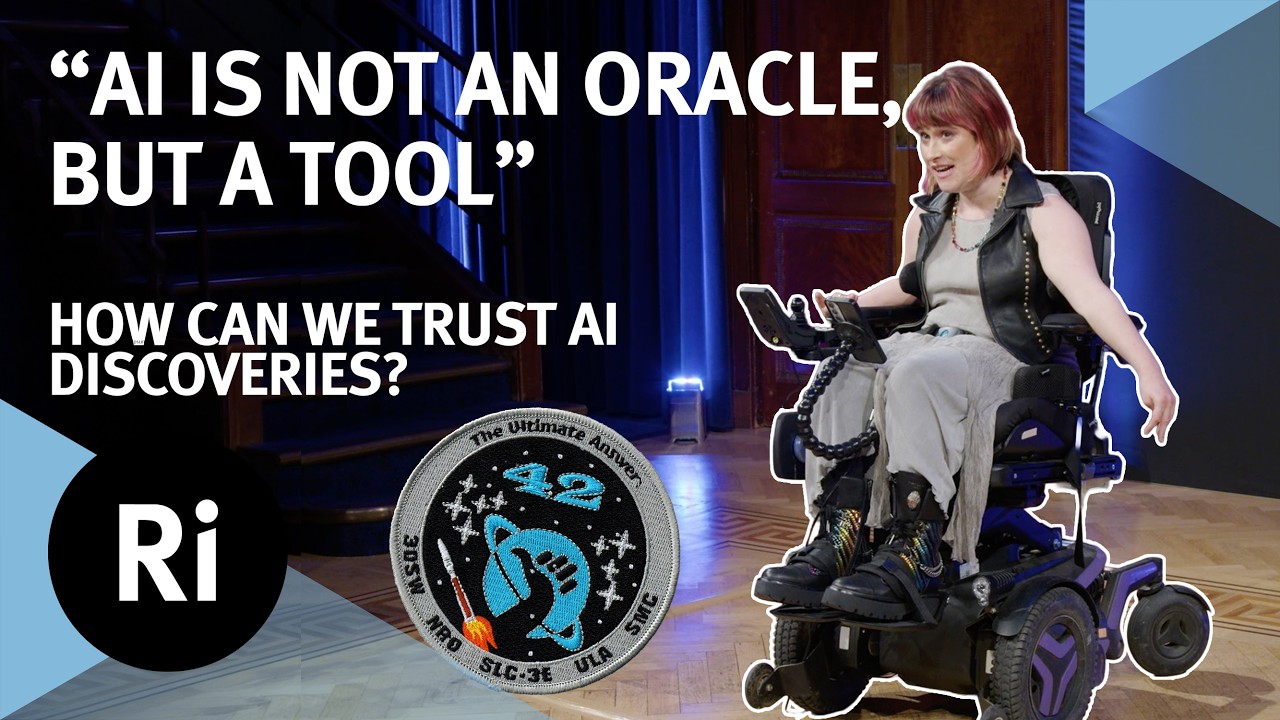
AI is solving science's biggest problems — but has no idea why it's right
Keywords
Summary
144 words
Critical Evaluation
The talk provides a clear and accessible overview of AI’s role in modern science, blending technical explanations with philosophical reflections. Malone’s expertise in particle physics lends credibility, and she effectively uses analogies (e.g., the volunteer sorting objects) to illustrate machine learning concepts. The discussion of transformer architecture and attention mechanisms is accurate and well-explained, though it simplifies complex ideas for a general audience. The philosophical framing, referencing the Vienna Circle and Popper, adds depth and situates AI within the broader context of scientific methodology. However, the talk lacks specific citations for its claims, and some examples (e.g., the probability wheel) are oversimplified. The title’s promise of addressing ‘why AI is right’ is only partially fulfilled; while Malone raises the question, she does not provide a definitive answer, instead highlighting the ongoing debate. The talk is more descriptive than critical, but it successfully stimulates thought about the nature of scientific discovery. Overall, it is a valuable resource for those interested in AI’s impact on science, though it could benefit from more rigorous sourcing and deeper analysis of counterarguments.
177 words
Title / Content Match
The title accurately reflects the central theme: AI's ability to solve scientific problems without understanding why, which is thoroughly explored.
Quality & Reliability
8/10
The talk is delivered by a particle physicist and science journalist with a PhD from CERN, providing credible expertise. It covers well-established concepts (e.g., transformer architecture, AlphaFold) and references key philosophical frameworks (Vienna Circle, Popper). However, it lacks detailed citations and relies on anecdotal examples, limiting its depth.
Chapters
- Introduction: AI and the Future of Scientific Discovery
- What Is Science? The Philosophy Behind the Method
- How Machine Learning and AI Actually Work
- How ChatGPT and Large Language Models Generate Text
- AlphaFold: How AI Solved a 50-Year Biology Problem
- How CERN Is Using AI to Analyse Particle Physics Data
- The Nobel Turing Challenge: Can AI Win a Nobel Prize?
- Why Current AI Can't Make True Scientific Discoveries
- Is AI a Scientific Collaborator or Just a Powerful Tool?
Cited Sources
- RI Science Podcast — Mentioned as a resource for further exploration.
- Royal Institution Membership — Support the Royal Institution's work.
- Editing RI Talks and Moderating Comments — Information about talk editing and comment moderation.
- Donate to the Royal Institution — Support the Royal Institution's activities.
Concurring Sources
- Attention Is All You Need — The paper introducing transformers, which the talk references as a breakthrough.
- AlphaFold — DeepMind's protein structure prediction, discussed as a major AI success in biology.
Dissenting Sources
- AI and the Limits of Understanding — Some researchers argue that AI's lack of causal understanding limits its ability to contribute to scientific theory, contrasting with the talk's optimistic view.
Contribution & Novelties
The talk offers a unique perspective by combining a working scientist’s experience at CERN with a philosophical analysis of AI’s role in science. It bridges the gap between technical AI concepts and the epistemological questions they raise, making it accessible to a broad audience. The discussion of AlphaFold and CERN’s use of AI provides concrete examples of AI’s impact, while the philosophical framework adds depth.
Pour aller plus loin :
- Attention Is All You Need — The seminal paper introducing the transformer architecture, central to the talk’s explanation of LLMs.
- AlphaFold — DeepMind’s protein structure prediction system, a key example of AI solving a long-standing scientific problem.
- Karl Popper — Stanford Encyclopedia of Philosophy entry on Popper’s falsificationism, relevant to the philosophical discussion.
- Vienna Circle — Stanford Encyclopedia of Philosophy entry on logical positivism, another philosophical reference in the talk.
140 words
Radar Profile
The radar profile shows high scores in information quantity and quality, with a moderate technical level. The talk is strong in providing accurate, well-structured information, but its technical depth is limited by the need to appeal to a general audience. The reliability is high due to the speaker's expertise, though the lack of detailed citations slightly reduces the score.