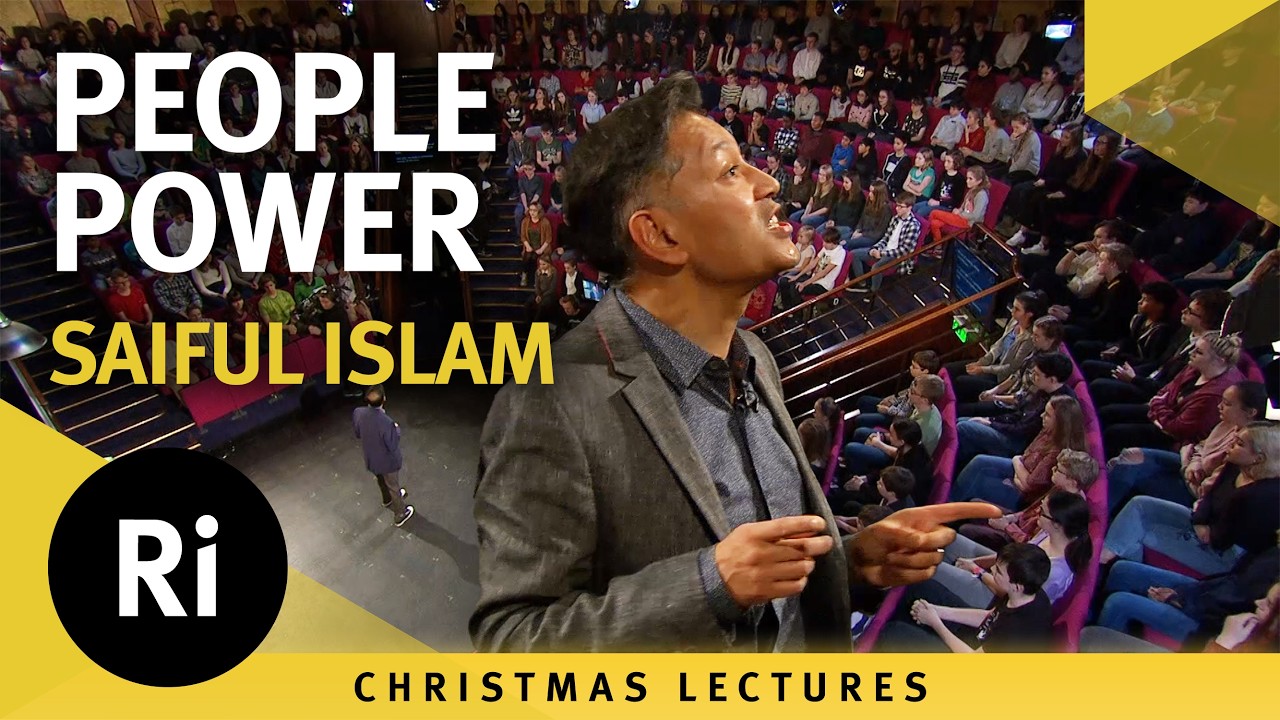
The human body as an energy system - 2016 CHRISTMAS LECTURES with Saiful Islam 2/3
Keywords
Summary
147 words
Critical Evaluation
The lecture provides a compelling and accessible introduction to the concept of the human body as an energy system. The presenter, Professor Saiful Islam, is a credible expert in chemistry, and the Royal Institution’s Christmas Lectures have a long-standing reputation for scientific rigor. The demonstrations are well-designed to illustrate key points: the infrared camera shows heat loss, the chest monitors quantify energy expenditure in real-time, and the food burning experiment visually compares energy content. The inclusion of a food diary and the weighing of intake and output provides a tangible link to metabolic processes. The lecture also touches on comparative biology with the goats, explaining ruminant digestion and the trade-off between food quality and quantity. However, the scientific depth is limited by the format; some explanations are simplified, and the energy measurements are approximate. The sources cited are primarily institutional pages, not specific research papers, which reduces the verifiability of the claims. Nevertheless, the lecture is scientifically sound and effectively communicates fundamental concepts of bioenergetics. The adéquation between title and content is excellent, as the lecture directly addresses the human body as an energy system. Overall, the lecture is informative and engaging, suitable for a general audience while maintaining scientific integrity.
201 words
Title / Content Match
The title accurately reflects the content, which focuses on the human body as an energy conversion system, with experiments and discussions on energy intake, expenditure, and efficiency.
Quality & Reliability
8/10
The lecture is presented by a professor of chemistry at a reputable institution, with live experiments and demonstrations. It includes references to past Christmas Lectures and uses scientific methods to measure energy expenditure. However, some demonstrations are simplified for a general audience, and the sources cited are mostly institutional pages rather than specific scientific papers.
Key Moments
Markers derived by PSI from the transcript: the creator did not define chapters.
- Introduction: heartbeat sounds, theme of energy conversion.
- Infrared camera demonstration showing audience heat.
- Setup of chest monitors for energy expenditure experiment.
- Introduction of 'movers and shakers' vs 'couch potatoes' groups.
- Food diary experiment: weighing weekly food intake.
- Weighing food output and discussion of energy balance.
- Great Energy Bake Off: burning sugar, protein, and fat.
- Comparison of energy content using AA batteries.
- Introduction of goats and explanation of ruminant digestion.
- Energy expenditure for various activities (piano, painting, walking).
Cited Sources
- Royal Institution Christmas Lectures — Mentioned as the series containing this lecture.
- Royal Institution Tumblr — Mentioned as a social media channel for the Royal Institution.
- Royal Institution Editorial Policy — Mentioned as the editorial policy for the Royal Institution's content.
Concurring Sources
- Human energy metabolism — Supports the concept of energy balance and expenditure.
- Bioenergetics — Provides background on energy conversion in living organisms.
Contribution & Novelties
The lecture offers a unique perspective on the human body as an energy system, using engaging demonstrations and live experiments to illustrate concepts of energy intake, expenditure, and efficiency. It bridges chemistry, biology, and physics, making complex ideas accessible to a general audience. The use of AA batteries as a unit of energy is an innovative pedagogical tool.
Pour aller plus loin :
- Human energy metabolism — Provides a comprehensive overview of energy balance in the human body.
- Bioenergetics — Explains the biochemical pathways of energy conversion.
- Ruminant digestion — Details the digestive system of ruminants and their ability to extract energy from plant material.
105 words
Radar Profile
The radar profile shows high scores in quantity and quality of information, with a moderate level of technical depth, indicating a well-balanced educational content. The reliability is high due to the credible presenter and institution.