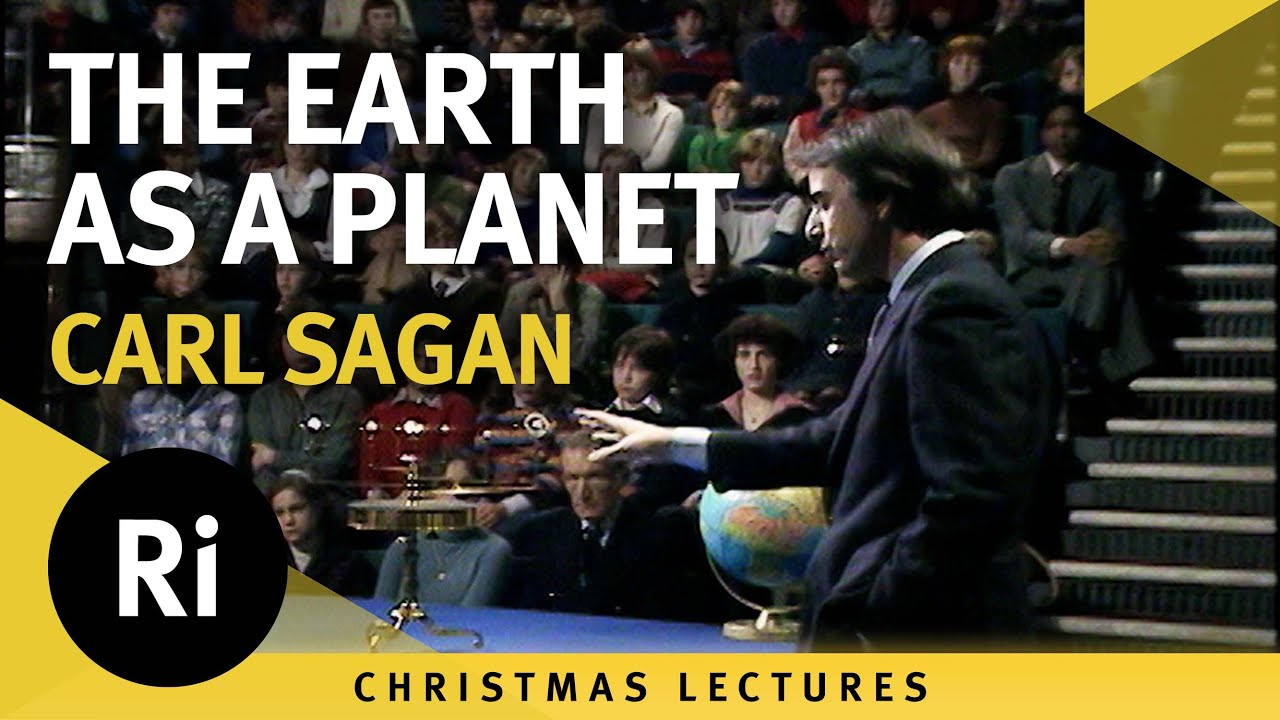
The earth as a planet - Carl Sagan's 1977 Christmas Lectures 1/6
Keywords
Summary
123 words
Critical Evaluation
This lecture is a masterclass in science communication. Carl Sagan’s ability to convey complex astronomical concepts with clarity and enthusiasm is unparalleled. The content is scientifically accurate for its time, and Sagan carefully explains the reasoning behind the heliocentric model, using the phases of Venus as a compelling piece of evidence. The demonstrations, such as the orrery and the live simulation of Venus’s phases, are effective pedagogical tools that engage the audience and make abstract ideas tangible. Sagan’s discussion of the scale of the solar system, with the audience participation in saying ‘hello universe’ and measuring the time delay, is a memorable and impactful way to convey vast distances. The lecture also provides historical context, tracing the evolution of our understanding from Aristotle to Galileo, which adds depth and perspective. The quality of the sources is excellent, as Sagan draws on his own expertise and the latest findings from space missions like Mariner and Viking. The only minor critique is that some information is dated, such as the number of moons of Jupiter and Saturn, but this does not detract from the fundamental principles being taught. The title accurately reflects the content, and the lecture fulfills its promise of exploring Earth as a planet. Overall, this is an outstanding educational resource that remains relevant and inspiring decades later.
218 words
Title / Content Match
The title accurately reflects the content: Sagan discusses Earth as a planet within the solar system, covering its place, scale, and history.
Quality & Reliability
9/10
Lecture by a renowned scientist, historically significant, with clear explanations and demonstrations. Content is accurate for its time, though some data (e.g., number of moons) have been updated. High credibility due to Sagan's expertise and the Royal Institution's reputation.
Key Moments
Markers derived by PSI from the transcript: the creator did not define chapters.
- Introduction: Sagan welcomes the audience and introduces the topic of the planets.
- Sagan demonstrates the orrery, explaining planetary motion and the relative speeds of planets.
- Discussion of the Moon's surface, craters, and the history of impacts.
- Presentation of Mercury and Mars, highlighting volcanic features on Mars.
- Introduction to Jupiter and its moons, with mention of the upcoming Voyager missions.
- Discussion of Saturn's rings and the Voyager spacecraft's future journey.
- Explanation of the Golden Record and the message to extraterrestrial civilizations.
- Historical overview of the geocentric vs. heliocentric models.
- Demonstration of Venus's phases with audience participation, illustrating Galileo's observations.
- Explanation of radar ranging and the scale of the solar system, with audience saying 'hello universe'.
Cited Sources
- RI Science Podcast — Mentioned in the video description as a resource for further science content.
- Royal Institution Christmas Lectures — Official page for the Christmas Lectures series, providing context and history.
- Editing RI talks and moderating comments — Policy page for editing and comment moderation, relevant to the video's publication.
- Donate to the Royal Institution — Support page for the Royal Institution, mentioned in the description.
- Playlist: Carl Sagan's 1977 Christmas Lectures — Link to the full series of six lectures.
- Playlist: Newest Christmas Lectures — Link to more recent Christmas Lectures.
Concurring Sources
- NASA Solar System Exploration — Current data on planets and missions, consistent with the lecture's content.
- The Planetary Society — Organization founded by Carl Sagan, promoting space exploration, aligning with the lecture's themes.
Dissenting Sources
Contribution & Novelties
This lecture provides a unique historical perspective on planetary science, capturing the state of knowledge in 1977 and Sagan’s visionary outlook on space exploration. It offers original insights into the educational methods of a master communicator, blending demonstrations, audience participation, and narrative to convey scientific concepts. The lecture’s emphasis on the scale of the solar system and the significance of the Voyager missions remains relevant today.
Pour aller plus loin :
- Voyager Golden Record — The actual record mentioned by Sagan, with details on its contents and purpose.
- Phases of Venus — Historical significance of Venus’s phases in establishing the heliocentric model.
- Radar astronomy — Technique used to measure distances in the solar system, as explained in the lecture.
119 words
Radar Profile
The radar profile shows high scores in quality of information and reliability, reflecting the lecture's scientific accuracy and Sagan's expertise. The quantity of information is also high, with a moderate technical level suitable for a general audience. This indicates a well-balanced and credible educational resource.
💬 Très positif. Sur les 30 commentaires analysés, l'immense majorité exprime une profonde admiration pour Carl Sagan et sa capacité à inspirer, avec des mentions récurrentes de son héritage et de l'impact durable de ses conférences.