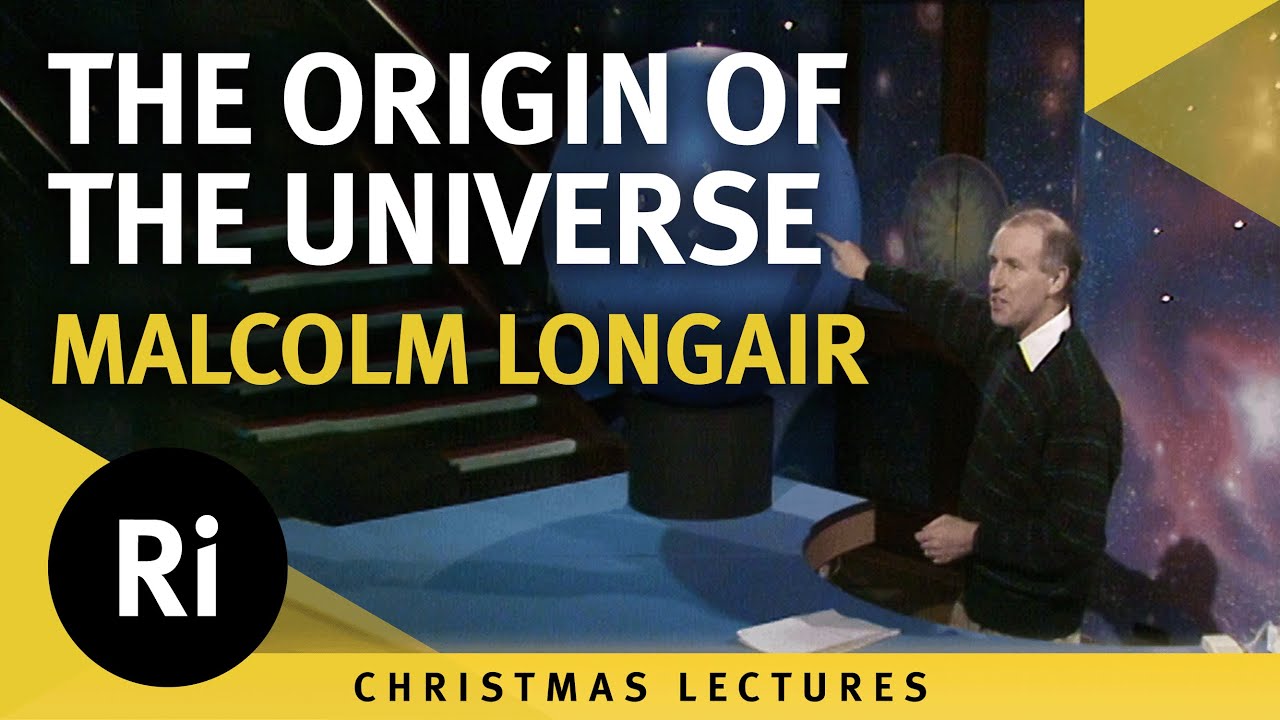
The origin of the universe – Malcolm Longair 1990 Christmas Lectures 5/5
Keywords
Summary
208 words
Critical Evaluation
This lecture, delivered by Malcolm Longair, a prominent astrophysicist, provides a comprehensive overview of cosmology as understood in 1990. The content is scientifically accurate for its time, and Longair’s explanations are clear and engaging. He effectively uses analogies, such as the cannonball and the balloon, to illustrate abstract concepts like critical density and curved space. The demonstrations with audience members help to make the ideas tangible. The lecture is well-structured, building from basic observations to more complex theories, and it clearly outlines the major open questions of the time. However, the lecture is now over three decades old, and our understanding of cosmology has advanced significantly. For instance, the discovery of dark energy in 1998 has changed our view of the universe’s expansion, which is now accelerating, not decelerating. The lecture also does not mention cosmic inflation in detail, which has become a cornerstone of modern cosmology. Despite these outdated aspects, the lecture remains valuable for its historical perspective and its clear explanation of fundamental concepts that are still relevant today. The sources cited are primarily the Royal Institution’s own resources, which are reliable but not primary research. The lecture’s strength lies in its pedagogical approach and the authority of the speaker. The title accurately reflects the content, and the lecture fulfills its promise to discuss the origin of the universe. Overall, this is a high-quality educational resource, though its age limits its current relevance.
235 words
Title / Content Match
The title accurately reflects the content, which focuses on the origin and evolution of the universe.
Quality & Reliability
8/10
Lecture by a renowned astrophysicist, part of the Royal Institution Christmas Lectures, with clear explanations and demonstrations. Content is dated (1990) but historically accurate and well-structured.
Key Moments
Markers derived by PSI from the transcript: the creator did not define chapters.
- Introduction to the lecture on the origin of the universe.
- Review of Hubble's law and the uniformity of the cosmic microwave background.
- Cannonball analogy to explain the dynamics of the universe.
- Introduction of the critical density concept.
- Demonstration of non-Euclidean geometry with a balloon.
- Discussion of the three possible geometries of the universe.
- Explanation of the fine-tuning problem of the critical density.
- Discussion of nucleosynthesis and the matter-antimatter asymmetry.
- Introduction of the horizon problem and the inflationary model.
- Conclusion summarizing the four fundamental problems.
Cited Sources
- Royal Institution Christmas Lectures — Official page for the Christmas Lectures series.
- RI Science Podcast — Podcast by the Royal Institution.
- Editing RI Talks and Moderating Comments — Guidelines for editing and moderating.
- Donate to the Royal Institution — Support page for the Royal Institution.
- Playlist of 1990 Christmas Lectures — Full series of lectures.
- Newest Christmas Lectures — Recent Christmas Lectures.
Concurring Sources
- Royal Institution Christmas Lectures — Official source for the lecture series.
Contribution & Novelties
This lecture provides a clear and accessible explanation of the state of cosmology in 1990, including the key problems and proposed solutions. It is valuable for its historical perspective and pedagogical approach.
Pour aller plus loin :
- Cosmic inflation — A key concept mentioned in the lecture, now a cornerstone of modern cosmology.
- Dark energy — Discovered after this lecture, it changed our understanding of the universe’s expansion.
- Cosmic microwave background — The radiation discussed in the lecture, crucial for understanding the early universe.
84 words
Radar Profile
The radar profile shows high scores in information quantity, quality, and technical level, with a slightly lower but still high score in reliability. This indicates a well-rounded, informative, and credible lecture.