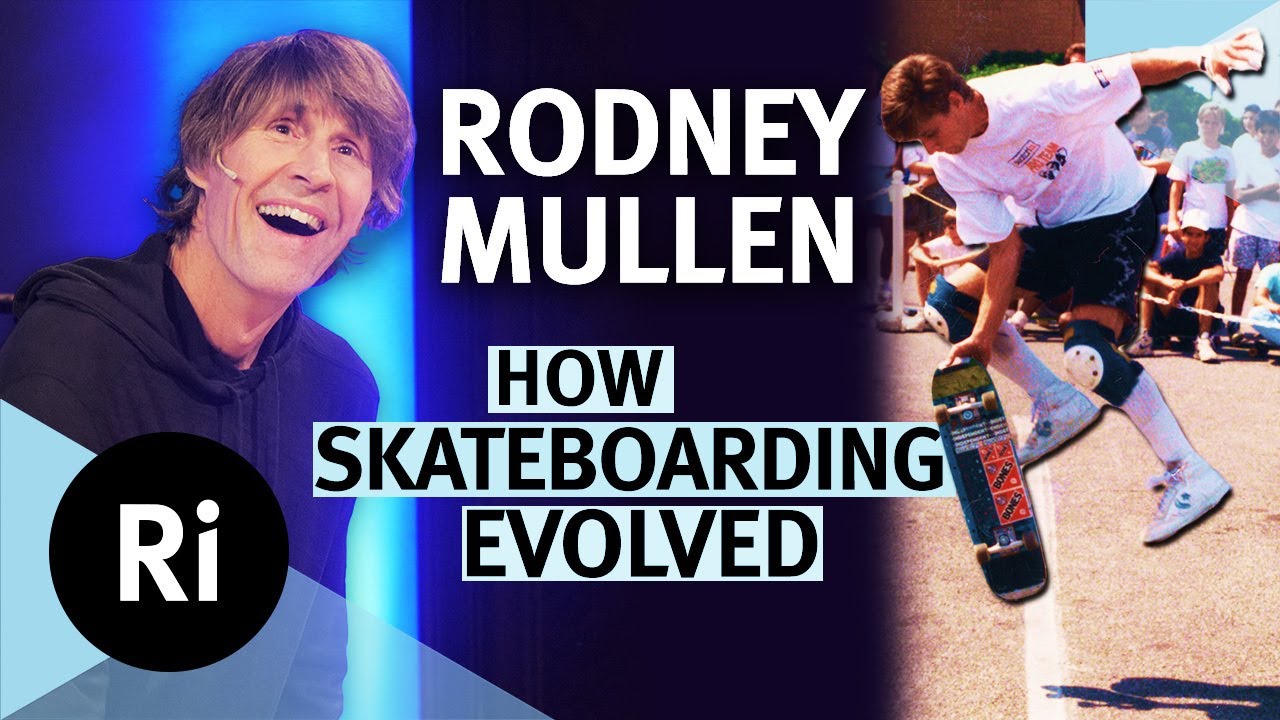
From impossible to iconic: Rodney Mullen's evolution of skateboarding
Keywords
Summary
174 words
Critical Evaluation
Rodney Mullen’s lecture at the Royal Institution is a masterclass in interdisciplinary thinking, seamlessly blending personal anecdote with scientific concepts. The talk’s primary strength lies in Mullen’s unique perspective as both a pioneer of skateboarding and a student of chemical engineering. His ability to articulate the tacit knowledge of skateboarding—the biomechanics, the physics, the embodied cognition—is exceptional. He effectively uses metaphors and analogies, such as comparing the grammar of tricks to chemical nomenclature, to make complex ideas accessible. The collaboration with IBM’s Watson to generate trick variations is a fascinating example of how structured language can encode physical principles, though the details are somewhat anecdotal. Mullen’s references to John Seely Brown and embodied cognition are credible, but he does not provide specific citations or data, which limits the scientific rigor. The talk is more of an expert opinion than a systematic analysis, but it is grounded in decades of practical experience and a genuine curiosity about the underlying science. The audience’s enthusiastic response and the positive comments reflect the talk’s inspirational value. However, from a strict scientific standpoint, the lack of empirical evidence and the reliance on personal narrative mean that the claims should be taken as insights rather than proven facts. The adéquation between title and content is excellent, as the talk indeed covers the evolution of skateboarding from ‘impossible’ tricks to iconic status. Overall, this is a high-quality, thought-provoking lecture that bridges art and science, though it would benefit from more rigorous referencing.
245 words
Title / Content Match
The title accurately reflects the content: Rodney Mullen discusses the evolution of skateboarding, from his early innovations to the broader cultural and scientific implications.
Quality & Reliability
8/10
The talk is delivered by Rodney Mullen, a legendary skateboarder with deep practical expertise, and hosted by the Royal Institution, a reputable scientific organization. The content blends personal experience with references to scientific concepts like embodied cognition and the scientific method. While not a formal scientific study, the information is credible and well-articulated, with some references to academic concepts and collaborations.
Chapters
Cited Sources
- Ri Science Podcast — Mentioned as a resource for further exploration of science topics.
- Ri Talks Editing and Comments Policy — Referenced for information on how Ri talks are edited and comments moderated.
- Donate to the Ri — Mentioned as a way to support the Royal Institution.
- Q&A with Rodney Mullen — The Q&A session following the lecture, made available for everyone.
Concurring Sources
- The Royal Institution — The hosting institution, known for public science lectures.
Contribution & Novelties
Rodney Mullen provides a unique insider perspective on the evolution of skateboarding, linking it to scientific principles such as embodied cognition and the scientific method. He introduces the idea that skateboarding tricks have a grammatical structure similar to language, and demonstrates a project where AI (IBM Watson) was trained to generate trick variations, suggesting that physics is embedded in the language. This interdisciplinary approach offers fresh insights into both skateboarding and innovation.
Pour aller plus loin :
- Embodied cognition — This concept is central to Mullen’s discussion of how physical skills become embedded in the body.
- John Seely Brown — Mullen explicitly borrows from Brown’s framework on creativity and imagination.
- Labanotation — Mullen references this dance notation system to illustrate the complexity of communicating movement.
125 words
Radar Profile
The radar profile shows high scores in quality of information and reliability, reflecting the credibility of the speaker and institution. The quantity of information is also strong, but the technical level is moderate, as the talk is accessible to a general audience. Overall, the profile indicates a well-rounded, informative lecture.
💬 Très positif : Sur les 30 commentaires analysés, l'écrasante majorité exprime une admiration profonde pour Rodney Mullen, sa sagesse, son humilité et son éloquence, avec des mentions récurrentes de l'impact émotionnel et de la valeur inspirante de la conférence.