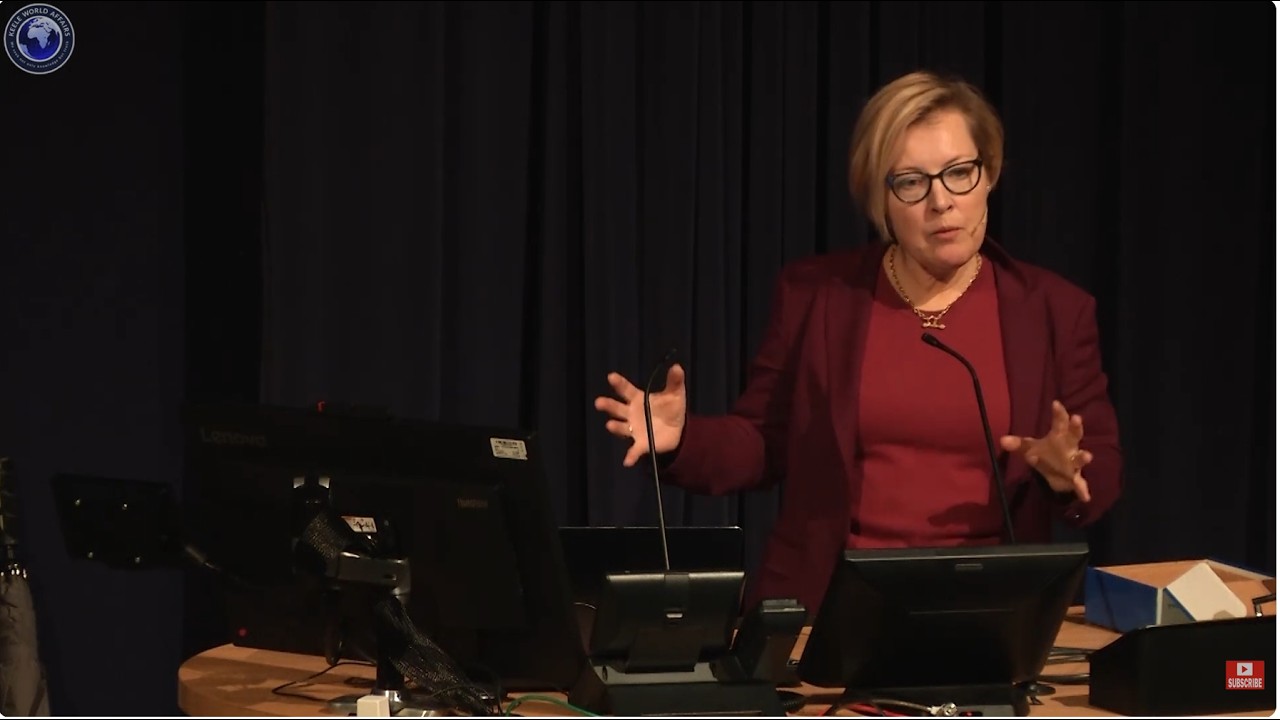
How to fix Capitalism?
Keywords
Summary
141 words
Critical Evaluation
Value of the Information & Strength of the Argument
The talk provides valuable insights into the current state of capitalism and the challenges it faces. Tett’s argumentation is solid, drawing on historical parallels (e.g., pre-WWI era) and contemporary examples (e.g., Davos, Trump’s policies). She effectively uses her anthropological perspective to deconstruct economic orthodoxies. However, the talk is more of an opinion piece than a rigorous analysis, with some proposals (e.g., conscious capitalism) lacking detailed implementation strategies.
Scientific Rigor, Source Quality, Title Accuracy
The speaker demonstrates high rigor by referencing historical events, economic theories, and her own journalistic experience. She mentions specific sources like the Bertelsmann Democracy Index and the IMF paper on industrial policy. The title accurately reflects the content, as the talk directly addresses the question of how to fix capitalism. No comments were provided for analysis.
138 words
Title / Content Match
The title accurately reflects the content, as the speaker directly addresses the question of how to fix capitalism, offering several reform proposals.
Quality & Reliability
8/10
The speaker is a highly credible expert with a strong background in anthropology and journalism, providing a well-informed and nuanced analysis. The talk is based on her extensive experience and observations, but it is an opinion piece rather than a systematic review or original study.
Key Moments
Markers derived by PSI from the transcript: the creator did not define chapters.
- Introduction: Tett's background and the question of capitalism.
- Comparison of Davos to a tribal wedding and the four pillars of the post-1989 consensus.
- Historical parallel with pre-WWI era and Keynes's warnings.
- The rise of geoeconomics and the shift from economics driving politics to politics driving economics.
- The impact of Trump and the three Ps: populism, protectionism, and patriotism.
- Proposals for reform: conscious capitalism, integrating externalities, addressing monopoly power, and reassessing growth.
- Discussion of green growth and green de-growth.
- Conclusion: the need for a more holistic approach to capitalism.
Cited Sources
- The Economic Consequences of the Peace — Referenced by Tett to draw parallels between pre-WWI globalization and today.
- Bertelsmann Democracy Index — Cited to illustrate the global decline in democracy since 2003.
- IMF paper on industrial policy — Mentioned to highlight the taboo around industrial policy.
Concurring Sources
- The Rise and Fall of Nations — Ruchir Sharma's book, which aligns with Tett's analysis of economic cycles and political shifts.
- The Great Transformation — Karl Polanyi's work, which supports Tett's argument about the embeddedness of markets in society.
Dissenting Sources
Contribution & Novelties
The talk offers a unique anthropological perspective on capitalism, framing it as a cultural system. Tett’s proposal for ‘conscious capitalism’ and her emphasis on integrating externalities into economic models are not entirely new but are presented in a compelling way. The discussion of geoeconomics and the shift in power dynamics is particularly timely.
Pour aller plus loin :
- Conscious Capitalism — A movement advocating for businesses to consider their social and environmental impact.
- Green growth — A concept Tett discusses, balancing economic growth with environmental sustainability.
- Degrowth — An alternative framework that challenges the growth imperative, relevant to Tett’s discussion of green de-growth.
103 words
Radar Profile
The radar profile shows high scores in information quantity, quality, and reliability, with a moderate technical level. This indicates a well-informed and credible talk that is accessible to a general audience, though it lacks deep technical detail.