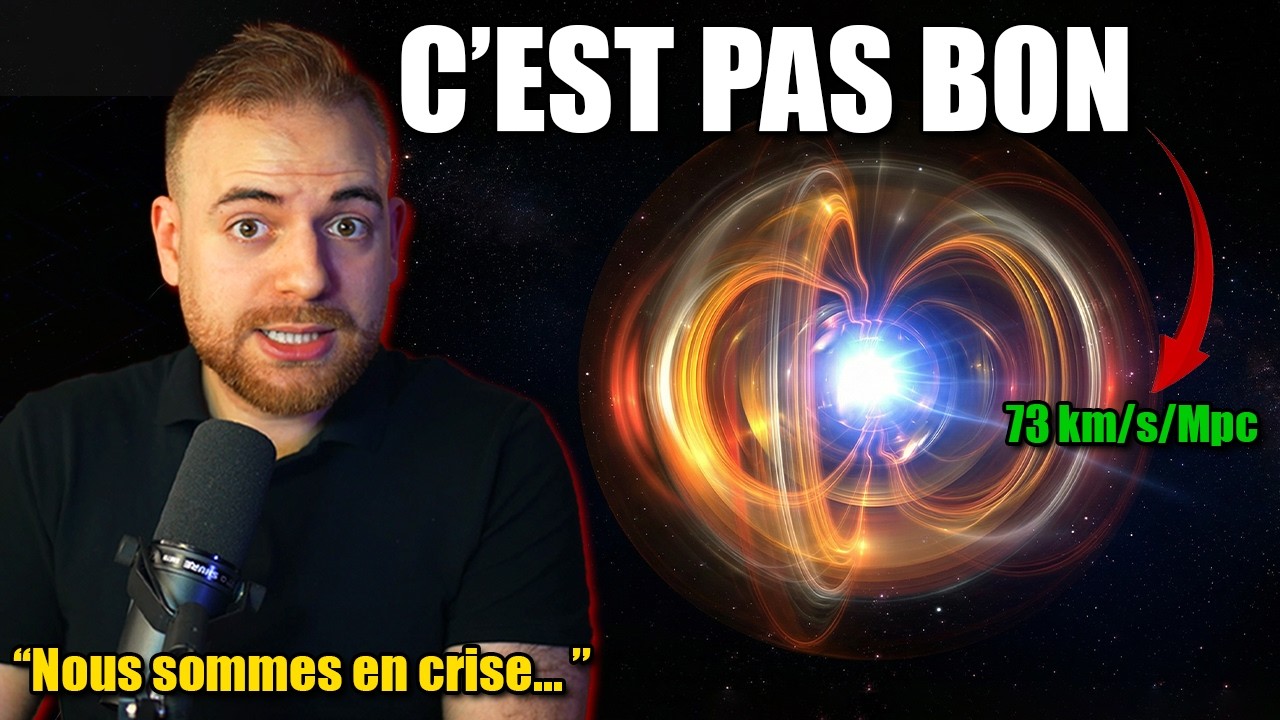
On s'est trompé sur l'univers pendant 100 ans ? (la vérité éclate enfin)
Keywords
Summary
120 words
Critical Evaluation
Value of the Information & Strength of the Argument
The video provides a broad overview of several real cosmological anomalies, which is valuable for raising awareness. However, the argumentation is superficial and relies on sensationalism. It does not delve into the nuances of the measurements or the statistical significance of the tensions. The narrative is built around a ‘crisis’ narrative, which is a valid perspective but presented without critical depth. The video also conflates different anomalies without clearly explaining their interconnections or the specific implications for the standard model.
Scientific Rigor, Source Quality, Title Accuracy
The video mentions several studies and researchers but does not provide specific citations or links to the original papers. The description contains only links to the creator’s own newsletter and training program, not to scientific sources. The title is misleading, suggesting a definitive revelation, whereas the content is a review of ongoing debates. The video’s scientific rigor is low, as it simplifies complex issues and does not offer a balanced view of the scientific consensus or the uncertainties involved.
174 words
Title / Content Match
The title is clickbait and overstates the content; the video discusses ongoing tensions in cosmology but does not reveal a definitive 'truth'.
Quality & Reliability
5/10
The video presents a sensationalized overview of recent cosmological tensions, but lacks precise citations, misattributes some claims, and includes a promotional segment. The scientific content is broadly accurate but oversimplified and not rigorously sourced.
Key Moments
Markers derived by PSI from the transcript: the creator did not define chapters.
- Introduction: claims that our understanding of the universe might be fundamentally wrong.
- Introduction of the standard cosmological model (ΛCDM) and its initial success.
- Historical analogy: Uranus/Neptune and Mercury/Einstein.
- Hubble tension: discrepancy between CMB and local measurements.
- Large-scale structures: Giant Arc, Big Ring, Hercules-Corona Borealis Wall.
- JWST discoveries: early mature galaxies and little red dots.
- DESI results: dark energy may be evolving.
- Fugaku simulations and the potential for a new paradigm.
- Conclusion: science progresses through crises, and the future is exciting.
- Promotional segment for the creator's AI training program.
Cited Sources
- Vision IA Newsletter — Mentioned in the video as a way to receive summaries of AI news.
- Vision IA Training Program — Promoted at the end of the video as a comprehensive AI course.
Concurring Sources
- Hubble tension — The video's description of the Hubble tension aligns with the general scientific consensus on this discrepancy.
- Dark Energy Spectroscopic Instrument (DESI) — The video's mention of DESI results is consistent with published findings on dark energy evolution.
Dissenting Sources
- ΛCDM model — The video suggests the model is in crisis, but many cosmologists still consider it the best fit for most observations, and the tensions may be due to systematic errors.
Contribution & Novelties
The video synthesizes recent cosmological findings into a narrative of crisis, which may be useful for a general audience. However, it does not provide new information or original analysis. The main value is in compiling various anomalies into a single overview.
Pour aller plus loin :
- Hubble tension — Provides a detailed overview of the discrepancy in measurements of the Hubble constant.
- Dark energy — Explains the concept of dark energy and its role in the accelerating expansion of the universe.
- James Webb Space Telescope — Details the telescope’s capabilities and its discoveries of early galaxies.
- DESI (Dark Energy Spectroscopic Instrument) — Information about the survey that produced the dark energy results mentioned in the video.
- ΛCDM model — The standard model of cosmology that is being challenged.
128 words
Radar Profile
The radar profile shows moderate scores across all dimensions, with a slight peak in quantity of information. This reflects a video that covers many topics but lacks depth and rigor, resulting in a balanced but not outstanding profile.
💬 Ferveur positive : Sur les 30 commentaires analysés, la grande majorité exprime un enthousiasme marqué pour les travaux de Jean-Pierre Petit et son modèle Janus, considéré comme une alternative crédible au modèle standard, avec un ton souvent admiratif et militant.