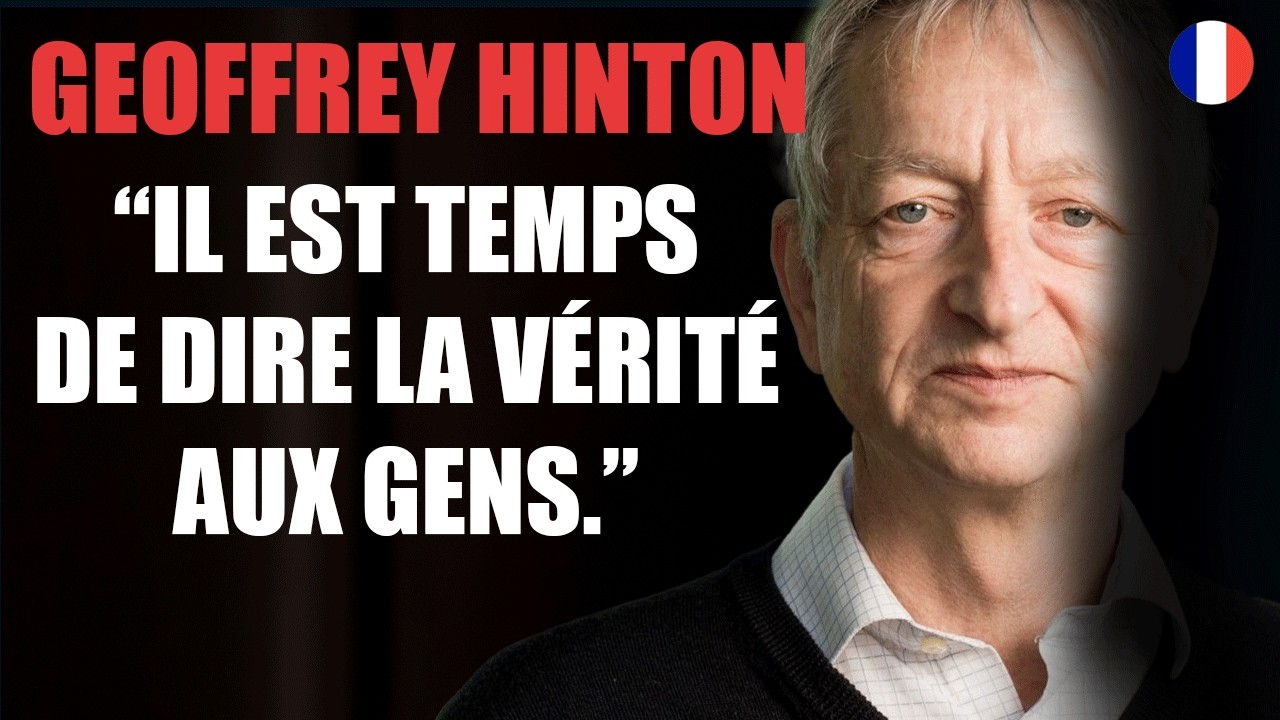
2030 ... c'est là que tout bascule selon cet expert en IA.
Keywords
Summary
135 words
Critical Evaluation
Value of the Information & Strength of the Argument
The video provides a valuable summary of Geoffrey Hinton’s public statements, which are significant given his prominence in the field. The argumentation is largely based on Hinton’s authority and personal opinions, rather than on empirical evidence or detailed technical analysis. The host presents Hinton’s views in a clear and engaging manner, but does not critically evaluate them or present counterarguments. The video’s value lies in raising awareness of AI risks, but it lacks depth in exploring the technical and societal complexities.
Scientific Rigor, Source Quality, Title Accuracy
The video cites the original interview with Geoffrey Hinton on the ‘The Diary of a CEO’ podcast, but does not provide direct links to any scientific papers or reports. The sources are primarily the interview itself and the channel’s own promotional links. The title is somewhat misleading as it emphasizes the year 2030, which is not a central focus of the content. The video is a secondary source that interprets Hinton’s statements, and the host’s commentary is not clearly separated from Hinton’s original words, which could lead to misrepresentation.
185 words
Title / Content Match
The title is somewhat sensationalist and focuses on the year 2030, which is not explicitly mentioned in the video; the content is more broadly about Hinton's warnings about AI risks.
Quality & Reliability
6/10
The video is a commentary on an interview with Geoffrey Hinton, presenting his views on AI risks. It is a secondary source that summarizes and interprets Hinton's statements, with some added commentary. The information is largely anecdotal and based on Hinton's personal opinions, not peer-reviewed research. The video includes promotional content for the channel's own courses.
Chapters
- Intro - Geoffrey Hinton a peur pour l'avenir de ses enfants
- Comment l'IA apprend différemment des humains - partage instantané de connaissances
- Les risques énumérés par Hinton - cyberattaques, armes biologiques, désinformation
- Le risque d'extinction - "tellement de façons de se débarrasser de nous"
- Chômage de masse - le bon et le mauvais scénario
- L'IA sera plus créative que nous - l'exemple du compost et de la bombe atomique
Cited Sources
- Original interview with Geoffrey Hinton — The original interview that the video is based on.
- Vision IA newsletter — Promotional link for the channel's newsletter.
- Vision IA training — Promotional link for the channel's AI training courses.
Concurring Sources
- Geoffrey Hinton's public statements on AI risks — BBC article covering Hinton's resignation from Google and his warnings about AI risks.
Dissenting Sources
- Optimistic views on AI development
Contribution & Novelties
The video synthesizes Geoffrey Hinton’s recent interview, making his warnings about AI accessible to a broader audience. It highlights key themes such as the speed of AI advancement, the potential for AI to surpass human intelligence, and the societal risks. However, it does not provide new information beyond the interview itself. The host adds some context and personal commentary, but the core content is a summary.
Pour aller plus loin :
- AI alignment — The challenge of ensuring AI systems act in accordance with human values.
- Existential risk from artificial general intelligence — Overview of the potential catastrophic risks posed by AGI.
- Universal basic income — A policy proposal discussed in the video as a potential response to job displacement.
120 words
Radar Profile
The radar profile shows moderate scores across all dimensions, with slightly higher scores for quantity of information and lower for technical level and reliability. This indicates a video that provides a good amount of information but lacks deep technical detail and relies heavily on the authority of the interviewee rather than on rigorous scientific evidence.
💬 Négatif : Sur les 30 commentaires analysés, la majorité exprime une inquiétude profonde et un sentiment d'impuissance face à l'IA, certains appelant à 'débrancher' l'IA, tandis que d'autres partagent des expériences personnelles de perte d'emploi liée à l'IA.