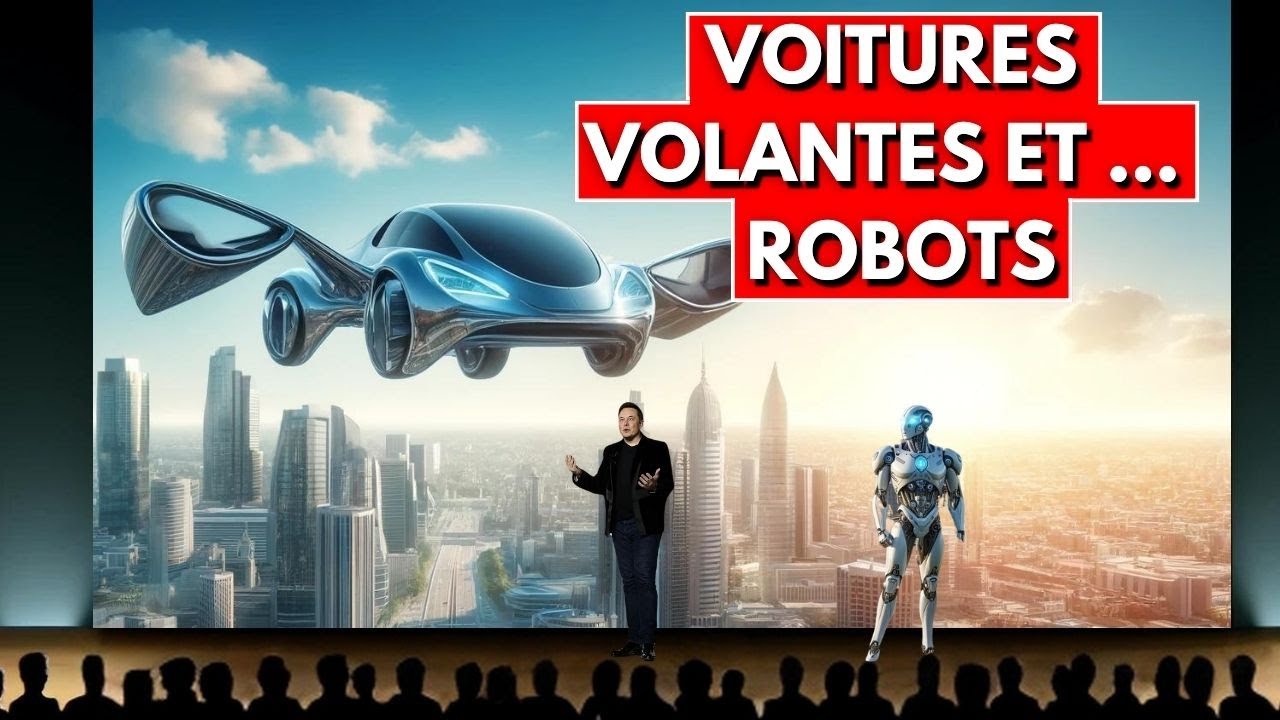
Incroyable Mais Vrai : La Voiture Qui Vole arrive, robots humanoïdes, neuralink, chimère rat/souris
Keywords
Summary
132 words
Critical Evaluation
Value of the Information & Strength of the Argument
The video provides a broad overview of several cutting-edge technologies, which can serve as a starting point for viewers unfamiliar with these topics. However, the information is presented in a sensationalist manner, with claims such as ’the future of urban delivery’ or ‘revolutionizing medical care’ without substantial evidence or expert commentary. The argumentation is largely narrative and lacks critical evaluation of the technologies’ limitations, feasibility, or potential negative consequences. For instance, the segment on ANYmal mentions its navigation capabilities but does not discuss the challenges of real-world deployment, such as regulatory hurdles or public acceptance. Similarly, the AirCar segment highlights its certification but omits the significant infrastructure and regulatory changes required for widespread adoption. The ethical discussions, particularly on brain-computer interfaces and chimeras, are raised but not deeply explored, leaving the viewer with a superficial understanding.
Scientific Rigor, Source Quality, Title Accuracy
The video does not cite specific sources within the narration, and the description provides no links to the mentioned projects or studies. The information appears to be based on publicly available news and press releases, but without direct references, the viewer cannot verify the claims. The title is somewhat sensationalist, using phrases like ‘Incroyable Mais Vrai’ to attract attention, but it does accurately reflect the content’s scope. The video’s scientific rigor is low; it presents complex topics in a simplified manner, occasionally with inaccuracies (e.g., describing ANYmal as a ‘humanoid robot’ when it is a quadruped). The lack of citations and the absence of critical analysis diminish its credibility as a scientific source.
264 words
Title / Content Match
The title accurately reflects the content, which covers flying cars, humanoid robots, Neuralink, and a rat-mouse chimera, though the 'Incroyable Mais Vrai' framing is sensationalist.
Quality & Reliability
5/10
The video presents a superficial overview of several emerging technologies, with limited technical depth and no critical analysis. Claims are presented without rigorous sourcing, and some statements are imprecise or potentially misleading (e.g., 'ANYmal' described as a humanoid robot, 'Bionic B' weight and capabilities). The content is more entertainment-oriented than scientifically rigorous.
Chapters
Cited Sources
- ANYmal - ETH Zurich — Mentioned as the robot developed by ETH Zurich capable of autonomous urban navigation.
- AirCar - Klein Vision — Mentioned as the flying car developed by Klein Vision, with a successful flight between Nitra and Bratislava.
- Neuralink — Mentioned as the brain-computer interface company founded by Elon Musk.
- Bionic Bee - Festo — Mentioned as a robotic bee developed by Festo for pollination and agriculture.
- Columbia University hybrid brain research — Mentioned as research at Columbia University creating hybrid rat-mouse brains to treat neurodegenerative diseases.
Concurring Sources
- ANYmal - ETH Zurich — Official page for ANYmal, confirming its capabilities and development.
- AirCar - Klein Vision — Official website of Klein Vision, detailing the AirCar's specifications and certification.
- Neuralink — Official site of Neuralink, providing information on their brain-computer interface technology.
- Bionic Bee - Festo — Festo's page on the Bionic Bee, confirming its design and capabilities.
- Columbia University hybrid brain research — Scientific paper on the creation of hybrid rat-mouse brains, supporting the video's claims.
Dissenting Sources
- ANYmal is a quadruped, not a humanoid — The video incorrectly describes ANYmal as a 'humanoid robot', but it is actually a quadrupedal robot.
Contribution & Novelties
The video compiles recent technological advancements into a single narrative, making it accessible to a general audience. Its novelty lies in the juxtaposition of diverse fields—robotics, aviation, neurotechnology, and biomimetics—highlighting the convergence of these technologies. However, it does not provide new insights or original analysis, serving more as a summary of existing news.
Pour aller plus loin :
- Reinforcement learning — Key technique behind ANYmal’s autonomous navigation.
- Flying car — Context for the AirCar and the challenges of urban air mobility.
- Brain-computer interface — Overview of the technology and its applications.
- Biomimetics — The inspiration behind the Bionic Bee and other nature-inspired robots.
- Chimera (genetics) — Background on hybrid organisms and their ethical implications.
114 words
Radar Profile
The radar profile shows moderate scores across all dimensions, with slightly higher 'quantite_information' and 'fiabilite_globale' compared to 'qualite_information' and 'niveau_technique'. This indicates a video that provides a decent amount of information but lacks depth and technical rigor, making it suitable for a general audience but not for those seeking detailed scientific analysis.
💬 Sur les 0 commentaires analysés, aucune tendance n'est disponible.