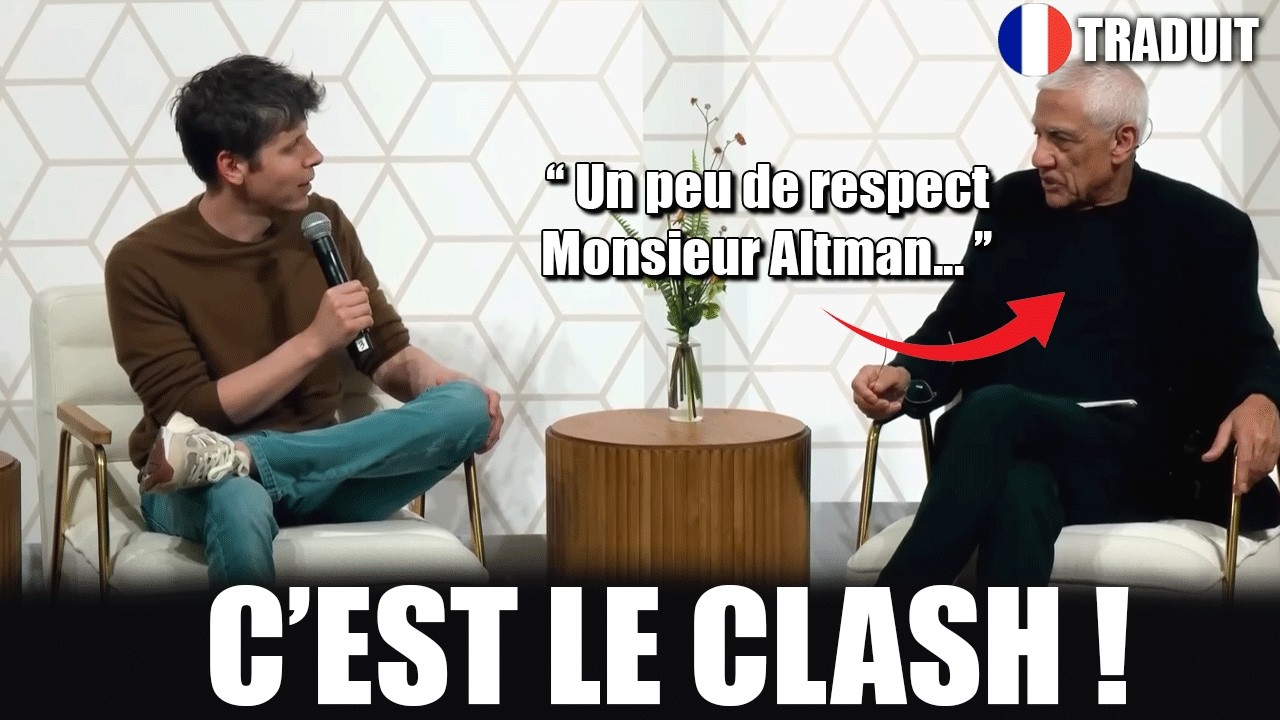
L'interview CHOC du PDG d'OpenAI devient VIRALE : "Vous n'avez aucune idée de ce qui arrive"
Keywords
Summary
156 words
Critical Evaluation
Value of the Information & Strength of the Argument
The video provides a valuable summary of Sam Altman’s key statements, making them accessible to a French-speaking audience. The speaker offers his own analysis, which adds perspective, though it is clearly opinion-based. The argumentation is generally coherent, but it relies heavily on Altman’s authority and speculative projections rather than empirical evidence. The discussion of scaling laws and the potential for AI-driven research acceleration is informative, but the lack of concrete data or citations weakens the overall argument.
Scientific Rigor, Source Quality, Title Accuracy
The video is based on a single source: an interview with Sam Altman. The original interview is linked in the description, but the video does not provide additional sources or citations. The speaker’s commentary is not clearly separated from Altman’s statements, which could confuse viewers. The title is somewhat sensationalist, but it does reflect the content’s focus on Altman’s bold predictions. The video’s promotional elements (links to courses and newsletter) are present but not intrusive.
167 words
Title / Content Match
The title is somewhat sensationalist ('CHOC', 'VIRALE', 'Vous n'avez aucune idée de ce qui arrive') but the content does cover the interview and its key points, so it is broadly accurate.
Quality & Reliability
6/10
The video is a French-language commentary on an interview with Sam Altman, CEO of OpenAI. The original interview is not directly shown but is summarized and discussed. The content is largely speculative and opinion-based, with limited verifiable data. The channel has a promotional focus, which may introduce bias. However, the discussion is grounded in real AI developments and the speaker appears knowledgeable.
Chapters
Cited Sources
- Original interview video — The original interview with Sam Altman that is the subject of this video.
- Vision IA newsletter — Newsletter signup for the channel, likely for updates on AI content.
- Vision IA training platform — Promotional link to AI training courses offered by the channel.
Concurring Sources
- OpenAI official website — Official source for OpenAI's mission, products, and research.
Dissenting Sources
- AI Impact — A platform that tracks AI incidents and risks, which may offer a more cautious perspective on AI progress.
Contribution & Novelties
The video’s main contribution is to synthesize and translate a high-profile interview with Sam Altman into French, making it accessible to a broader audience. It adds commentary and analysis, but does not present new information or original research. The discussion of scaling laws and the future of AI is a useful summary for those unfamiliar with the concepts.
Pour aller plus loin :
- Scaling laws for neural language models — The original paper by Kaplan et al. that introduced scaling laws for language models.
- Artificial general intelligence — Wikipedia overview of AGI, its definitions, and challenges.
- The Future of Jobs Report — World Economic Forum report on job displacement and creation due to AI and automation.
116 words
Radar Profile
The radar profile shows moderate scores across all dimensions, indicating a video that is informative but not deeply technical or highly rigorous. The balance between information quantity and quality is fairly even, with a slight emphasis on opinion over verifiable data.
💬 No comments were provided for analysis.