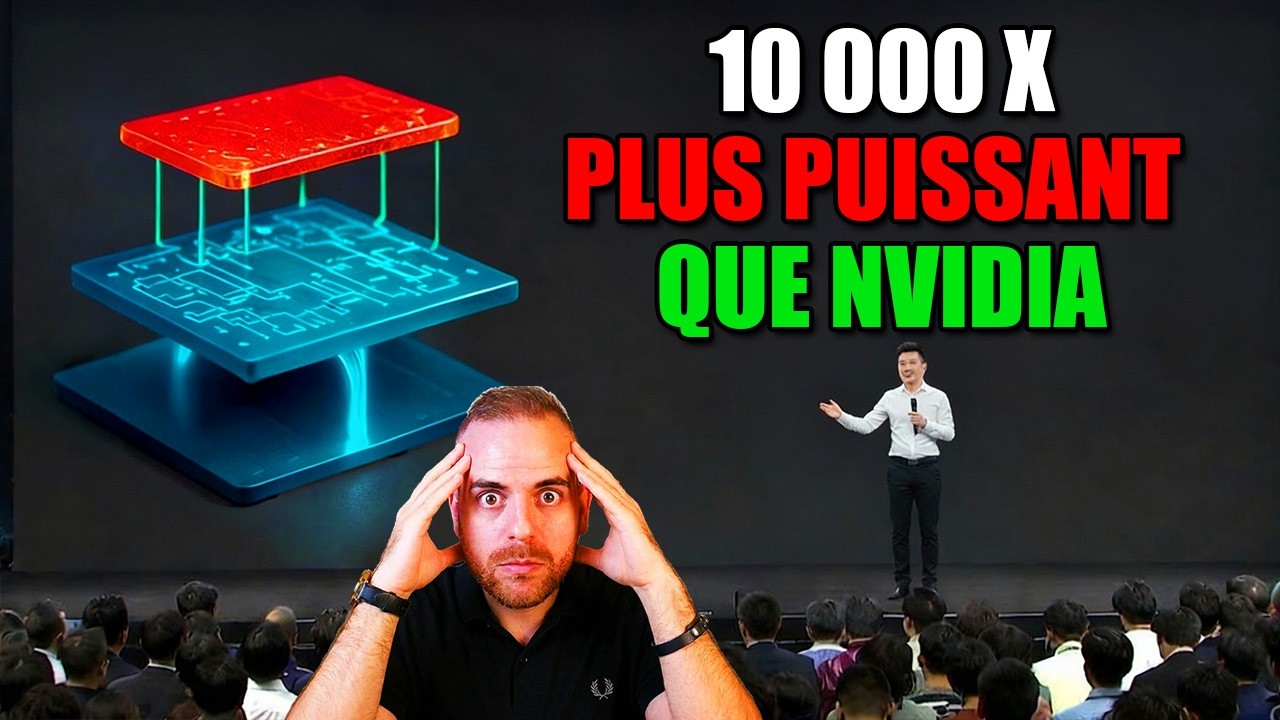
Si ça marche… l'AGI arrivera plus vite que prévu (Calcul Thermodynamique).
Keywords
Summary
137 words
Critical Evaluation
Value of the Information & Strength of the Argument
The video provides a clear and engaging explanation of a novel computing paradigm, using accessible analogies to convey the concept of probabilistic computing. It presents both the potential benefits (massive energy savings) and the challenges (simulation results, need for new algorithms). The argumentation is persuasive but relies heavily on the startup’s claims and lacks independent verification. The presenter’s enthusiasm is evident, but the video does not critically examine potential technical hurdles or alternative perspectives in depth.
Scientific Rigor, Source Quality, Title Accuracy
The video cites Extropic’s published results and mentions that independent researchers have confirmed the mathematics, but it does not provide specific references or links. The description only contains links to the creator’s newsletter and training program, not to the cited research. The title is somewhat clickbait, linking AGI arrival to the technology, which is speculative. The content is generally accurate in its description of the technology, but the lack of verifiable sources and the promotional segment reduce its scientific rigor.
171 words
Title / Content Match
The title is somewhat sensationalist, linking AGI arrival to the thermodynamic computing breakthrough, but the video focuses on the technology's potential rather than a direct timeline for AGI.
Quality & Reliability
6/10
The video presents a mix of factual claims about Extropic's technology and speculative projections. It lacks detailed technical depth and relies on analogies and rhetorical emphasis. The claims are not independently verified within the video, and the presenter's promotional segment reduces overall rigor.
Key Moments
Markers derived by PSI from the transcript: the creator did not define chapters.
- Introduction of Extropic and the claim of 10,000x energy efficiency.
- Explanation of p-bits and how they use thermal noise for computation.
- Discussion of the energy consumption of current AI and the potential impact of Extropic's technology.
- Presentation of Extropic's prototype chip (X0) and future plans (Z1).
- Comparison with other AI chip developments and the energy crisis.
- Promotional segment for the creator's AI training program.
Cited Sources
- Vision IA Newsletter — Link to the creator's newsletter, mentioned for additional content.
- Vision IA Training Program — Link to the creator's AI training program, promoted at the end of the video.
Concurring Sources
- Extropic's official website — Official site of the startup, likely containing their research and claims.
Dissenting Sources
- Critics' view on stochastic computing — The video mentions that critics consider the approach as 'stochastic computing recycled with new marketing', but no specific source is provided.
Contribution & Novelties
The video introduces a novel concept in AI hardware: thermodynamic computing using p-bits, which could drastically reduce energy consumption. It provides a clear explanation of the technology and its potential implications for the AI industry. The video also highlights the growing energy crisis of AI data centers, adding urgency to the discussion.
Pour aller plus loin :
- Probabilistic computing — Overview of probabilistic computing concepts.
- Thermodynamic computing — Background on thermodynamic computing.
- Extropic — Official website of the startup, though not verified in the video.
85 words
Radar Profile
The radar profile shows moderate scores across all dimensions, with slightly higher scores in information quantity and quality, but lower technical depth and reliability. This suggests a video that is informative and engaging but lacks deep technical rigor and independent verification.
💬 No comments were provided for analysis.