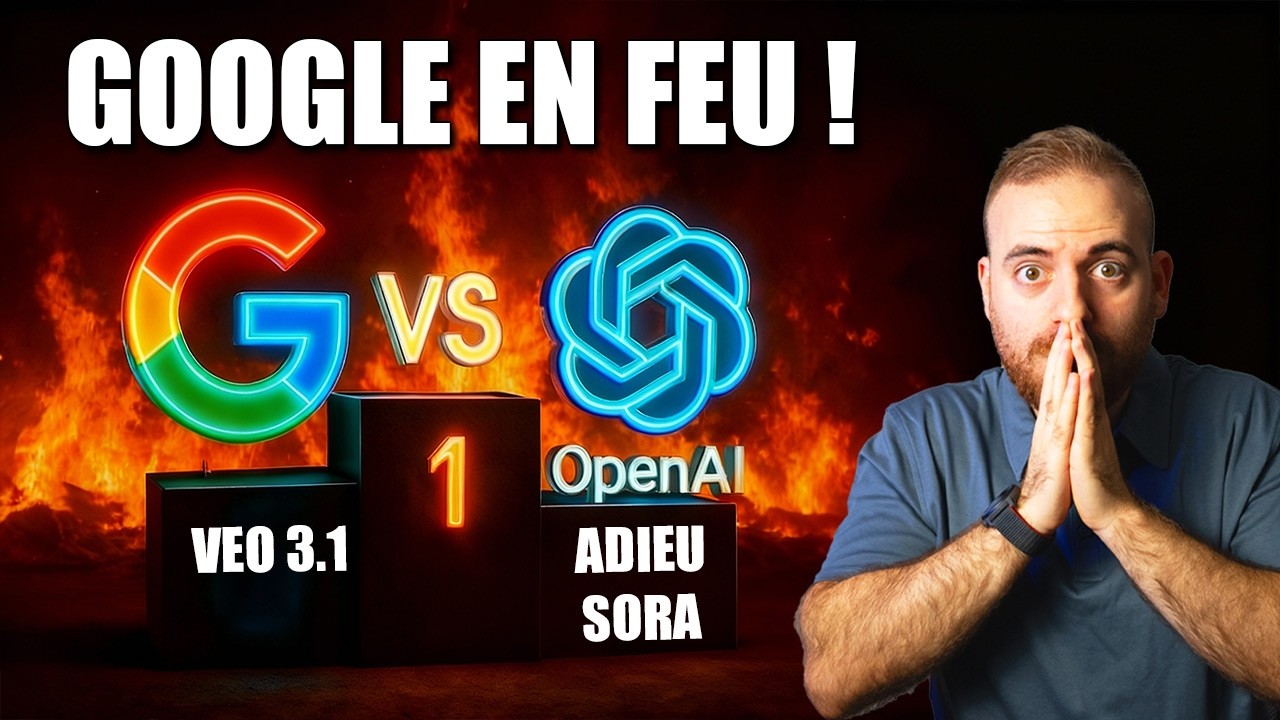
Sora 2 plus beau ? Google ÉCRASE OpenAI avec l'édition
Keywords
Summary
161 words
Critical Evaluation
Value of the Information & Strength of the Argument
The video provides a valuable overview of recent AI developments, highlighting their practical implications for creators and developers. The argumentation is generally coherent, presenting each announcement with context and potential use cases. However, the analysis is often superficial, relying on claims from the companies without critical evaluation. The creator’s enthusiasm is evident, but the lack of independent verification or deeper technical discussion limits the depth of the information. The sponsored segment, while clearly marked, occupies a significant portion and may bias the presentation.
Scientific Rigor, Source Quality, Title Accuracy
The video cites no specific sources beyond the companies’ announcements and the sponsor’s website. The information is presented as news, but the lack of direct references or links to official documentation reduces its scientific rigor. The title is somewhat clickbait, focusing on the Google vs. OpenAI rivalry, but the content covers a broader range of topics. The adéquation between title and content is partial: the video does discuss Google’s editing capabilities, but also covers other news. The overall reliability is moderate, as the claims are plausible but not thoroughly verified.
188 words
Title / Content Match
The title is somewhat sensationalist and focuses on the comparison between Sora 2 and Google's editing capabilities, but the video covers a broader range of AI news. The title captures the main highlight but not the full scope.
Quality & Reliability
6/10
The video presents recent AI announcements with a mix of factual claims and promotional content. While the core information about Google Veo 3.1, Anthropic's Haiku 4.5, Kong's Volcano, and Karpathy's NanoChat appears plausible and aligns with industry trends, the video lacks detailed technical verification and includes a significant sponsored segment. The creator's expertise is evident but the presentation is more journalistic than deeply analytical.
Key Moments
Markers derived by PSI from the transcript: the creator did not define chapters.
- Introduction and overview of the week's AI news
- Sponsored segment for Mammouth.ai
- Google Veo 3.1 announcement: new editing tools in Flow, including object insertion and Frame to Video
- Anthropic Haiku 4.5: cost-effective model, multi-agent orchestration, and safety improvements
- Kong's Volcano: open-source platform for building AI agents using MCP, demo with 900 coffee orders
- Andrej Karpathy's NanoChat: train your own ChatGPT-like model for $100 and 4 hours
- Conclusion and promotion of Vision IA's training program
Cited Sources
- Mammouth.ai — Sponsor of the video, offering access to multiple AI models in one interface.
- Vision IA Newsletter — Newsletter subscription link mentioned in the description.
- Vision IA Training — Promotion of the creator's AI training program.
Concurring Sources
- Google DeepMind Veo — Official page for Google's Veo model, supporting the video's claims about Veo 3.1.
- Anthropic Claude — Official page for Anthropic's models, supporting the Haiku 4.5 announcement.
Contribution & Novelties
The video synthesizes recent AI announcements, providing a quick overview for a general audience. Its main contribution is the aggregation of news, though it lacks deep analysis. The discussion of NanoChat is particularly interesting as it highlights a trend towards democratizing AI training.
Pour aller plus loin :
- Model Context Protocol (MCP) — Official documentation for the protocol mentioned in the Volcano segment.
- Andrej Karpathy’s NanoChat — GitHub repository for the project, if available.
- Anthropic’s Claude models — Official page for Claude models, including Haiku 4.5.
- Google Veo — Official page for Google’s video generation model.
96 words
Radar Profile
The radar profile shows moderate scores across all dimensions, with a slight peak in information quantity. This suggests the video provides a decent amount of content but lacks depth and critical analysis, making it suitable for a general audience seeking quick updates rather than in-depth understanding.
💬 No comments were provided for analysis.