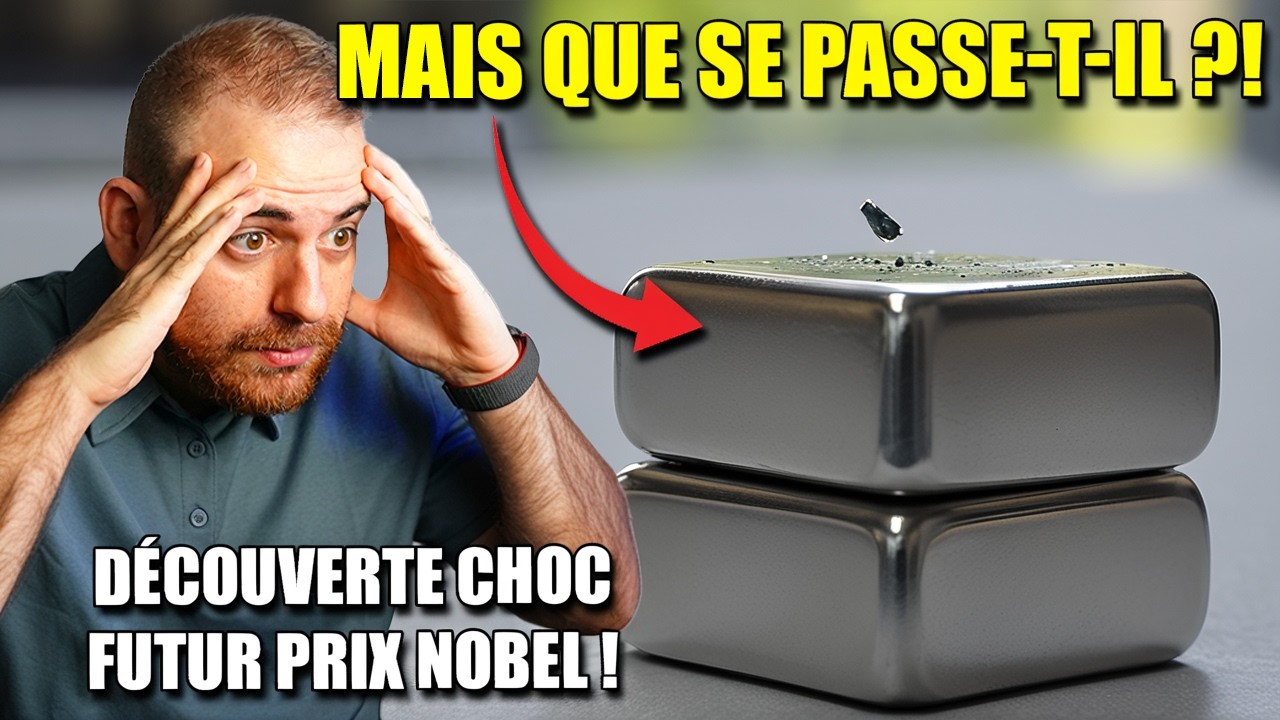
On vient de découvrir un nouvel état de la matière
Keywords
Summary
162 words
Critical Evaluation
Value of the Information & Strength of the Argument
The video provides a clear and engaging explanation of a complex scientific discovery, using analogies (weaving, DNA) to make it accessible. The argumentation is structured: it establishes the importance of crystals, introduces ferroelectricity, describes the unexpected observation, presents the evidence, and discusses implications. The comparison to quasicrystals is effective in contextualizing the significance. However, the video does not provide specific details about the experimental methods or the exact publication reference, which limits its scientific depth. The presenter’s enthusiasm is palpable but sometimes leads to speculative statements (e.g., Nobel Prize potential) that are not substantiated.
Scientific Rigor, Source Quality, Title Accuracy
The video mentions a publication in a Nature group journal and a review in Nature Physics, but does not provide direct links or citations. The description only contains links to the creator’s newsletter and training program, not to the scientific sources. The title is catchy but not misleading, as the discovery indeed represents a new state of matter. The video’s scientific rigor is moderate: it accurately describes the phenomenon but omits methodological details and does not provide references for the claims. The presenter’s background is in AI education, not physics, which may affect the depth of analysis.
206 words
Title / Content Match
The title is somewhat sensationalist but accurately reflects the core claim of a new, unexpected state of matter (3D weaving of ferroelectric domains).
Quality & Reliability
7/10
The video presents a recent discovery in ferroelectric materials, referencing a publication in a Nature group journal and a review in Nature Physics. The claims are plausible and align with known physics, but the video lacks direct citations or links to the primary sources, and the presenter's enthusiasm may lead to overstatement. The mention of a Nobel Prize potential is speculative.
Chapters
Cited Sources
- Newsletter Vision IA — Mentioned as a free daily newsletter for AI news.
- Formation IA Vision IA — Promoted as a comprehensive AI training program.
Concurring Sources
- Nature Physics (mentioned) — The video mentions a review in Nature Physics that surveys known crystal structures, implying the discovery is novel.
Contribution & Novelties
The video’s original contribution is to popularize a recent scientific discovery that is not yet widely known. It explains the concept of 3D weaving of ferroelectric domains in an accessible way, highlighting its potential implications for memory and computing. The video also connects the discovery to broader trends in materials science and AI-driven research.
Pour aller plus loin :
- Ferroelectricity — Provides background on ferroelectric materials and their properties.
- Quasicrystal — Historical context of a similar unexpected discovery that led to a Nobel Prize.
- Neuromorphic engineering — Relevant to the potential application in neuromorphic chips.
95 words
Radar Profile
The radar profile shows balanced scores across information quantity, quality, technical level, and reliability, indicating a well-rounded but not exceptional video. The technical level is moderate, making it accessible to a general audience while still conveying scientific content.