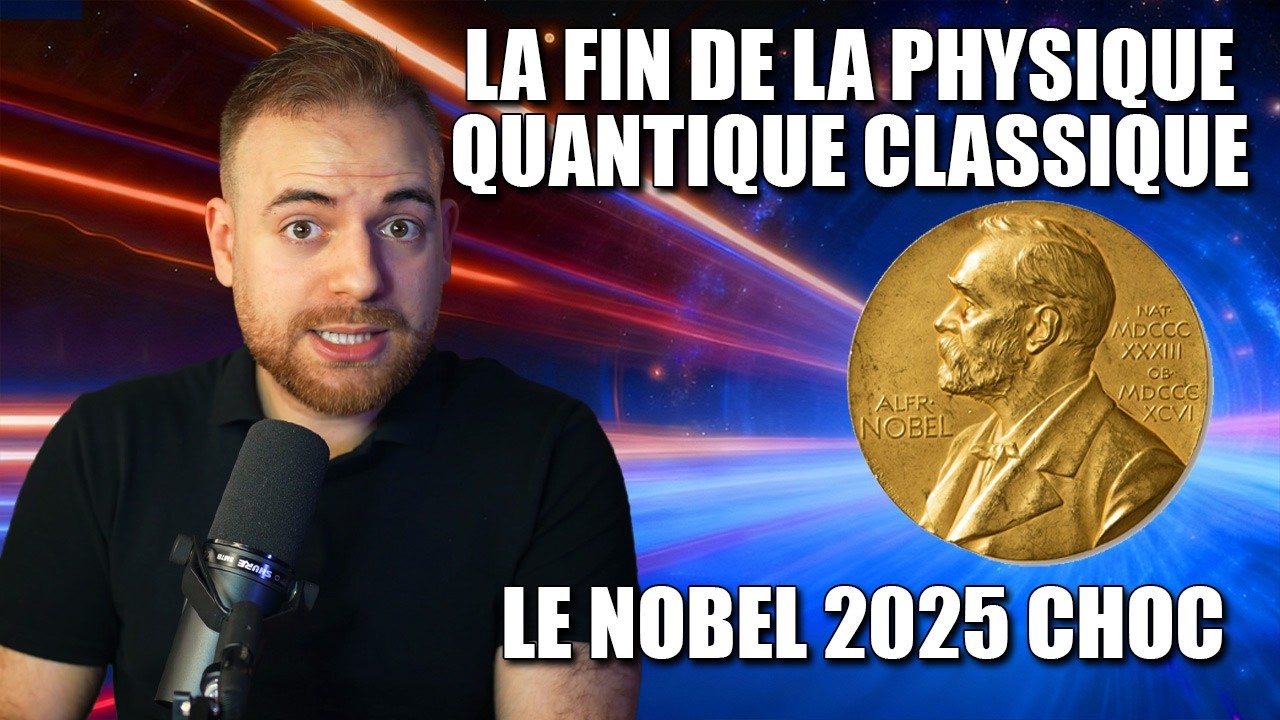
Des milliards d'électrons traversent un mur SANS y entrer : Nobel 2025 expliqué
Keywords
Summary
132 words
Critical Evaluation
Value of the Information & Strength of the Argument
The video provides a clear and engaging narrative of the Nobel Prize-winning work, effectively explaining the concept of macroscopic quantum tunneling and its significance. The argumentation is structured chronologically, from the 1985 experiments to modern applications, and uses analogies (e.g., particle in prison) to make the physics accessible. However, the scientific depth is limited, and some claims are exaggerated or imprecise, such as the description of electrons ‘crossing a wall’ and the potential of quantum computers. The promotional segment for the AI training program is a significant digression that weakens the scientific focus.
Scientific Rigor, Source Quality, Title Accuracy
The video does not cite specific scientific sources, but the description includes links to the creator’s newsletter and training program, which are not relevant to the scientific content. The title is somewhat sensationalist but is clarified in the video. The content is generally accurate but contains minor errors (e.g., ‘John Clark’ instead of ‘John Clarke’) and oversimplifications. The video does not provide references to the original 1985 papers or the Nobel committee’s announcement, which would have strengthened its credibility. The comments show a mix of appreciation and critical feedback, with some viewers pointing out the need for more precise language.
208 words
Title / Content Match
The title is somewhat sensationalist but broadly reflects the content, which explains the Nobel Prize-winning work on macroscopic quantum tunneling. The phrase 'traversent un mur SANS y entrer' is a simplification that could mislead, but the video does clarify the concept of the wavefunction.
Quality & Reliability
6/10
The video provides a generally accurate account of the 2025 Nobel Prize in Physics, correctly identifying the laureates and the phenomenon of macroscopic quantum tunneling. However, it contains several inaccuracies and exaggerations, such as the claim that 'billions of electrons cross a wall without entering it' and the misattribution of the Nobel to 'John Clark' instead of 'John Clarke'. The presentation is engaging but lacks depth and precise scientific detail, and the promotional segment for the creator's AI training program detracts from the scientific focus.
Chapters
Cited Sources
- Vision IA Newsletter — Mentioned in the video description as a way to subscribe to the creator's newsletter.
- Vision IA AI Training Program — Promoted at the end of the video as a paid training program for learning AI.
Concurring Sources
- Nobel Prize in Physics 2025 (official announcement) — Official source confirming the laureates and the scientific background.
Dissenting Sources
- Critique of macroscopic quantum tunneling claims — Some physicists argue that the term 'macroscopic' is misleading and that the quantum effects observed are still at the mesoscopic scale, not truly macroscopic.
Contribution & Novelties
The video provides a contemporary explanation of the 2025 Nobel Prize in Physics, highlighting the work of Clarke, Devoret, and Martinis on macroscopic quantum tunneling. It connects this fundamental discovery to modern quantum computing developments, such as IBM’s HSBC demonstration and China’s Zuchongzhi 3. The video also emphasizes the importance of fundamental research, a message that resonates with the scientific community.
Pour aller plus loin :
- Quantum tunnelling — Provides a comprehensive overview of the phenomenon.
- Josephson effect — Explains the physics behind the junctions used in the experiments.
- Quantum computing — Discusses the technology that builds on these discoveries.
100 words
Radar Profile
The radar profile shows moderate scores across all dimensions, with a slight strength in information quantity and a weakness in technical depth. This suggests the video is informative but not highly detailed, suitable for a general audience but not for experts seeking deep scientific analysis.
💬 Positif — Sur les 30 commentaires analysés, le climat est globalement positif, avec des éloges pour la clarté de la vidéo et l'intérêt du sujet, bien que certains commentaires critiquent le manque de précision scientifique et la promotion commerciale.