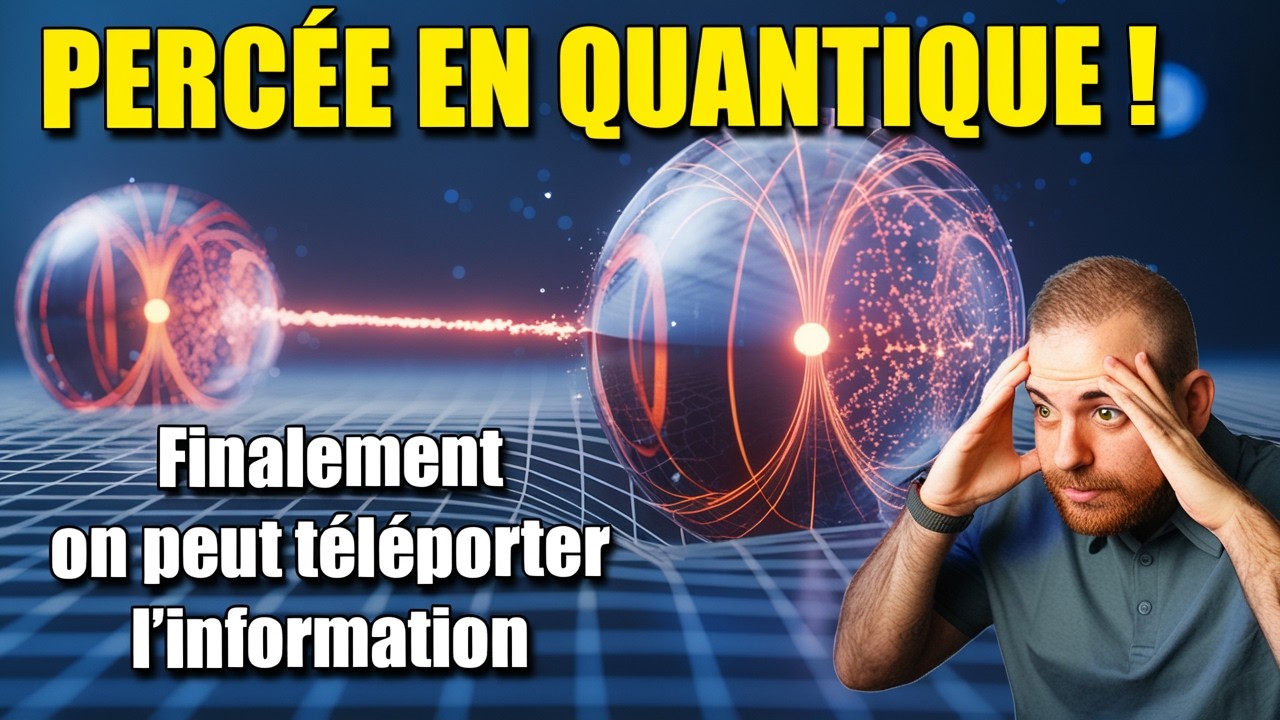
La téléportation de Star Trek vient de devenir réelle
Keywords
Summary
182 words
Critical Evaluation
The video provides a compelling and accessible overview of a significant scientific development in quantum information. The presenter effectively explains the no-cloning theorem and its implications, using analogies like Star Trek teleportation to make the concepts relatable. The explanation of the mathematical basis (the requirement that a number equal its square) is simplified but accurate. The introduction of the new protocol by Yamaguchi and Kempf is clear, and the distinction between cloning and reading is well-articulated. The video also reports on the experimental validation on IBM hardware, which adds credibility. However, there are some weaknesses. The video does not provide direct citations or links to the original papers, making it difficult for viewers to verify the claims. The presenter’s enthusiasm sometimes leads to oversimplification, such as the statement that the theorem has been ‘broken’ or ‘cracked’, when in fact it is circumvented. The video also does not discuss potential limitations or criticisms of the protocol. The adéquation between title and content is good, though the title is somewhat sensationalist. Overall, the video is informative and engaging, but viewers should seek primary sources for deeper understanding. The comments show a positive reception, with some requesting sources and others offering nuanced corrections about the no-cloning theorem.
204 words
Title / Content Match
The title is somewhat sensationalist but accurately reflects the content's focus on quantum teleportation and cloning breakthroughs.
Quality & Reliability
7/10
The video presents a recent scientific development (quantum cloning with encryption) with a clear explanation of the theoretical background and experimental validation. The claims are consistent with known quantum mechanics principles, and the video references a specific paper and experimental test. However, the video lacks explicit citations in the description, and the presenter's enthusiasm may oversimplify some nuances.
Chapters
Cited Sources
- Newsletter Vision IA — Mentioned as a free newsletter for tech news.
- Formation IA - Vision IA — Promoted as a paid AI training course.
Concurring Sources
- No-cloning theorem - Wikipedia — Confirms the theorem's statement and implications.
- Quantum teleportation - Wikipedia — Explains the standard teleportation protocol and its reliance on no-cloning.
Dissenting Sources
- Comment by user — A commenter noted that the no-cloning theorem is not 'broken' but circumvented, which is a nuance the video could have emphasized more.
Contribution & Novelties
The video presents a recent breakthrough in quantum information: the possibility of cloning encrypted quantum states, which was previously thought impossible. This has implications for quantum error correction and cloud quantum computing. The video explains the theoretical basis and experimental validation, making it accessible to a general audience.
Pour aller plus loin :
- No-cloning theorem - Wikipedia — Foundational concept explained.
- Quantum teleportation - Wikipedia — Related protocol.
- Physical Review Letters — Journal where the original paper was published (specific article not linked).
83 words
Radar Profile
The radar profile shows high scores in information quantity and quality, with a moderate technical level and reliability. This indicates a well-balanced video that is informative and accessible, but with room for improvement in citing sources and addressing nuances.
💬 Positive: The comments are overwhelmingly positive, with viewers expressing appreciation for the clear explanations and the fascinating topic. Some request sources, and a few offer technical corrections, but overall the reception is enthusiastic.