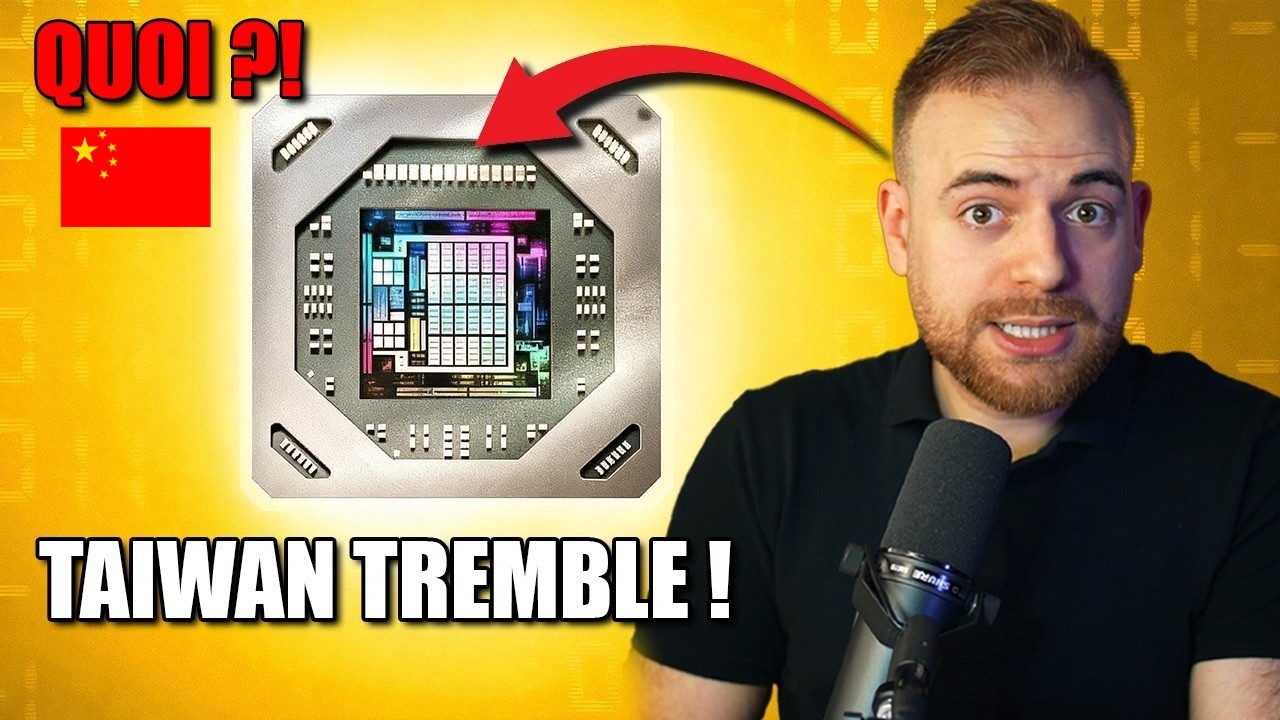
La Chine vient de construire sa propre machine EUV
Keywords
Summary
149 words
Critical Evaluation
Value of the Information & Strength of the Argument
The video provides valuable insights into the technical and strategic aspects of China’s EUV development, explaining complex concepts in an accessible manner. The argumentation is structured logically, moving from the basics of EUV to China’s specific challenges and strategic choices. However, the video lacks direct citations to primary sources, relying on general knowledge and unverified claims. The promotional segment for the creator’s AI training program, while not detracting from the technical content, is clearly a commercial pitch. Overall, the video offers a good overview but would benefit from more rigorous sourcing.
Scientific Rigor, Source Quality, Title Accuracy
The video demonstrates a reasonable level of scientific rigor, accurately describing the principles of EUV lithography and the challenges involved. However, it does not cite specific sources for its claims, such as the performance figures for Chinese prototypes or the details about Shanghai Aengna. The title accurately reflects the content, and the video’s structure with chapters helps viewers navigate the topics. The lack of direct references to primary sources or official announcements reduces the overall reliability, but the information presented is generally consistent with known developments in the field.
195 words
Title / Content Match
The title accurately reflects the main topic of the video, which discusses China's construction of an EUV machine prototype.
Quality & Reliability
6/10
The video provides a coherent overview of China's EUV lithography efforts, citing specific technical details and recent developments. However, it lacks direct citations to primary sources, relies on unverified claims, and includes promotional content for the creator's AI training program, which reduces overall reliability.
Chapters
Cited Sources
- Vision IA Newsletter — Mentioned as a way to receive daily AI news and ideas.
- Vision IA Training Program — Promoted at the end of the video as a comprehensive AI learning program.
Concurring Sources
- ASML's EUV technology — ASML's official description of EUV lithography, which aligns with the video's explanation.
Dissenting Sources
- Claims about Chinese EUV prototype power — The video states that Chinese prototypes achieve 100-150W, but without a verifiable source, this figure is uncertain and may be disputed.
Contribution & Novelties
The video provides a clear and up-to-date overview of China’s progress in EUV lithography, highlighting the alternative LDP method and the strategic implications. It offers a nuanced perspective on why China’s prototype is larger and less powerful, and how it might still be viable for domestic use. The video also connects these developments to the broader geopolitical competition over AI and semiconductor manufacturing.
Pour aller plus loin :
- Extreme ultraviolet lithography — Provides background on EUV technology and its challenges.
- ASML Holding — Information on the leading EUV machine manufacturer.
- Semiconductor industry in China — Context on China’s semiconductor sector and its strategic goals.
104 words
Radar Profile
The radar profile shows a balanced performance across information quantity, quality, and technical level, with a slightly lower reliability score due to lack of citations. This suggests the video is informative and technically sound but would benefit from more rigorous sourcing.
💬 No comments were provided for analysis.