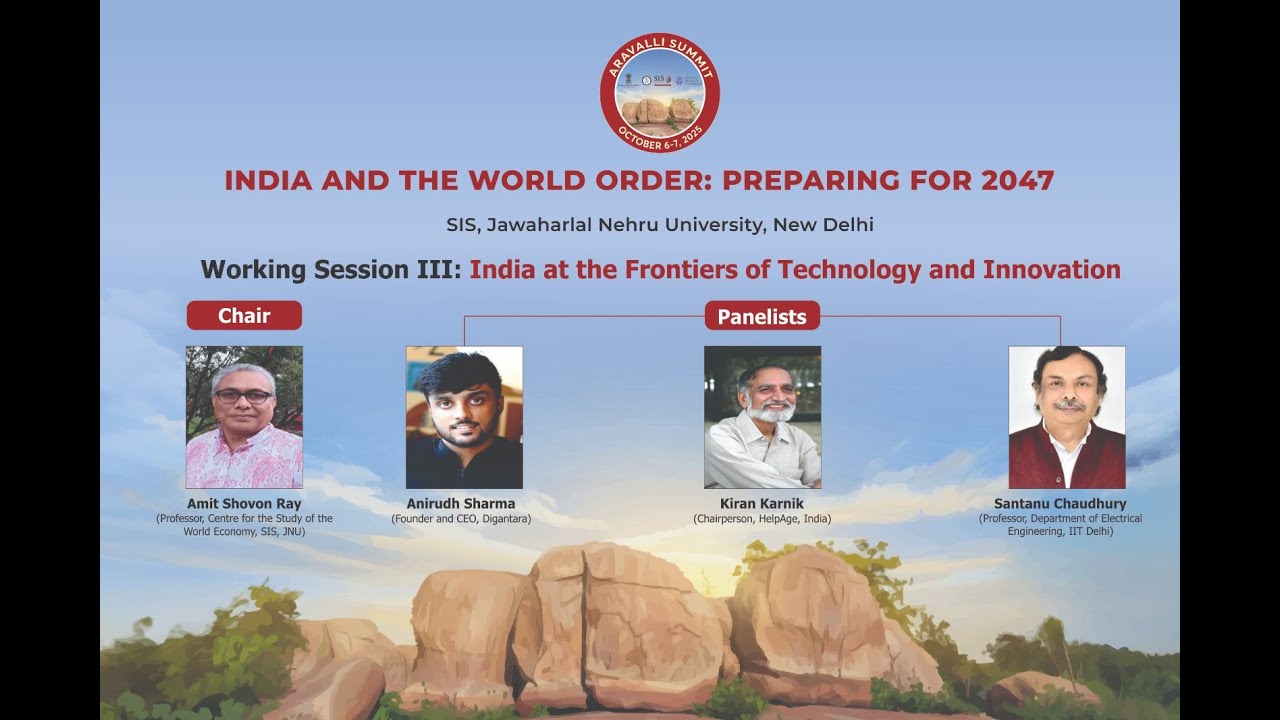
Working Session III: India at the Frontiers of Technology and Innovation
Keywords
Summary
172 words
Critical Evaluation
Value of the Information & Strength of the Argument
The session provides valuable insights from practitioners and academics, offering a mix of personal experience (Sharma) and strategic perspectives (Chaudhury, Karnik). Sharma’s account of building a space tech startup in India is concrete and informative, highlighting challenges and successes. Chaudhury’s argument for a human-centric approach to technology and the need for increased R&D is well-reasoned, though somewhat general. Karnik’s philosophical take on innovation and ‘jugaad’ is thought-provoking and adds a cultural dimension. The arguments are generally coherent, but some claims lack empirical backing, and the discussion remains at a high level without deep technical detail.
Scientific Rigor, Source Quality, Title Accuracy
The session is a panel discussion with expert opinions, but it does not cite specific sources or studies. The speakers reference general trends and personal experiences, which limits the scientific rigor. The title accurately reflects the content, focusing on India’s technological frontiers. The discussion is well-structured, but the lack of citations and data verification reduces its reliability as a scientific source.
171 words
Title / Content Match
The title accurately reflects the session's focus on India's technological frontiers and innovation, with panelists discussing space tech, AI, and innovation ecosystems.
Quality & Reliability
6/10
Panel of experts provides informed opinions and personal experiences, but lacks rigorous citations and data verification. The discussion is qualitative and forward-looking, with some statistical claims (e.g., satellite numbers) not sourced.
Key Moments
Markers derived by PSI from the transcript: the creator did not define chapters.
- Introduction and welcome by the chair, setting the context for the session.
- Professor Ray introduces the topic and provides historical examples of technology and geopolitics.
- Anirudh Sharma begins his presentation on space technology and his company Digantara.
- Sharma discusses the growth of satellites and India's position, and the role of space in geopolitics.
- Professor Chaudhury speaks about the fifth industrial revolution and the need for human-centric technology.
- Kiran Karnik shares his views on innovation, 'jugaad', and the importance of human imagination.
- Concluding remarks and Q&A session begins.
Contribution & Novelties
The session offers a unique blend of perspectives on India’s technological future, combining entrepreneurial experience, academic insight, and policy-oriented thinking. It highlights the importance of space situational awareness as a new frontier and emphasizes the need for a human-centric approach to AI. The discussion on ‘jugaad’ as a cultural asset provides a novel angle on innovation.
Pour aller plus loin :
- Space Situational Awareness — Relevant to Digantara’s work.
- Fourth Industrial Revolution — Context for the discussion.
- Jugaad — Concept discussed by Karnik.
83 words
Radar Profile
The radar profile shows moderate scores across all dimensions, with slightly higher scores in information quantity and reliability, reflecting a balanced but not deeply technical discussion.