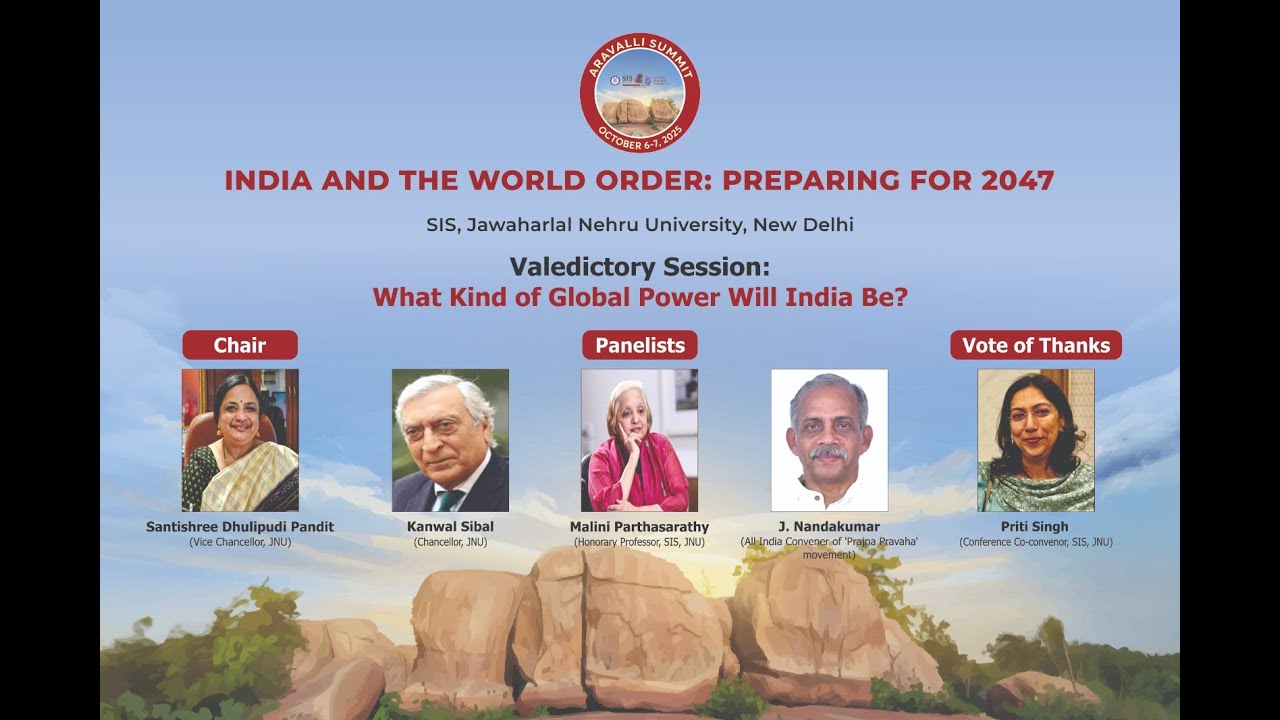
Valedictory Session: What Kind of Global Power Will India Be?
Keywords
Summary
190 words
Critical Evaluation
Value of the Information & Strength of the Argument
The value of the information lies in the diverse perspectives of the panelists, who bring deep experience in diplomacy, journalism, and academia. Ambassador Sibal provides a comprehensive analysis of global power dynamics, drawing on historical and contemporary examples. His argument that India should redefine the concept of global power based on its civilizational values is thought-provoking. Malini Parthasarathy offers a pragmatic view, highlighting the external challenges India faces and the need for strategic autonomy. The argumentation is generally coherent and well-structured, though it relies more on opinion and experience than on empirical data. The panelists do not engage in deep debate but rather present complementary viewpoints, which limits the critical examination of ideas.
Scientific Rigor, Source Quality, Title Accuracy
The session does not cite specific sources or references, but the speakers’ credentials lend credibility to their statements. The title accurately reflects the content, as the session directly addresses the question of India’s future global role. The discussion is grounded in real-world events and policy considerations, but lacks formal citations. The documentary on SIS’s history provides context but is not directly relevant to the main topic. Overall, the rigor is moderate, with a reliance on expert opinion rather than verifiable data.
209 words
Title / Content Match
The title accurately reflects the session's focus on India's future role as a global power, with panelists addressing the question directly.
Quality & Reliability
7/10
The session features distinguished diplomats and scholars providing informed perspectives on India's global role, but it is primarily an opinion-led debate without rigorous citation of sources or empirical data.
Key Moments
Markers derived by PSI from the transcript: the creator did not define chapters.
- Introduction and welcome remarks by the moderator.
- Documentary on the history of SIS, highlighting its founding and evolution.
- Ambassador Kanwal Sibal begins his keynote address on defining global power.
- Sibal discusses India's civilizational legacy and its implications for its global role.
- Sibal concludes his address, emphasizing India's unique approach to global power.
- Malini Parthasarathy begins her presentation on India's external challenges.
- Parthasarathy discusses the impact of US policies and the need for strategic autonomy.
- Panel discussion begins, with speakers responding to questions from the audience.
- Discussion on India's relations with China and Russia.
- Concluding remarks by the Vice Chancellor, summarizing the session's key points.
Contribution & Novelties
The session provides a nuanced perspective on India’s potential as a global power, arguing for a model based on cooperation and civilizational values rather than traditional power politics. It offers a unique blend of diplomatic and academic insights, contributing to the discourse on India’s future role.
Pour aller plus loin :
- Non-Aligned Movement — Historical context for India’s strategic autonomy.
- Vasudhaiva Kutumbakam — The concept of ‘world is one family’ referenced in the discussion.
- India’s Act East Policy — Related to India’s regional engagement.
84 words
Radar Profile
The radar profile shows moderate to high scores across all dimensions, with the highest in 'quantite_information' and 'qualite_information', indicating a content-rich discussion. The 'niveau_technique' is moderate, reflecting the accessible yet informed nature of the debate. The 'fiabilite_globale' is slightly lower due to the lack of formal citations.