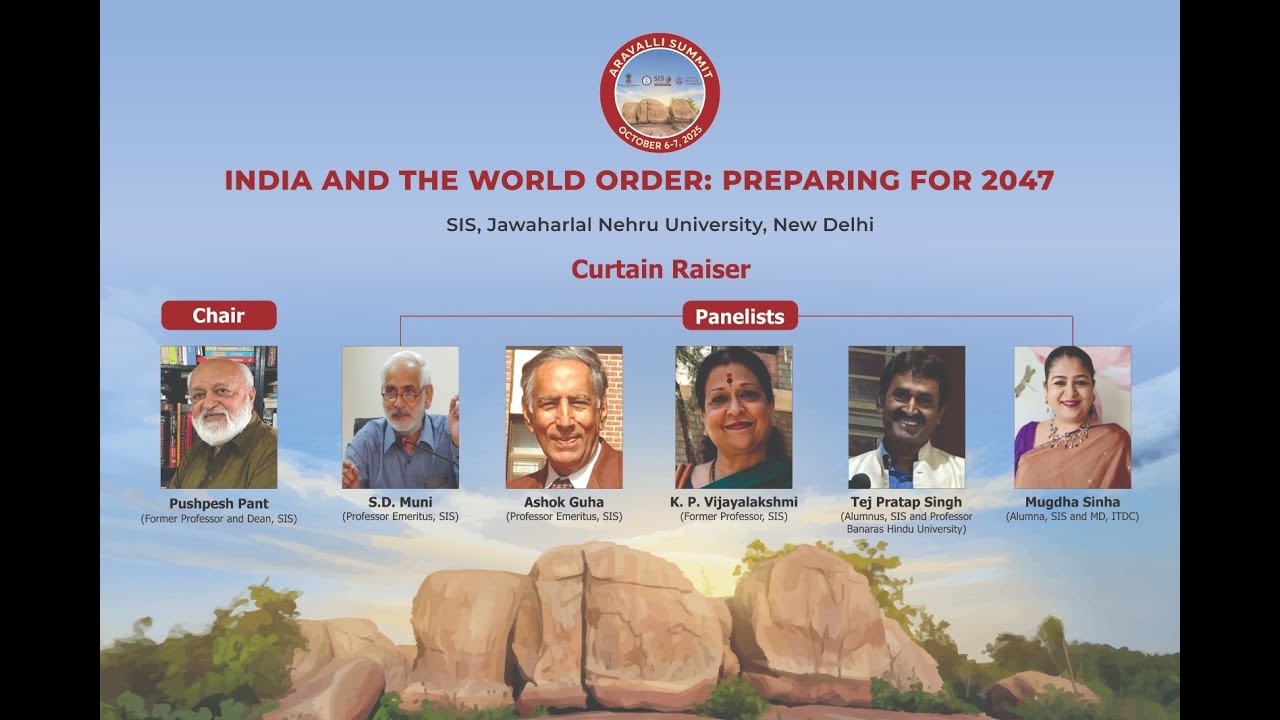
Aravalli Summit 2025: Curtain Raiser
Keywords
Summary
198 words
Critical Evaluation
Value of the Information & Strength of the Argument
The video provides valuable firsthand accounts of the history and evolution of SIS, offering unique insights into its institutional culture and contributions to international studies in India. The panelists’ personal stories add depth and authenticity, illustrating the school’s impact on individuals and the nation. The argumentation is largely anecdotal and reflective, rather than analytical, but it effectively conveys the significance of SIS as a center of learning and policy engagement. The documentary portion is well-produced and informative, though it presents a celebratory narrative without critical examination.
Scientific Rigor, Source Quality, Title Accuracy
The video is a primary source, featuring direct testimonies from individuals who were part of SIS’s history. However, it does not cite external sources or provide references for the claims made. The title accurately reflects the content, as it is indeed a curtain raiser for the Aravalli Summit. The content is consistent with the title, focusing on the school’s legacy and setting the stage for the summit’s discussions.
169 words
Title / Content Match
The title accurately reflects the content, which is a curtain raiser event for the Aravalli Summit, featuring a documentary and reminiscences.
Quality & Reliability
7/10
The video is an institutional documentary and panel discussion featuring eminent academics and alumni. It provides firsthand accounts and historical details, but lacks citations to external sources and is partly promotional.
Key Moments
Markers derived by PSI from the transcript: the creator did not define chapters.
- Introduction and welcome by a PhD student from SIS, outlining the Aravalli Summit's theme and purpose.
- Start of the documentary on SIS's 70-year history, from its founding in 1955.
- Documentary covers the merger with JNU in 1970 and expansion of centers.
- Documentary discusses the 1990s changes and SIS's role in shaping India's nuclear doctrine and WTO negotiations.
- Documentary highlights SIS's expansion into new areas like environmental governance and Indo-Pacific studies.
- Documentary concludes with reflections on SIS's legacy and future.
- Panel discussion begins with introduction of panelists by the moderator.
- Pushpesh Pant shares reminiscences, including anecdotes about professors and the school's early days.
- Ashok Guha tells humorous stories about the first vice-chancellor and the Bulgarian computer.
- Panel continues with more reminiscences and reflections on SIS's impact.
Contribution & Novelties
The video offers a unique insider perspective on the history and evolution of SIS, providing personal anecdotes and reflections that are not typically found in official histories. It highlights the school’s role in shaping India’s foreign policy discourse and its commitment to indigenous knowledge production. The documentary and panel discussion together provide a rich narrative of institutional memory.
Pour aller plus loin :
- School of International Studies, JNU — Official website for further information on the school’s programs and history.
- International Studies journal — The journal launched by SIS in 1959, now published by Sage.
- Jawaharlal Nehru University — Official website of JNU, providing context on the university’s history and structure.
111 words
Radar Profile
The radar profile shows high scores in quantity and quality of information, reflecting the rich historical content and firsthand accounts. The technical level is moderate, as the content is accessible to a general audience. The overall reliability is good, given the credibility of the speakers, though the lack of external citations slightly reduces the score.