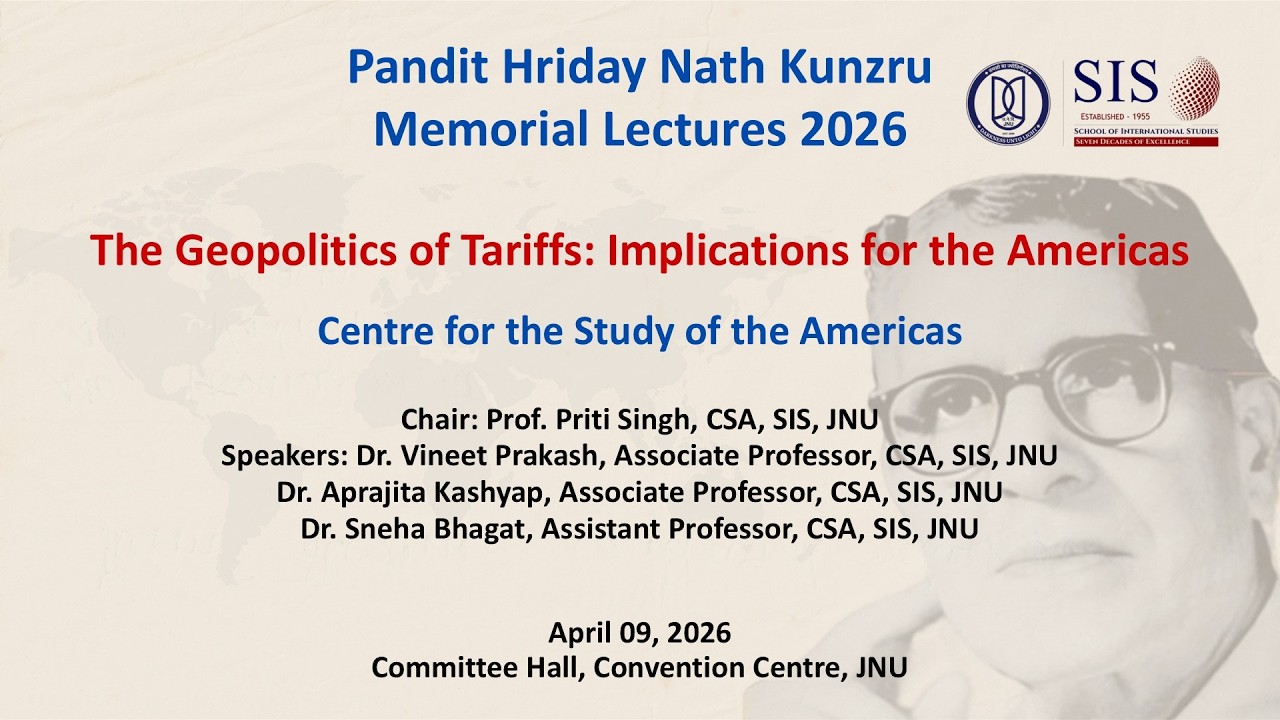
The Geopolitics of Tariffs: Implications for the Americas
Keywords
Summary
198 words
Critical Evaluation
Value of the Information & Strength of the Argument
The video provides valuable insights into the geopolitical dimensions of tariffs, offering a multi-perspective analysis from US, Canadian, and Latin American viewpoints. The argumentation is generally solid, with speakers grounding their points in historical context and contemporary examples. Dr. Prakash effectively deconstructs Trump’s claims about tariffs, using data to show that revenue generation has been minimal and that tariffs act as a regressive tax. Dr. Bhagat’s application of the staples thesis and weaponized interdependence concepts adds analytical depth. However, some arguments could be strengthened with more empirical evidence, and the discussion occasionally lacks critical engagement with counterarguments.
Scientific Rigor, Source Quality, Title Accuracy
The speakers demonstrate academic rigor by referencing historical events and economic theories, but they do not cite specific sources or provide verifiable references. The title accurately reflects the content, which is focused on the geopolitical implications of tariffs for the Americas. The video does not include any commercial advertisements or sponsorships. The discussion is well-structured and maintains a high level of expertise, though the lack of explicit citations limits its scholarly rigor.
184 words
Title / Content Match
The title accurately reflects the content, which focuses on the geopolitical implications of tariffs for the Americas, including the US, Canada, and Latin America.
Quality & Reliability
7/10
The video features academic experts from JNU providing a structured analysis of tariffs' geopolitical implications, with references to historical and contemporary examples. However, it lacks citations to specific sources and contains some unverified claims, reducing its overall reliability.
Key Moments
Markers derived by PSI from the transcript: the creator did not define chapters.
- Introduction by chair Prof. Priti Singh, framing the discussion on tariffs and geopolitical realignment.
- Dr. Vineet Prakash begins his presentation on tariffs and their role in world trade.
- Dr. Prakash discusses Trump's rationale for tariffs and their impact on the US economy.
- Dr. Sneha Bhagat starts her analysis of Canada's economic history and the staples thesis.
- Dr. Bhagat explains the concept of weaponized interdependence and Canada's response to tariffs.
- Discussion on the USMCA sunset clause and the future of North American trade relations.
Cited Sources
- Pandit Hriday Nath Kunzru Memorial Lectures 2026 — The video itself is part of this lecture series, providing the context for the discussion.
Concurring Sources
- The Geopolitics of Tariffs: Implications for the Americas — The video itself serves as a primary source, presenting the panel's analysis.
Contribution & Novelties
The video offers a comprehensive and nuanced analysis of the geopolitical implications of tariffs on the Americas, integrating perspectives from the US, Canada, and Latin America. It contributes to the discourse by highlighting the structural dependencies and the weaponization of interdependence, as well as the challenges posed by the USMCA’s sunset clause. The discussion provides a timely examination of how tariffs are reshaping global trade patterns and the multilateral trading system.
Pour aller plus loin :
- Staples thesis — Relevant to understanding Canada’s economic history and its reliance on raw material exports.
- Weaponized interdependence — Key concept used to analyze how states exploit asymmetric dependencies in global networks.
- USMCA — The trade agreement central to the discussion of North American trade relations and its sunset clause.
126 words
Radar Profile
The radar profile shows high scores in quantity of information and technical level, indicating a content-rich and moderately technical discussion. The quality of information and global reliability are also strong, reflecting the academic expertise of the speakers. The overall balance suggests a reliable and informative analysis, though with room for more explicit sourcing.