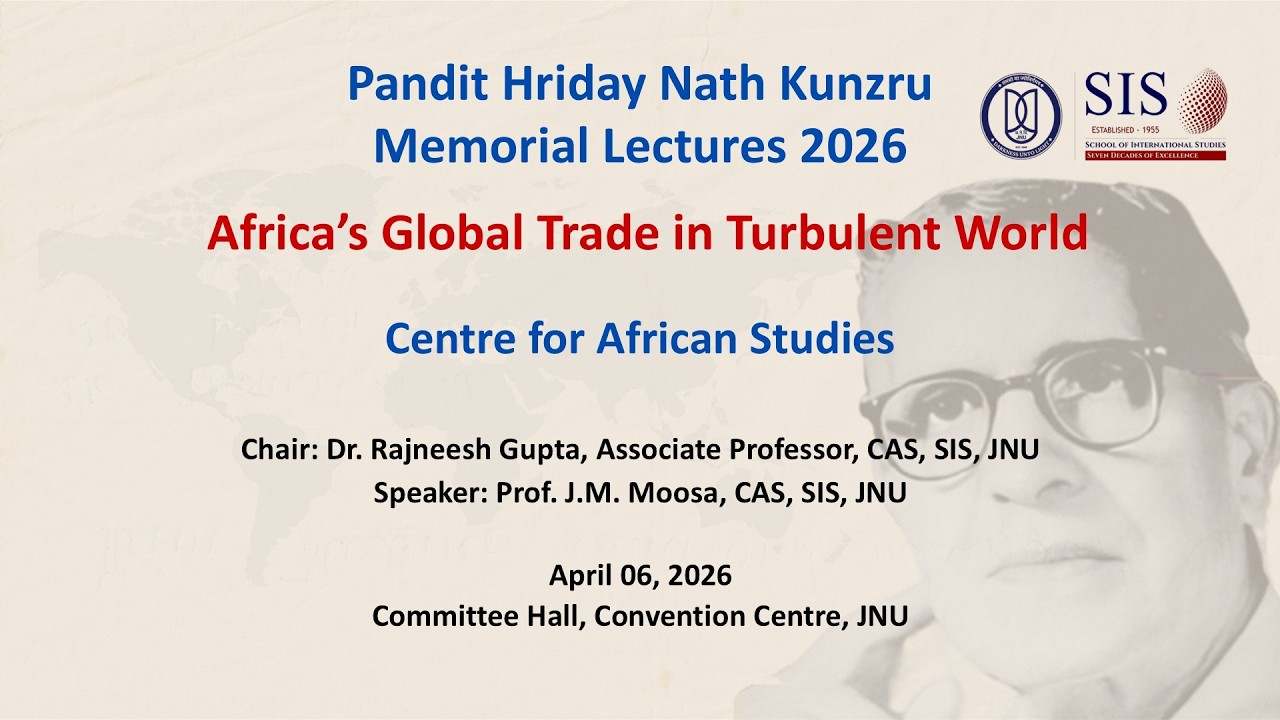
Africa’s Global Trade in Turbulent World
Keywords
Summary
144 words
Critical Evaluation
Value of the Information & Strength of the Argument
The lecture provides a valuable synthesis of Africa’s trade history and current challenges, offering a broad perspective that is useful for understanding the continent’s position in the global economy. The argumentation is coherent, tracing historical legacies to present-day structures, and emphasizes the need for African integration and value addition. However, the argumentation relies heavily on generalizations and lacks deep empirical analysis or specific case studies, which limits its robustness. The speaker acknowledges this limitation, noting the need for more detailed examination.
Scientific Rigor, Source Quality, Title Accuracy
The lecture demonstrates moderate scientific rigor, drawing on historical facts and some statistical data (e.g., UNCTAD studies, trade figures). However, specific sources are not cited in detail, and the data presented is not systematically referenced. The title accurately reflects the content, which is a broad overview of Africa’s global trade. The speaker’s expertise lends credibility, but the lack of precise citations and the reliance on general knowledge reduce the overall rigor.
167 words
Title / Content Match
The title accurately reflects the content, which focuses on Africa's global trade dynamics amidst current global turbulence.
Quality & Reliability
7/10
The lecture is an expert opinion by a professor of African Studies, providing a broad historical and contemporary overview of Africa's trade. It relies on general knowledge and some cited statistics (UNCTAD, etc.) but lacks detailed citations or rigorous data verification. The speaker acknowledges generalizations and the need for deeper analysis.
Key Moments
Markers derived by PSI from the transcript: the creator did not define chapters.
- Introduction by chair, Dr. Rajneesh Gupta, setting the context of Africa as a playground in international politics.
- Speaker begins, acknowledging lack of expertise and outlining the lecture's scope.
- Historical overview: Portuguese arrival, Estado da India, and the Atlantic slave trade.
- Discussion of colonial partitioning at the Berlin Conference and its lasting impact on African boundaries.
- Analysis of colonial economic structures: labor reservoirs, plantation economies, and mining complexes.
- Mention of the CFA franc zone and its monetary implications for former French colonies.
- Current trade statistics: Africa's share of global exports, concentration in fuels and minerals, and comparison of trade vs. aid and FDI.
- Discussion of Africa's critical minerals for the energy transition and the skewed distribution of exports among countries.
- Examination of intra-African trade and the potential of the African Continental Free Trade Area (AfCFTA).
- Challenges to AfCFTA implementation, including ratification status and unresolved rules of origin.
- Impact of global shocks (e.g., Ukraine war) on African food security and energy diversification efforts.
- Concluding remarks on Africa's agency in negotiating its future in a turbulent world.
Cited Sources
- UNCTAD studies on African trade — Referenced for data on African export composition and concentration.
- African Continental Free Trade Area (AfCFTA) — Discussed as a policy initiative for African integration.
Concurring Sources
- UNCTAD — Provides data on African trade patterns and development.
Contribution & Novelties
The lecture provides a comprehensive historical and contemporary overview of Africa’s trade, emphasizing the persistence of primary commodity dependence and the potential of AfCFTA. It offers a balanced perspective on Africa’s agency in global negotiations.
Pour aller plus loin :
- African Continental Free Trade Area — Overview of the AfCFTA, its objectives, and implementation status.
- CFA franc — Explanation of the CFA franc zone and its economic implications.
- Berlin Conference — Historical context of the partitioning of Africa.
- UNCTAD — Source for trade statistics and analysis on developing economies.
89 words
Radar Profile
The radar profile shows moderate scores across all dimensions, with slightly higher scores in information quantity and quality, reflecting the lecture's broad coverage but limited depth. The low technical level indicates accessibility to a general audience, while the moderate reliability suggests a need for more rigorous sourcing.
💬 No comments were provided for analysis.