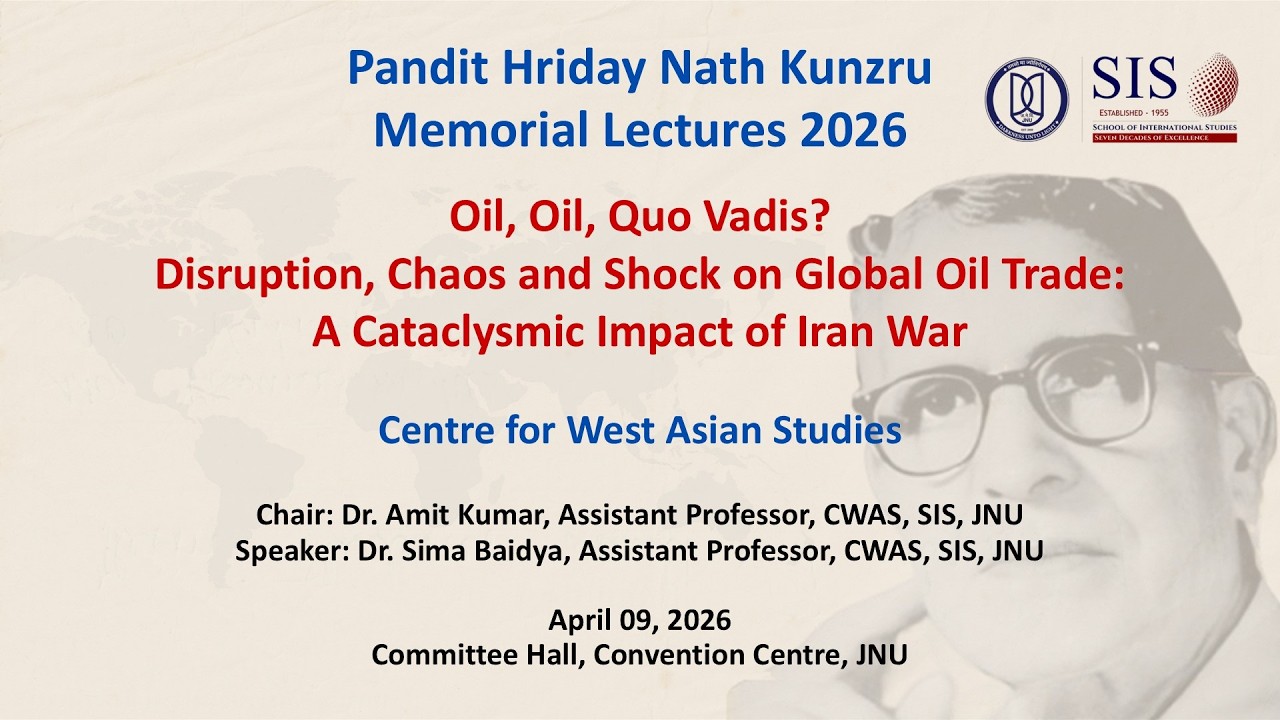
Oil, Oil, Quo Vadis? Disruption, Chaos and Shock on Global Oil Trade
Keywords
Summary
181 words
Critical Evaluation
Value of the Information & Strength of the Argument
The lecture provides valuable insights into the geopolitical and economic dimensions of the Iran war, particularly focusing on the disruption to global oil supply and its disproportionate impact on Asian economies. The speaker effectively uses data to illustrate the scale of disruption and the dependence of various countries on the Strait of Hormuz. The argumentation is coherent, linking the war to broader systemic issues such as the capitalist system and petrodollar dominance. However, the presentation is largely descriptive and lacks a rigorous theoretical framework, as the speaker herself notes that it is not a theoretical work. The argumentation relies heavily on the speaker’s expertise and personal interpretation, with limited engagement with alternative perspectives or counterarguments.
Scientific Rigor, Source Quality, Title Accuracy
The lecture demonstrates moderate scientific rigor. The speaker cites some data points and references, such as the Energy Information Administration and a bulletin from the Waste Rainforest Movement, but does not provide systematic citations or a bibliography. The sources used are not always clearly identified or verifiable from the transcript. The title accurately reflects the content, which focuses on disruption, chaos, and shock in global oil trade. The lecture is well-structured, but the lack of detailed sourcing and the reliance on anecdotal evidence (e.g., personal experiences with gas booking) detract from its overall rigor. No comments were provided for analysis.
230 words
Title / Content Match
The title accurately reflects the content, which discusses disruption, chaos, and shock in global oil trade due to the Iran war.
Quality & Reliability
6/10
The lecture provides a broad overview of the impact of the Iran war on global oil trade, with some data points and references, but lacks detailed citations and rigorous sourcing. The speaker is an academic expert in the field, lending credibility, but the presentation is more of an expert opinion than a peer-reviewed analysis.
Key Moments
Markers derived by PSI from the transcript: the creator did not define chapters.
- Introduction by chair Dr. Amit Kumar, setting the context of the lecture.
- Speaker begins her presentation, explaining the title 'Quo Vadis' and outlining the focus on economic aspects.
- Discussion of the start of the US-Israeli war on Iran and the scale of oil supply disruption (20%).
- Data on Asian market dependence on the Strait of Hormuz, including China, Japan, South Korea, and India.
- Analysis of Iran's oil exports, sanctions, and the role of the shadow fleet.
- Comparison of oil exporters and reserves, highlighting Iran's position despite sanctions.
- Impact on oil prices, volatility linked to Trump's statements, and effects on other sectors.
- Discussion of attacks on energy infrastructure and the broader economic consequences.
- Examination of Israel's energy vulnerabilities and Iran's retaliation doctrine.
- Conclusion on the systemic nature of the war and the recent ceasefire's impact on oil prices.
Cited Sources
- Energy Information Administration (EIA) — Cited for data on Israel's oil reserves and production.
- Waste Rainforest Movement Bulletin — Quoted on petroleum as a pillar of capitalist expansion.
- Gary Wilson, La Lucha for Socialismo — Quoted on the US war on Iran being waged for decades through sanctions.
Concurring Sources
- International Energy Agency (IEA) — Mentioned in the lecture regarding the release of strategic reserves.
Contribution & Novelties
The lecture provides a timely analysis of the Iran war’s impact on global oil trade, emphasizing the disproportionate effect on Asian economies and the systemic nature of the conflict. It offers a unique perspective on the intersection of oil, geopolitics, and capitalism, drawing on historical parallels and current data. The speaker’s expertise on Iran and the Persian Gulf adds depth to the discussion.
Pour aller plus loin :
- Strait of Hormuz — Key chokepoint for global oil trade, central to the lecture’s analysis.
- Petrodollar recycling — Concept relevant to the discussion of petrodollar hegemony.
- Iran’s economy — Provides background on Iran’s economic resilience and diversification.
105 words
Radar Profile
The radar profile shows a balanced but moderate performance across all dimensions, with quantity of information slightly higher than quality and technical level. This suggests the lecture is informative but lacks deep analytical rigor and technical sophistication.