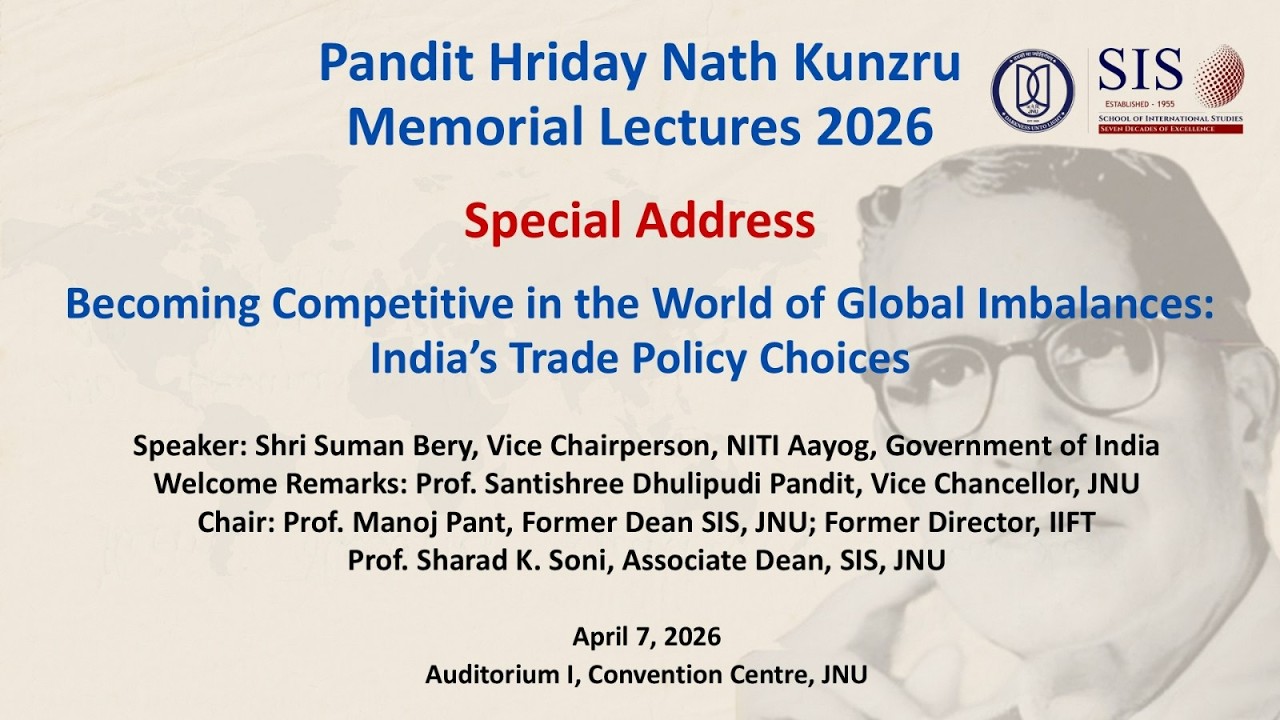
Special Address by Shri Suman Bery, Vice Chairperson, NITI Aayoga at KML 2026 in JNU
Keywords
Summary
164 words
Critical Evaluation
Value of the Information & Strength of the Argument
The talk provides valuable insights into India’s economic policy thinking from a high-level official. Bery’s argument for a ’third path’ is well-structured, contrasting with historical models and emphasizing India’s unique position. He effectively argues that India’s size and growth give it agency, and that domestic reforms are key. The argumentation is coherent, though it relies more on strategic vision than on detailed data or empirical evidence. The speaker’s authority adds weight, but the lack of specific policy details or citations limits the depth of the argument.
Scientific Rigor, Source Quality, Title Accuracy
The talk is an expert opinion rather than a rigorous academic presentation. Bery references general concepts (e.g., Arthur Lewis, total factor productivity) but does not cite specific sources. The title is only partially accurate as the speaker explicitly shifts his focus due to recent events. The content is more about strategic direction than detailed trade policy analysis. No comments were provided for analysis.
164 words
Title / Content Match
The title is somewhat misleading as the speaker explicitly changes his focus to 'Finding opportunity in crisis' due to recent global events, though the core themes of trade and competitiveness remain.
Quality & Reliability
7/10
The speaker is a high-ranking policy official with extensive experience, providing informed perspectives on India's economic strategy. However, the talk is largely opinion-based and lacks detailed empirical evidence or citations.
Key Moments
Markers derived by PSI from the transcript: the creator did not define chapters.
- Welcome remarks by Vice Chancellor Prof. Santishree Dhulipudi Pandit.
- Introduction of speaker and chair by Prof. Manoj Pant.
- Suman Bery begins his address, acknowledging the recent global changes and reframing his talk.
- Discussion on India's position as the fourth-largest economy and its agency in the global system.
- Introduction of the 'third path' development model, balancing openness and prudence.
- Emphasis on supply-side growth, raising fixed capital formation, and total factor productivity.
- Discussion on the role of NITI Aayog in center-state cooperation and inclusive growth.
- Concluding remarks on the need for a theory of reform and long-term thinking.
Cited Sources
- NITI Aayog — Mentioned as the institution he represents.
- World Bank — Referenced for defining advanced economy criteria.
Concurring Sources
- IMF World Economic Outlook — Provides data on India's economic growth and global imbalances.
Contribution & Novelties
The talk offers a high-level strategic perspective on India’s economic policy, particularly the ’third path’ concept. It provides insight into the thinking of a key policy advisor. The emphasis on domestic agency and the need for a tailored reform theory is noteworthy.
Pour aller plus loin :
- India’s Trade Policy — Overview of India’s trade policy history.
- Total Factor Productivity — Concept central to the discussion on growth.
- NITI Aayog — Background on the institution.
75 words
Radar Profile
The radar profile shows balanced scores across information quantity, quality, technical level, and reliability, indicating a well-rounded but not exceptional presentation. The talk is strong on strategic insight but lacks detailed empirical support.