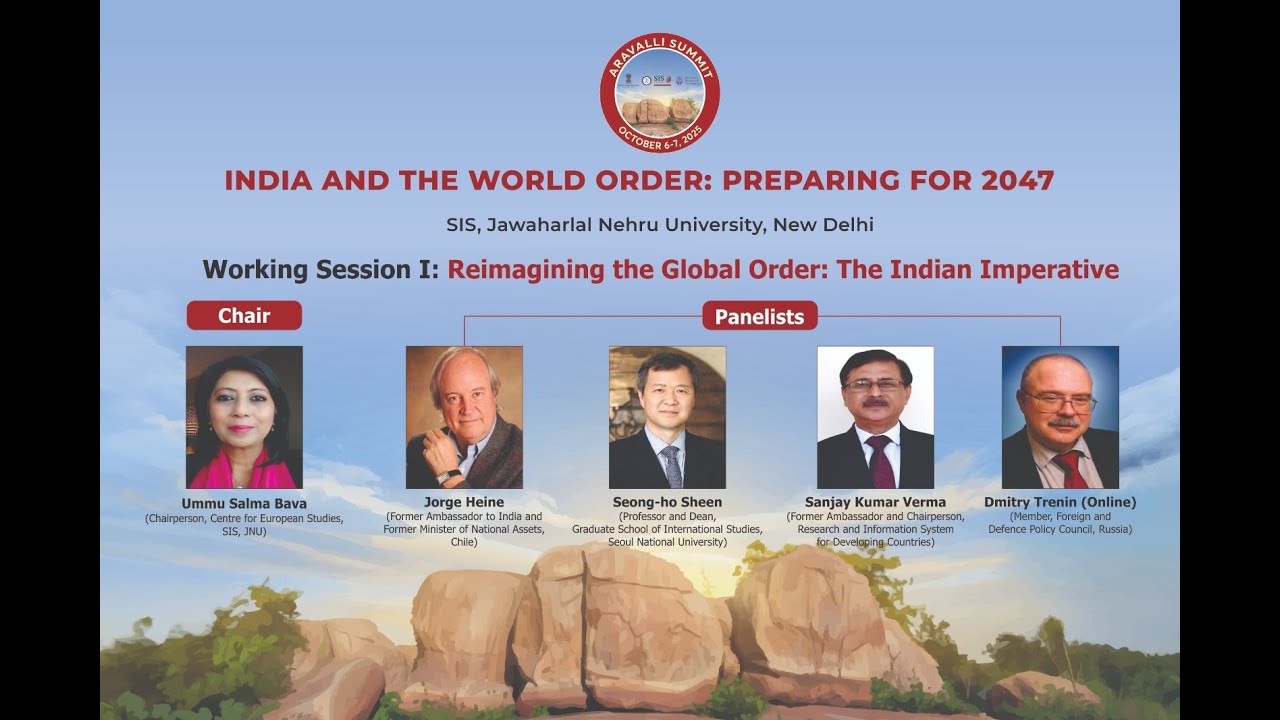
Working Session I: Reimagining the Global Order: The Indian Imperative
Keywords
Summary
150 words
Critical Evaluation
Value of the Information & Strength of the Argument
The session provides valuable insights into the current global order’s fragility and the role of emerging powers like India. Ambassador Heine’s argument that the West is breaking up and being reconfigured as a civilizational entity is provocative and well-articulated, supported by examples such as the UN vote and tariffs on India. The discussion on the ‘rise of the rest’ and the wealth shift to Asia is substantiated with statistics. Professor Sheen’s comparative perspective adds depth, highlighting shared historical experiences and the potential for Korea-India cooperation. The chair’s framing of seven key points provides a structured approach. However, some arguments rely on broad generalizations and lack detailed evidence, and the panelists’ perspectives are largely aligned, with limited critical debate.
Scientific Rigor, Source Quality, Title Accuracy
The panelists cite several sources, including Antonio Gramsci’s ‘Prison Notebooks’, Fareed Zakaria’s ‘The Rise of the Rest’, and Samuel Huntington’s ‘Clash of Civilizations’. They also reference specific data points, such as the G7’s declining GDP share and the number of foreign service officers. The title accurately reflects the content, focusing on India’s imperative in reimagining the global order. The discussion is rigorous in its use of expert opinions and historical references, though some claims are not fully sourced. The session is a debate format, so it does not provide a systematic literature review, but it offers a well-informed exchange of ideas.
234 words
Title / Content Match
The title accurately reflects the session's focus on reimagining the global order from an Indian perspective, as the panelists discuss India's role in a changing world.
Quality & Reliability
7/10
The discussion features experienced diplomats and academics providing informed perspectives on global order transitions. While not peer-reviewed, the panelists' expertise and the structured format lend credibility. Some claims are presented without detailed evidence, but overall the content is reliable.
Key Moments
Markers derived by PSI from the transcript: the creator did not define chapters.
- Introduction and welcome by Aayushi, setting the stage for the session on reimagining the global order.
- Chair Ummu Salma Bava outlines seven key points for discussion, including fragility of the global system, shifting power balances, and contested norms.
- Ambassador Jorge Heine argues that the liberal international order is dead, citing the breakup of the West and the rise of the rest.
- Heine discusses the wealth shift to Asia and the need for India to take a more active role in global leadership.
- Professor Seong-ho Sheen draws parallels between Korea and India's independence histories and emphasizes cooperation in shaping the future.
- Sheen highlights the importance of India's economic growth and its potential role in the global order.
- Ambassador Sanjay Kumar Verma's remarks (not fully captured) on India's foreign policy and global role.
- Q&A session and concluding remarks from the chair, summarizing the key themes.
Cited Sources
- Prison Notebooks — Quoted by Jorge Heine to describe the interregnum between the old and new world orders.
- The Rise of the Rest — Referenced by Heine to describe the growing influence of non-Western countries.
- Clash of Civilizations — Mentioned by Heine to argue that the current conflict is a white nationalist Christian revival.
Concurring Sources
- World Bank data on GDP shares — Referenced by Heine to illustrate the economic shift to Asia.
- IMF data on India's GDP — Mentioned by Sheen to highlight India's economic growth.
Dissenting Sources
- Claims of US decline — Heine argues the US is not in absolute decline but the West is breaking up; some scholars may contest this view.
Contribution & Novelties
The session offers a nuanced perspective on the global order transition, emphasizing India’s potential as a bridge between the global north and south. It contributes to the discourse by framing the current crisis as a ’time of monsters’ and highlighting the breakup of the West as a civilizational entity. The discussion on the ‘rise of the rest’ and the wealth shift to Asia provides a fresh lens on global power dynamics.
Pour aller plus loin :
- Multiplex World — Concept by Amitav Acharya, referenced indirectly, relevant to understanding the emerging global order.
- Liberal International Order — Background on the order that is being discussed as dead.
- Global South — Key concept in the discussion on India’s role.
117 words
Radar Profile
The radar profile shows high scores in quantity and quality of information, reflecting the depth of discussion. The technical level is moderate, suitable for an informed audience. Overall reliability is good, given the expertise of the panelists.
💬 No comments were provided for analysis.