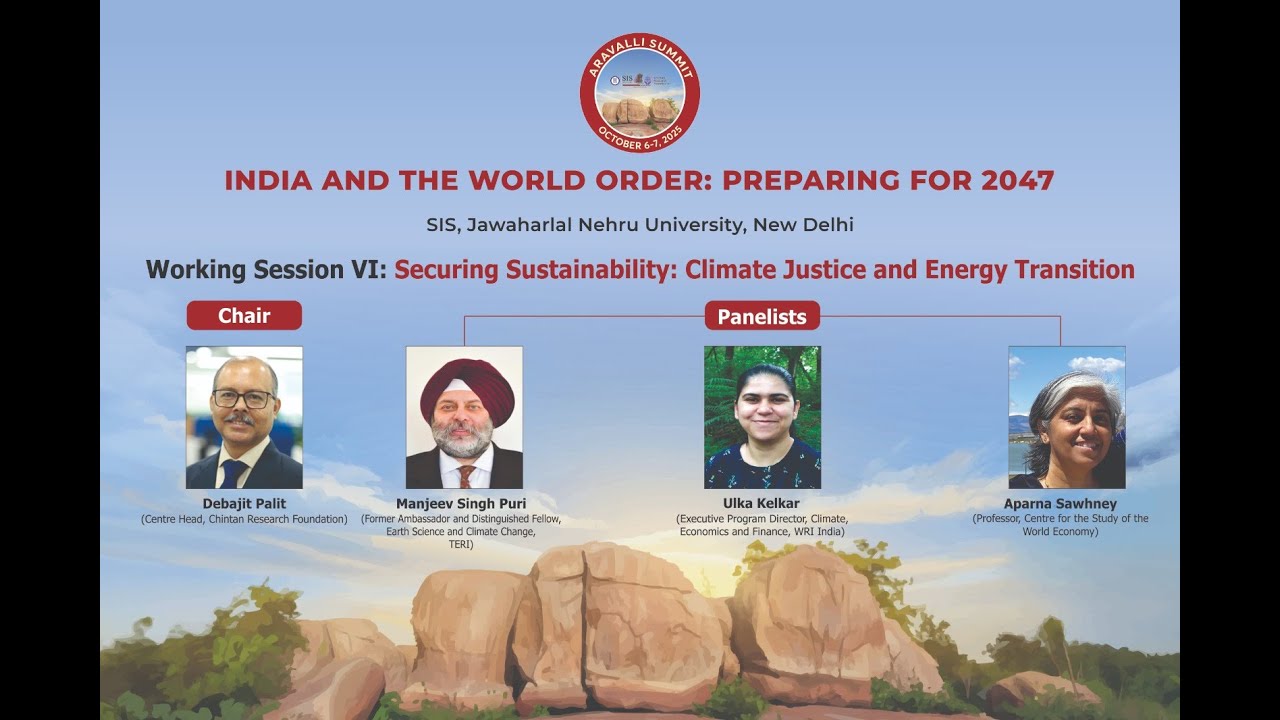
Working Session VI: Securing Sustainability: Climate Justice and Energy Transition
Keywords
Summary
146 words
Critical Evaluation
Value of the Information & Strength of the Argument
The value of the information lies in the high-level expertise of the panelists, who provide nuanced perspectives on climate governance, finance, and trade. Ambassador Puri’s argumentation is strong, grounding his points in historical context and current geopolitical realities, such as the US withdrawal from the Paris Agreement and the role of the G77. Ulka Kelkar’s presentation is data-driven, referencing a systems dynamics model and highlighting the inadequacy of climate finance flows. Aparna Sawhney’s analysis of CBAM is particularly valuable, explaining its potential impacts on developing economies. The arguments are generally well-structured and persuasive, though some claims lack direct citations, relying instead on the panelists’ authority and experience.
Scientific Rigor, Source Quality, Title Accuracy
The session demonstrates scientific rigor through the panelists’ use of established frameworks (UNFCCC, IPCC, CBDR) and reference to specific events (COP28, Baku). However, sources are not explicitly cited during the discussion, and the reliance on anecdotal evidence (e.g., personal experiences) is notable. The title accurately reflects the content, focusing on sustainability, climate justice, and energy transition. The discussion is well-aligned with the title, though it occasionally veers into broader geopolitical commentary.
193 words
Title / Content Match
The title accurately reflects the session's focus on climate justice and energy transition within a sustainability framework.
Quality & Reliability
7/10
Panel of experts with substantial experience in climate diplomacy, economics, and policy. Arguments are grounded in established frameworks (UNFCCC, CBDR, climate finance) and current events, but lack formal citations and some claims are presented without direct evidence.
Key Moments
Markers derived by PSI from the transcript: the creator did not define chapters.
- Introduction of the session and panelists by the moderator.
- Chair's opening remarks on India's civilizational ethos of sustainability and the need for climate justice.
- Ambassador Puri discusses the challenges to global cooperation and the importance of policy space for India.
- Ambassador Puri highlights the trade-climate nexus and the need for India to engage strategically.
- Ulka Kelkar presents on climate finance, emphasizing the gap between commitments and actual flows.
- Ulka Kelkar discusses the need for innovative financial mechanisms and the role of multilateral development banks.
- Aparna Sawhney analyzes the EU's Carbon Border Adjustment Mechanism and its implications for developing countries.
- Panelists engage in Q&A, addressing questions on India's energy transition and climate justice.
Cited Sources
- UNFCCC — Referenced as the framework for climate negotiations.
- Paris Agreement — Mentioned in the context of India's role in its success.
- IPCC — Referenced as the scientific body for climate change assessments.
- WRI India — Ulka Kelkar's affiliation, relevant to climate finance.
- TERI — Ambassador Puri's affiliation, relevant to climate governance.
Concurring Sources
- IPCC Sixth Assessment Report — Supports the scientific basis for climate impacts and the need for urgent action.
- UNEP Emissions Gap Report — Highlights the gap between current emissions and required reductions, aligning with the panel's concerns.
Dissenting Sources
- Climate change is a hoax — Ambassador Puri quotes a statement by a major political leader, which contradicts the scientific consensus and the panel's position.
Contribution & Novelties
The session provides a comprehensive overview of the challenges and opportunities in climate justice and energy transition from a Global South perspective. It uniquely combines diplomatic, economic, and trade perspectives, offering a holistic view of the issues. The discussion on CBAM and its implications for developing countries is particularly insightful.
Pour aller plus loin :
- Common but Differentiated Responsibilities (CBDR) — A key principle in climate negotiations, central to the discussion.
- Carbon Border Adjustment Mechanism (CBAM) — The EU’s policy discussed by Aparna Sawhney.
- Climate Finance — The financial flows discussed by Ulka Kelkar.
- Mission LiFE — India’s lifestyle for environment initiative, mentioned by the chair.
106 words
Radar Profile
The radar profile shows high scores in quality of information and reliability, reflecting the expertise of the panelists. The lower score in technical level suggests that the discussion is accessible to a general audience, while still providing depth. The balance between quantity and quality indicates a well-rounded session.
💬 Sur les 0 commentaires analysés, aucune tendance n'a pu être dégagée.