Less is more: effects of frequency of assessment on unhealthy snacking behaviors
Keywords
Summary
155 words
Critical Evaluation
Value of the Information & Strength of the Argument
The presentation offers valuable insights into the application of EMA for behavior change, particularly the manipulation of assessment density. The argumentation is structured, moving from background to methodology, results, and conclusions. The speaker clearly explains the rationale for the study and interprets findings in the context of existing literature. However, the presentation is concise and lacks in-depth discussion of effect sizes, statistical power, and potential confounders. The Q&A adds value by addressing limitations and alternative interpretations, but the overall argumentation would benefit from more detailed evidence and comparison with prior studies.
Scientific Rigor, Source Quality, Title Accuracy
The scientific rigor is moderate: the study design is sound, but the presentation does not provide full methodological details (e.g., exact statistical models, handling of missing data). No external sources are cited in the talk, and the description only includes general hashtags and a link to the conference website. The title accurately reflects the content, and the talk is well-structured. The lack of references to prior work limits the ability to verify claims, but the speaker appears knowledgeable and the study seems methodologically appropriate.
190 words
Title / Content Match
The title accurately reflects the content, focusing on the effect of assessment frequency on unhealthy snacking.
Quality & Reliability
7/10
The presentation is based on an original EMA study with a clear methodology, but limited details on statistical analyses and no peer-reviewed publication referenced. The speaker is a researcher, but the talk is informal and lacks full transparency on data and methods.
Key Moments
Markers derived by PSI from the transcript: the creator did not define chapters.
- Introduction to the talk and background on self-monitoring in behavioral psychology.
- Explanation of the study design: EMA, three conditions (low, medium, high frequency), and inclusion criteria.
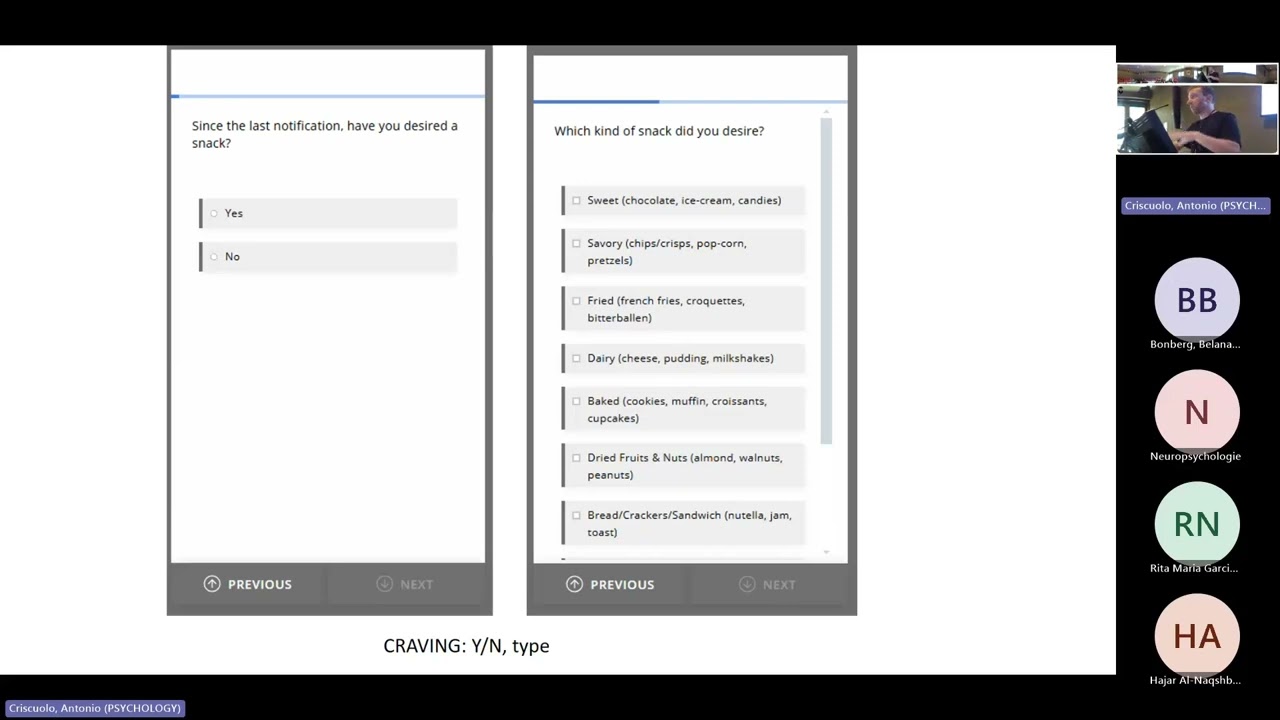
- Description of EMA items: craving degree, craving amount, snacking amount, stress, and self-control.
- Participant flow and characteristics, compliance rates, and power analysis.
- Between-subject results: decrease in craving and snacking over time across conditions.
- Additional variables: stress and self-control levels, especially in high monitoring condition.
- Network analysis: contemporaneous, temporal, and between-subject networks; differences in density.
- Interpretation of temporal networks: higher frequency leads to denser networks, stress and self-control play a role.
- Conclusions: self-monitoring reduces snacking, effects within two weeks, 'less is more' message.
- Q&A: discussion on stress-snacking relationship and potential moderators.
Cited Sources
- Body-Brain Waves Conference — Mentioned as the event hosting the talk.
Concurring Sources
- Ecological Momentary Assessment — General methodology used in the study.
Contribution & Novelties
The study contributes to the literature on EMA reactivity by systematically manipulating assessment frequency and using network analysis to explore dynamic relationships. The finding that lower frequency may be as effective as higher frequency challenges assumptions about optimal EMA density. The inclusion of stress and self-control as momentary variables provides insight into mechanisms.
Pour aller plus loin :
- Ecological Momentary Assessment — Overview of EMA methodology.
- Network analysis in psychology — Introduction to network models for psychological data.
- Self-monitoring — Concept in psychology.
- Craving — Definition and research on craving.
- Stress and eating — Overview of stress-eating relationship.
98 words
Radar Profile
The radar profile shows balanced scores across dimensions, with slightly lower reliability due to lack of external references. The high technical level and information quantity are offset by moderate quality and reliability, indicating a solid but not fully rigorous presentation.