Body-Brain Waves - 28th September '24 - Talk by Tahnée Engelen
Keywords
Summary
175 words
Critical Evaluation
Value of the Information & Strength of the Argument
The value of the information is high, as it addresses a fundamental question in interoception research: whether the brain is globally sensitive to all visceral rhythms or exhibits organ-specific sensitivity. The study design is robust, using within-subject comparisons and identical measures across rhythms, which strengthens the validity of the independence findings. The argumentation is solid, with clear reasoning from prior evidence to the hypothesis, and the use of Bayesian statistics to quantify evidence for the null hypothesis is appropriate. The speaker also acknowledges limitations, such as the inability to test interactions between rhythms with their current models, and discusses potential mechanisms, showing scientific rigor.
Scientific Rigor, Source Quality, Title Accuracy
The scientific rigor is evident in the careful methodology, including neuronavigation and regression of coil distance effects. The speaker references prior work (e.g., by Vadim and Ignasio) and discusses candidate mechanisms, though specific citations are not provided in the talk. The title accurately reflects the content, focusing on the independent modulation of corticospinal excitability by visceral rhythms. The talk is part of a scientific series, indicating a scholarly context. No comments were provided for analysis.
194 words
Title / Content Match
The title accurately reflects the content, which is a talk on body-brain interactions, specifically focusing on cardiac, respiratory, and gastric rhythms.
Quality & Reliability
8/10
The talk presents original research with a clear methodology, including TMS, physiological recordings, and statistical controls. The speaker acknowledges limitations and discusses alternative interpretations. The study appears well-designed, though not peer-reviewed in this context.
Key Moments
Markers derived by PSI from the transcript: the creator did not define chapters.
- Introduction: Tahnée introduces the topic of organ specificity in interoception.
- Background: Discusses large-scale coupling between visceral rhythms and brain networks.
- Rationale: Why motor system is a key region to study coupling with all three rhythms.
- Methods: TMS and MEP recording, simultaneous measurement of cardiac, respiratory, and gastric rhythms.
- Control: Coil distance predicts MEP amplitude, regressed out in main analyses.
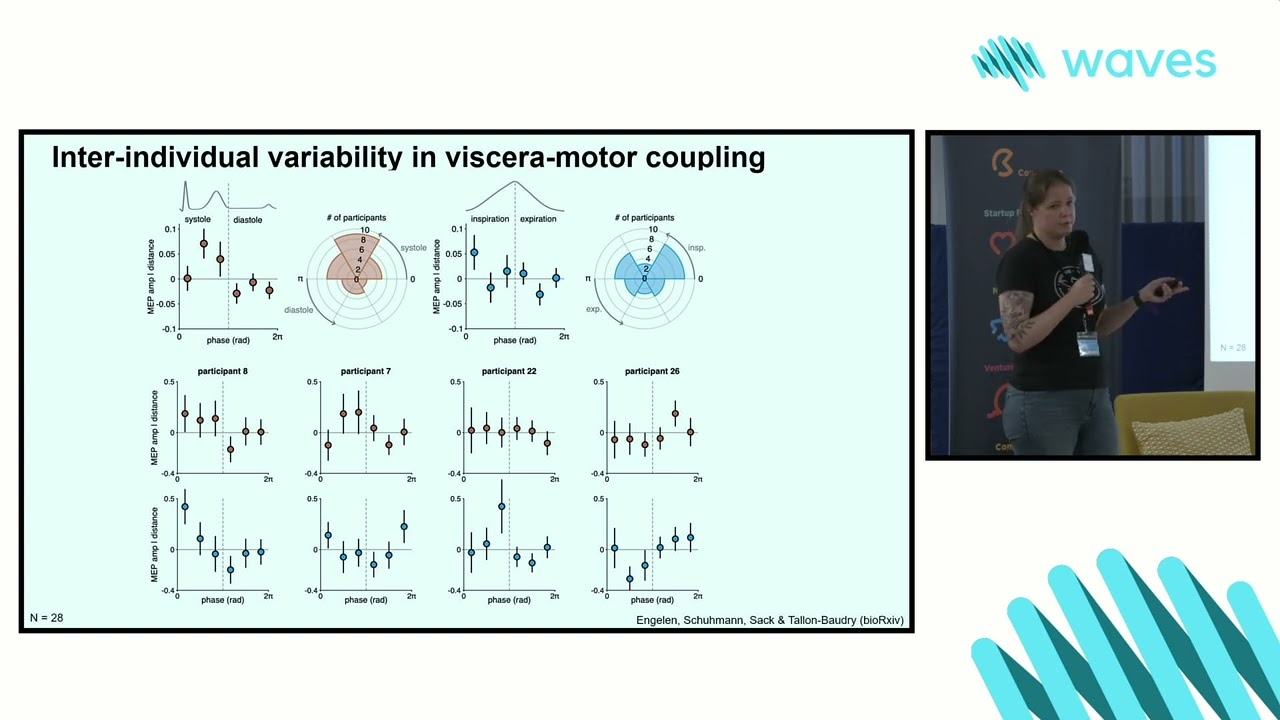
- Results: All three visceral phases modulate MEP amplitude, with no correlation between coupling strengths.
- Bayesian evidence for independence of effects.
- Individual examples: Different interoceptive profiles across participants.
- Exploratory analysis: Phase-specific effects (systole/diastole, inspiration/expiration) and interindividual variability.
- Discussion: Implications for underlying mechanisms and individual differences.
Cited Sources
- waves-conference.com — Official website of the Body-Brain Waves conference series.
Concurring Sources
- Park et al. (2018) - Neural sources of interoception — Study showing large-scale brain networks coupled to visceral rhythms.
Dissenting Sources
- Some studies may not find independent effects — While this study finds independence, other research might suggest shared mechanisms; however, no specific discordant sources were mentioned.
Contribution & Novelties
This study provides novel evidence for organ-specific modulation of corticospinal excitability, showing that cardiac, respiratory, and gastric rhythms independently influence MEP amplitude. The finding of independent interoceptive profiles challenges the notion of a general interoceptive sensitivity and suggests distinct neural pathways for each visceral signal. This has implications for understanding individual differences in interoception and potential links to mental health.
Pour aller plus loin :
- Interoception — Overview of interoception, the sense of the internal state of the body.
- Transcranial magnetic stimulation — Technique used to non-invasively stimulate the brain.
- Motor evoked potential — Electrical potential recorded from a muscle following brain stimulation.
- Phase-amplitude coupling — Concept of coupling between the phase of one oscillation and the amplitude of another.
120 words
Radar Profile
The radar profile shows high scores across all dimensions, indicating a well-rounded presentation with strong scientific content, technical depth, and reliability. The talk is particularly strong in information quantity and quality, reflecting the detailed methodology and results.