Body-Brain Waves - 28th September '24 - Talk by Irena Arslanova
Keywords
Summary
189 words
Critical Evaluation
Value of the Information & Strength of the Argument
The talk provides valuable insights into the emerging field of embodied cognition, specifically how visceral signals like heartbeats modulate time perception. The argumentation is solid, building from prior work on cardiac phase effects on sensory processing to novel behavioral and EEG findings. The speaker carefully explains the methodology and acknowledges variability in results, which enhances credibility. The correlation between EEG and behavioral effects strengthens the interpretation. However, the talk is a conference presentation, so some details are abbreviated, and the speaker notes that some findings are preliminary.
Scientific Rigor, Source Quality, Title Accuracy
The talk demonstrates scientific rigor through a clear experimental design, use of established tasks (temporal bisection), and integration of prior literature. The speaker cites relevant studies, such as the one on somatosensory detection during systole, and discusses theoretical frameworks like coding efficiency. The title accurately reflects the content, focusing on the influence of heartbeats on duration perception. The talk is part of a scientific conference series, which adds credibility. However, no specific sources are listed in the description, and the talk is not peer-reviewed.
186 words
Title / Content Match
The title accurately reflects the content, focusing on the relationship between heartbeats and duration perception.
Quality & Reliability
8/10
The talk presents original research with a clear methodology, including behavioral and EEG experiments, and discusses findings in the context of existing literature. The speaker is a researcher in the field, and the talk is part of a scientific conference series. However, the presentation is a conference talk, not a peer-reviewed publication, and some details are simplified for a general audience.
Key Moments
Markers derived by PSI from the transcript: the creator did not define chapters.
- Introduction to the talk and the role of the heart in time perception.
- Discussion of prior work on cardiac phase effects on sensory detection.
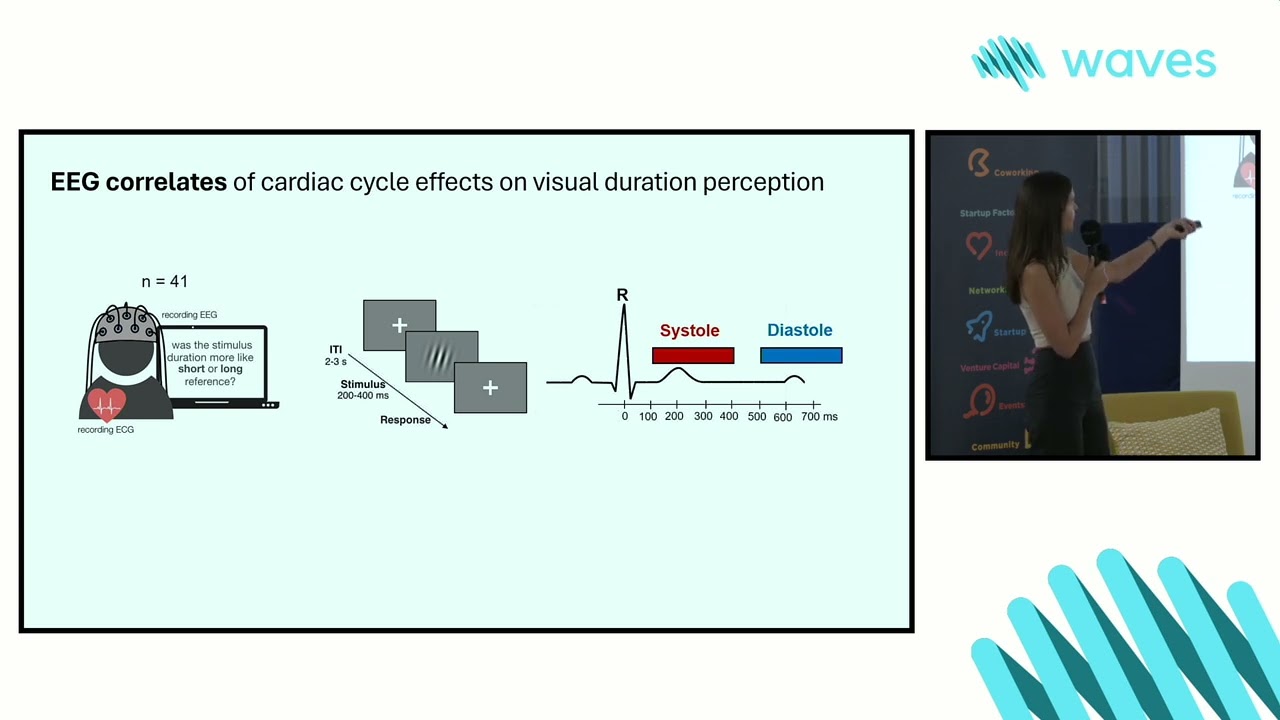
- Description of the temporal bisection task and behavioral experiments.
- Presentation of behavioral results showing systolic contraction of time.
- EEG study design and results showing LPC suppression during systole.
- Interpretation of findings in the context of coding efficiency and embodied time.
- Discussion of arousal effects and future directions.
- Conclusion and Q&A session.
Cited Sources
- waves-conference.com — Official website of the Body-Brain Waves conference series.
Concurring Sources
- Al, E., et al. (2020). Heart-brain interactions shape pain and cognitive processing. — Review discussing how cardiac signals modulate sensory and cognitive processing, supporting the idea that heartbeats influence perception.
Dissenting Sources
- Kononowicz, T. W., & van Wassenhove, V. (2016). In search of oscillatory traces of the internal clock. — This paper argues for a central clock mechanism in time perception, contrasting with the embodied coding efficiency account proposed in the talk.
Contribution & Novelties
This talk contributes novel findings on the influence of cardiac phase on duration perception, providing both behavioral and EEG evidence. It extends previous work on interoception and time perception by showing that systole contracts perceived duration, and this is associated with a suppression of a late positive component. The research supports embodied accounts of time perception and suggests that temporal processing is not solely based on a central clock but is modulated by visceral signals.
Pour aller plus loin :
- Interoception — Overview of interoception and its role in cognition.
- Temporal bisection — Explanation of the temporal bisection task used in timing research.
- Embodied cognition — Theoretical framework linking bodily states to cognitive processes.
114 words
Radar Profile
The radar profile shows high scores in information quantity, quality, and reliability, with a slightly lower technical level, indicating a well-balanced presentation accessible to a scientific audience. The talk is strong in providing original data and clear methodology, but the technical depth is moderate, suitable for a conference talk.
💬 No comments were provided for analysis.