Evoked responses and neural oscillations in cardioception
Keywords
Summary
154 words
Critical Evaluation
Value of the Information & Strength of the Argument
The talk provides valuable insights into the generation of evoked responses, proposing a unifying mechanism that challenges traditional views. The argumentation is solid, supported by computational models, empirical data, and references to published studies. The speaker systematically builds the case for the baseline shift mechanism, addressing potential counterarguments and limitations. The presentation of preliminary findings is appropriately cautious, acknowledging the need for further validation.
Scientific Rigor, Source Quality, Title Accuracy
The talk demonstrates high scientific rigor, with clear methodology and appropriate use of sources. The speaker cites relevant peer-reviewed papers and preprints, and the title accurately reflects the content. The talk is well-structured, with a logical flow from theoretical foundations to empirical evidence. The inclusion of preliminary data is clearly labeled as work in progress, maintaining scientific integrity.
137 words
Title / Content Match
The title accurately reflects the content, focusing on evoked responses and neural oscillations in the context of cardioception.
Quality & Reliability
8/10
The talk presents original research from a leading expert, with references to peer-reviewed studies and preprints. The methods are well-described, but some findings are preliminary and not yet fully published.
Key Moments
Markers derived by PSI from the transcript: the creator did not define chapters.
- Introduction to the talk and the topic of evoked responses and oscillations.
- Discussion of the classical additive model of evoked responses.
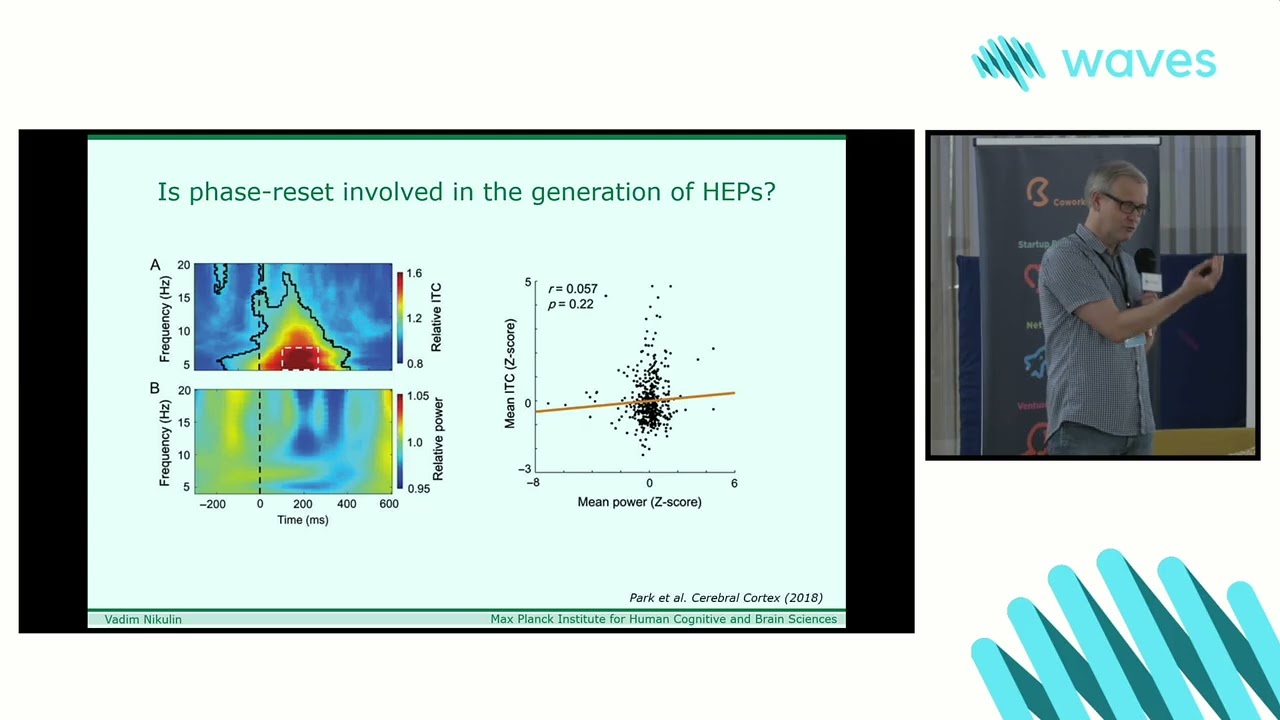
- Introduction of the phase reset model and its limitations.
- Explanation of the baseline shift mechanism and its prerequisites.
- Evidence from computational modeling showing non-zero mean alpha oscillations.
- Application of baseline shift to P300 and alpha oscillations.
- Preliminary findings on heart-evoked potentials and alpha oscillations.
- Discussion of cardiac cycle effects on cortical excitability using TMS.
- Study on extrasystoles and predictive coding in heart-evoked potentials.
Cited Sources
- waves-conference.com — Official website of the Body-Brain Waves conference series.
- Nikulin et al. (2007) - A novel mechanism for evoked responses in the human brain — Theoretical paper on baseline shift mechanism.
- Park et al. (2018) - Intracranial recordings of heart-evoked potentials — Study on phase reset in heart-evoked potentials.
- Jones et al. (2009) - Human Neocortical Neurosolver — Computational model used to demonstrate non-zero mean oscillations.
- Nikulin et al. (2024) - Preprint on sorting and heart-evoked potentials — Recent preprint on methodological implications.
Concurring Sources
- Park et al. (2018) - Intracranial recordings of heart-evoked potentials — Supports the idea that HEPs may be generated by phase reset.
- Recent preprint on TMS and cardiac cycle — Confirms increased motor evoked potentials during systole.
Dissenting Sources
- Classical additive model of evoked responses — The traditional view that evoked responses are additive to ongoing activity, which the talk challenges.
Contribution & Novelties
The talk presents a novel perspective on the generation of evoked responses, proposing that many are not additive but result from amplitude modulation of ongoing oscillations with non-zero mean. This ‘baseline shift’ mechanism is supported by computational and empirical evidence, and has implications for interpreting EEG data, particularly in cardioception. The talk also provides new insights into cardiac cycle effects on cortical excitability, using TMS and behavioral measures.
Pour aller plus loin :
- Phase resetting in neuroscience — Overview of phase resetting as a mechanism for neural synchronization.
- Heart-evoked potential — Definition and research context of HEPs.
- Common spatial pattern — Technique used to identify spatial filters in EEG analysis.
- Predictive coding — Theoretical framework for brain function, relevant to the interpretation of HEPs in extrasystole study.
127 words
Radar Profile
The radar profile shows high scores across all dimensions, indicating a well-rounded and reliable scientific talk. The strongest aspects are the quality and quantity of information, with slightly lower scores for technical level and global reliability due to the preliminary nature of some findings.